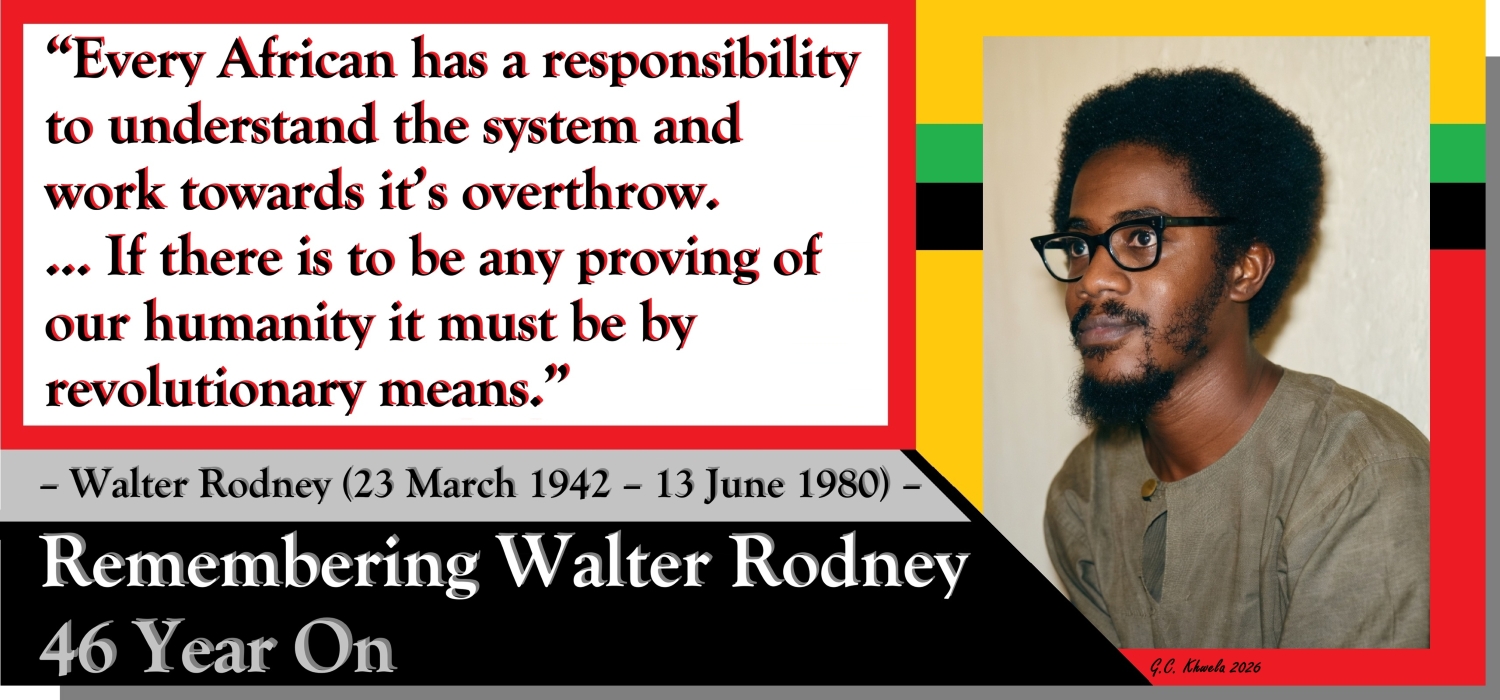
Remembering Walter Rodney 46 Year On
On 13 June 1980, a 38-year-old prominent Marxist scholar, activist and author, Walter Rodney, was killed by a state-planted bomb in Georgetown, Guyana. His landmark 1972 political economy book fundamentally re-evaluated the relationship between European colonialism and the deliberate economic suppression of the African continent, and his death was widely regarded as a devastating blow to the international struggle for working-class liberation and Pan-Africanism. He taught at the University of Dar es Salaam in Tanzania during the late 1960s and early 1970s, deeply influencing African national liberation movements and post-colonial socialist development ideas.
Walter Anthony Rodney was a prominent Guyanese historian, political activist and preeminent academic who became a globally recognised voice for Pan-Africanism, Marxist theory and the working class. Born in Georgetown, British Guiana, on 23 March 1942. He won a scholarship to the University of the West Indies (UWI) in Jamaica and completed his Doctoral Degree in African History at the School of Oriental and African Studies (SOAS) in London by age 24. While teaching at UWI Jamaica in 1968, his radical advocacy for the working poor and Rastafarian communities led the Jamaican government to ban him from re-entering the country.
This triggered massive civil unrest known as the “Rodney Riots”, which sparked a wave of political consciousness across the Caribbean. The 1968 Rodney Riots in Kingston, Jamaica, stand as one of the most critical political turning points in modern Caribbean history. What began as a peaceful university student protest on 16 October 1968, rapidly transformed into a massive working-class uprising. It shattered the illusion of stability in post-independence Jamaica and acted as the catalyst for the region’s dynamic Black Power movement. What was the real cause of these riots?
In January 1968, a 26-year-old Walter Rodney began teaching African History at his alma mater, the University of the West Indies (UWI) Mona campus in Kingston. True to his theory of “grounding”, he regularly left campus to educate Rastafarians, urban youth, and the unemployed in Kingston’s poorest settlements. The conservative Jamaican government, led by Prime Minister Hugh Shearer, viewed Rodney’s Marxist ideas and immense popularity with the urban poor as a major national security threat. On October 15, 1968, while Rodney was returning from the Congress of Black Writers in Montreal, Canada, the government declared him persona non grata and banned him from re-entering the country, effectively stranding his pregnant wife and son.
Outraged by the ban, roughly 900 UWI students (including future political leaders like Ralph Gonsalves, the current Prime Minister of St. Vincent and the Grenadines) defied emergency laws. They marched toward Parliament in Kingston to demand Rodney’s reinstatement. The police intercepted the marching students, brutally beating them and dispersing the crowd with heavy tear gas. News of the police attacks on the students spread like wildfire. Thousands of impoverished, disenfranchised youths and Rastafarians from downtown Kingston flooded the streets to join the fray.
The demonstration exploded into an anti-capitalist, anti-imperialist rebellion. Protesters targeted symbols of foreign wealth, burning 15 municipal buses, overturning corporate police vehicles, and looting massive North American and European-owned companies. By the time the Jamaican military and police completely cordoned off and locked down the city and the UWI campus, several people were dead, hundreds were injured, and millions of dollars in property damage had been caused. The riots were never just about Walter Rodney; his ban was merely the match that ignited a mountain of dry tinder.
Jamaica had gained independence from Great Britain in 1962, but six years later, the economic structure had not changed. The newly installed Black political elite worked hand-in-hand with white and light-skinned merchant families, while the vast majority of Black working-class Jamaicans remained locked in deep poverty, facing mass unemployment and political exclusion. When the government targeted Rodney, the poor felt the state was attacking the one intellectual who actually stood up for them. Barred from Jamaica, Rodney sent his notes and lectures to radical publishers in the United Kingdom. This directly led to the founding of Bogle-L’Ouverture Publications, which printed Rodney’s foundational 1969 book, “The Groundings With My Brothers”.
The riots forced Jamaican society to reckon with structural racism and inequality. This cultural awakening directly paved the way for Michael Manley’s democratic socialist government to win power in 1972 on a pro-Black, anti-imperialist platform. Protests erupted in support of Rodney across the Caribbean, Ottawa, and London. This collective uprising birthed the regional Black Power movement, showing that the post-colonial working class would not passively accept exploitation by their own governments.
During the late 1960s and 1970s, Walter Rodney was monitored through a tightly coordinated intelligence-sharing network involving the U.S. Central Intelligence Agency (CIA), the British MI5, and local Caribbean intelligence branches. Declassified documents obtained by institutions like the National Security Archives at George Washington University revealed how Western powers viewed Rodney’s Pan-African Marxist ideas as a direct Cold War security threat. The primary methods and mechanics of how they monitored him include the fact that Rodney was never just watched by one nation; he was a target of an international, collaborative dragnet.
Declassified records from the Jamaican Intelligence Services showed that they had compiled an extensive file on Rodney dating back to his undergraduate days at the University of the West Indies (UWI). Jamaican spymasters actively routinely shared their files and live surveillance updates on Rodney with both the U.S. Embassy in Kingston and British MI5 handlers. This ensured his movements were flagged whenever he travelled across regional borders. Intelligence agencies routinely mapped out Rodney’s close circles to predict his actions.
Other declassified records also revealed that Jamaican security forces successfully recruited assets and informants “close” to Rodney within the UWI student body and faculty. These informants provided inside details on his schedule, the names of people attending his private meetings and his general state of mind. When Rodney moved to London for his PhD, MI5 utilised assets within London’s Caribbean diaspora communities to monitor his political organising, speech-making at Hyde Park, and academic associations. Western intelligence agencies kept a strict, real-time log of Rodney’s international travel, viewing his visits to socialist states as evidence of a global conspiracy.
Agencies like the CIA meticulously tracked his flights to Revolutionary Cuba, his teaching tenure in socialist Tanzania, and his lectures in Canada and the United States. When Rodney travelled to Montreal in October 1968 for the Congress of Black Writers, Western intelligence agencies closely monitored his speeches. The local Jamaican spymasters used this window of absence to finalise his permanent ban, effectively trapping him outside Jamaica based on intelligence gathered during his trip. Declassified documents exposed how Western intelligence agencies not only just fear Rodney’s ideology; they feared his economic impact.
Jamaican intelligence and U.S. embassy memos explicitly argued that Rodney’s “grounding” with the urban poor was radicalising the working class to a point that threatened Jamaica’s lucrative foreign tourism industry and foreign-owned bauxite mining operations. CIA files from the era explicitly categorised Rodney as a high-risk vector for the regional explosion of the Black Power movement. They feared his rhetoric would destabilise US-backed, capitalist political administrations across the West Indies.
This perpetual monitoring did not stop after 1968. When Rodney returned to Guyana, the CIA and MI5 continued to share critical political data with the autocratic regime of Forbes Burnham. Even after his assassination in 1980, declassified CIA and U.S. embassy cables revealed that Western diplomats knew almost instantly that the Guyanese state had executed the bombing, documenting the regime’s clumsy attempts to manufacture a cover-up.
Upon returning to Guyana in 1974, the government blocked his university appointment, prompting him to dedicate himself entirely to grassroots political resistance. Rodney co-founded the Working People’s Alliance (WPA), a multi-ethnic socialist organisation. It sought to unite Afro-Guyanese and Indo-Guyanese working classes, directly threatening the race-divided, authoritarian regime of President Forbes Burnham. On 13 June 1980, Rodney was killed when a bomb disguised as a walkie-talkie detonated in his car. While the regime initially tried to obscure the truth, a formal Commission of Inquiry concluded – and the Guyanese government officially accepted in 2021 – that Rodney’s death was a state-sponsored assassination carried out with the full knowledge of President Burnham.
Walter Rodney’s ideas blended rigorous academic history with radical grassroots activism. He rejected the concept of the “detached scholar”, believing that intellectual work must directly serve human liberation. Amongst his influential literary works were “How Europe Underdeveloped Africa”, which was published in 1972. The book argued that Africa’s structural economic struggles were not due to internal failures, but were the direct outcome of exploitation by international capitalist and imperial powers. His initial work was “The Groundings With My Brothers”, in 1969, which explored Black Power, Caribbean identity, and his experiences organising with the marginalised working class in Jamaica. Another work, “A History of the Guyanese Working People, 1881–1905”, which was published posthumously, in 1981, it highlighted the historic, collective role of ordinary labourers in building modern Guyanese society.
His core theories focused on how global capitalism shapes poverty, racism and political division. For instance, with “The Theory of Underdevelopment”, Rodney fundamentally challenged how the Western world viewed poverty in the Global South. He argued that Europe did not simply “develop” faster than Africa. Rather, European development was actively built on the violent exploitation of African resources and human beings. He showed how colonialism forced African economies into a single role: exporting raw materials and importing expensive manufactured goods. This structure made self-sufficiency impossible.
Rodney proved that prior to European contact, African societies were developing along their own advanced technological, social and economic paths, which colonialism abruptly shattered. He redefined the role of a university academic through his concept of “grounding” in which he believed intellectuals must leave universities to sit down, listen and learn directly from the most marginalised people. In Jamaica, for example, he “grounded” with Rastafarians and urban youth. He shared African history to restore their pride, while they shared their lived realities of oppression with him. Rodney argued that education is only valuable if it equips the working class with the tools to understand and dismantle their own exploitation.
While many leaders used Pan-Africanism as a vague cultural concept, Rodney demanded a radical, anti-capitalist version, wherein he criticised post-independence African leaders who replaced European colonisers but kept the same capitalist systems. He called this “Black Neo-colonialism”. He viewed the liberation of Black people in the Caribbean, Africa, and the United States as part of a single, global struggle against global imperialism.
In his home country of Guyana, Rodney applied his theories to combat severe racial division. He argued that the ruling political elites deliberately stoked tension between Afro-Guyanese and Indo-Guyanese citizens to keep the working class divided and weak. Rodney also taught that a poor Indian sugar worker and a poor Black bauxite miner shared the exact same economic enemies. His political party, the Working People’s Alliance (WPA), was built to unite these groups under a shared class consciousness.
Walter Rodney’s economic theories applied directly to modern post-colonial states by exposing how the formal end of colonialism did not end economic exploitation. Instead, it merely shifted into “neo-colonialism” – a system where countries possessed political independence but remained economically subjugated by global powers and institutions. Contemporary economists and social movements frequently look to Rodney’s 1972 seminal framework to explain the paradox of why the Global South is rich in natural resources yet home to some of the poorest populations.
Modern nations often boast booming Gross Domestic Product (GDP) metrics, yet Rodney argued that economic growth and human development are entirely different entities. A post-colonial nation could show rapid ‘growth’ driven by foreign-dominated oil, gas, or mining sectors. If the profits from that growth flow immediately out of the country to multinational corporations, and the local population still lacked basic infrastructure, hospitals or schools, the nation was experiencing ‘growth’, but not ‘development’. It was still being systematically underdeveloped.
Colonial powers structured conquered territories to serve as raw material exporters. Rodney noted that post-colonial states failed to break this design. Many African and Latin American states remained entirely dependent on exporting one or two primary goods – such as crude oil, gold, copper or cocoa. Because these nations do not manufacture finished products, they were compelled to buy them back from the West at exorbitant prices. When global commodity prices crashed post-colonial economies collapsed, proving they are still trapped in a colonial division of labour.
Rodney’s core thesis was that external institutions controlled by the Global North dictated the economic survival of the Global South. When post-colonial states encounter economic crises, they relied on loans from organisations like the International Monetary Fund (IMF) and the World Bank. These loans come with strict “Structural Adjustment” conditions. To pay back international debt, states were forced to slash funding for healthcare, education and domestic agriculture. Rodney viewed this as modern imperialism, where foreign banks successfully override national sovereignty.
Rodney heavily criticised post-colonial leadership, warning that a “Black Neo-colonialism” would replace white governors. Many post-colonial states are governed by highly wealthy political elites who manage the country’s resources in partnership with foreign corporations. This ruling class acts as middlemen or a “comprador bourgeoisie”. They secure luxury high-rises and massive bank accounts for themselves while leaving the working class in poverty, effectively maintaining the old colonial pipeline. When resources are scarce and controlled externally, political survival relies on manipulation.
Political parties in post-colonial states frequently form along ethnic, tribal or religious lines rather than ideological or policy differences. Elites deliberately stoke these identity wars to prevent the poor from realising they share identical economic struggles. It distracts the population from challenging the actual system of exploitation. Rodney’s theories concluded that modern post-colonial states cannot fix their economies by participating “better” in the global capitalist system. True liberation requires radical self-reliance – disengaging from unequal global trade agreements, aggressively diversifying domestic manufacturing and forming cooperative, cross-border alliances with other exploited nations.
The untimely death of Walter Rodney on 13 June 1980, sent shockwaves through the global leftist, Pan-African, and Caribbean communities. His supporters reacted with a mixture of profound shock, intense rage, and an immediate, unified rejection of the state’s cover-up narrative. The dictatorship of President Forbes Burnham immediately claimed that Rodney was killed by “misadventure”, arguing he was an insurrectionist destroyed by his own bomb while attempting to attack a prison. Supporters and the Working People’s Alliance (WPA) instantly countered this narrative. They maintained that Rodney was assassinated by a state agent (later identified as Gregory Smith, a sergeant in the Guyana Defence Force) who gave Rodney a booby-trapped walkie-talkie.
While the assassination caused immense trauma, supporters noted it followed a systematic wave of state violence. The regime had already harassed, beaten, and killed other WPA activists like Ohene Koama and Edward Dublin. The initial heartbreak quickly galvanised into a massive, organised global resistance network. Activists formed the WPA Support Group and the Committee Against Repression in Guyana (CARIG) in cities like London, New York and Toronto. Protests and massive memorial services were held globally to honor his name. Supporters outside Guyana did not view the assassination as a localised, isolated event.
International Pan-African groups and newspapers viewed the murder as a calculated imperialist operation meant to decapitate a highly successful revolutionary movement. Supporters emphasised that the state killed Rodney because his ability to unite Afro-Guyanese and Indo-Guyanese working classes posed a fatal threat to the ruling elite’s divide-and-rule power structure. For over 40 years, Rodney’s family, the WPA, and global allies fiercely refused to accept the official historical record. Renowned intellectual C.L.R. James urged supporters not to just look at the murder as a moral battle of “an evil dictator killing a good revolutionary”, but to rigorously analyse the political vacuum his death left behind.
The unyielding pressure from supporters culminated in June 2021. Following a thorough Commission of Inquiry, the Guyanese government formally apologised to the Rodney family. They officially changed his death certificate from “misadventure” to “assassination” and declared his execution a state-sponsored act. Renowned activist Angela Davis captured the sentiment of his global supporters, stating: “If Rodney’s assassins were under the impression that they could arrest the flow of his ideas by destroying his body, they could not have been more wrong.”
Sources:
Wikipedia.
Richard Gray, “The Death of Walter Rodney”, History Today, Vol. 30, Issue 9, September 1980.
C.L.R. James, “Walter Rodney and the Question of Power”, Race Today Publications, 30 January 1981.
Eusi Kwayana, “The Caribbean Left’s Legacy: Sara Abraham Interviews Eusi Kwayana”, Against the Current, ATC 112, September–October 2004.
Michael O. West, “Walter Rodney and Black Power: Jamaican Intelligence and US Diplomacy”, African Journal of Criminology and Justice Studies, Vol. 1 Issue 2, Fall 2005.
Clairmont Chung (Ed.), “Walter A Rodney Reviewed in the Journal of Colonialism and Colonial History”, Monthly Review Press, 2012.
Giovanni Vimercati, “The Persisting Relevance of Walter Rodney’s ‘How Europe Underdeveloped Africa’”, Los Angeles Review of Books, 18 April 2019.
Charisse Burden-Stelly, “Between Radicalism and Repression: Walter Rodney’s Revolutionary Praxis”, Black Perspectives, 6 May 2019.
Mary E. Curry (Ed.), “The Walter Rodney Murder Mystery in Guyana 40 Years Later”, National Security Archive, 13 June 2020.
Mary E. Curry, “A Brief Biography of Walter Rodney”, National Security Archive, 13 June 2020.
Lee Wengraf, “How Europe Underdeveloped Africa: The Legacy of Walter Rodney”, Review of African Political Economy, 16 December 2021. roape.net.
Chinedu Chukwudinma, “The Rodney Rebellion: Black Power in Jamaica”, Review of African Political Economy, 1 April 2022. roape.net.
Chaitram Aklu, “A Revolutionary for Our Time: The Walter Rodney Story”, Review of African Political Economy, Volume 52, Issue 186, 5 July 2022.
David Kenneth Johnson, “Walter Rodney and the Method of Political Economy: Retrieving A Critical-Historical IPE”, Review of International Political Economy, Special Feature: 30th Anniversary, 27 December 2022.
Phethani Madzivhandila, “Walter Rodney Was Right”, Review of African Political Economy, 27 October 2023. roape.net.
Franklin Obeng-Odoom, “Underdevelopment in Africa: Walter Rodney’s Pioneering Approach and Its Influence on Stratification Economics”, Journal of World Affairs: Voice of the Global South, Vol. 1, No. 19, 2026.
Castro Khwela
Good morning fellow Compatriots!🙏🏾✊🏾👊🏾
Discover more from CASTRO KHWELA
Subscribe to get the latest posts sent to your email.