

The Motshabi Commission Report
The Motshabi Commission Report On 2 May 1975, the Motshabi Commission delivered an interim report on the condition of the African National Congress’s (ANC’s) existing People’s Army abroad. The “Commission on the State of Affairs in Umkhonto we Sizwe (MK) in East Africa” was established by the ANC Revolutionary Council on 17 April 1975, with a mandate to investigate the causes of and possible remedies for the “deterioration of the standard of military life and…
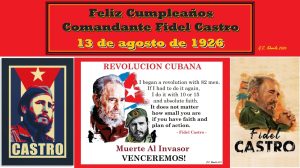
100 Years Feliz Cumpleaños Comandante Fidel Castro
100 Years Feliz Cumpleaños Comandante Fidel Castro On this day, 13 August 1926, 100 years ago, Fidel Alejandro Castro Ruz was born in Biran, Cuba, a son of a wealthy Spanish farmer. Castro adopted leftist and anti-imperialist ideas while studying law at the University of Havana. After participating in rebellions against right-wing governments in the Dominican Republic and Colombia, he planned the overthrow of Cuban president Fulgencio Batista, launching a failed attack on the Moncada…
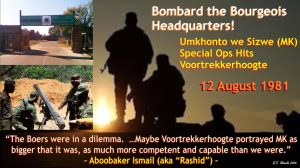
Bombard the Bourgeois Headquarters!Umkhonto we Sizwe (MK) Special Ops Hits Voortrekkerhoogte
Bombard the Bourgeois Headquarters!Umkhonto we Sizwe (MK) Special Ops Hits Voortrekkerhoogte On 12 August 1981, 45 years ago, around 22:30, Lieutenant van Dyk was busy writing a situation report at the Operations Room of the Voortrekkerhoogte military base, when he heard a huge roar, followed by a large explosion. He then called the guards at the gate to confirm what had happened. A guard responded that there was a great explosion somewhere near the base,…
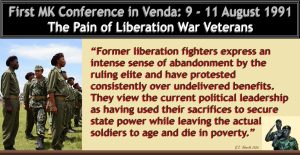
First MK Conference in Venda and the Pain of Liberation War Veterans
First MK Conference in Venda and the Pain of Liberation War Veterans On 9 – 11 August 1991, Umkhonto we Sizwe (MK) held its first conference at the University of Venda, in Thohoyandou, following African National Congress (ANC) President Nelson Mandela’s instruction to the ANC Conference in Durban in July the same year that he must set-up a conference to address the concerns of MK Cadres. Hopes for a peaceful transfer of power from the…
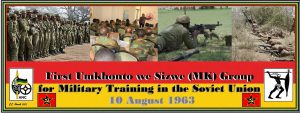
First MK Group for Military Training in the Soviet Union
First MK Group for Military Training in the Soviet Union On 10 August 1963, a group of thirty Umkhonto we Sizwe (MK) recruits were flown on a British Overseas Airways Corporation plane from Dar es Salaam, Tanganyika, to Khartoum, Sudan. From the Sudan they were flown on a Russian aeroplane to Moscow, in the Union of Soviet Socialist Republics, the Soviet Union. They were then met by Russian officials in civilian clothes, who took them…
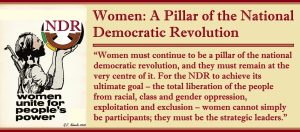
Women: A Pillar of the National Democratic Revolution
Women: A Pillar of the National Democratic Revolution “To drive this profound societal shift, the country must move from treating women’s empowerment as a social welfare issue to treating it as a hard macroeconomic strategy.” During the 1950s and 1960s in South Africa, the apartheid regime heavily suppressed liberation movements, forcing organisations like the African National Congress (ANC), the South African Communist Party (SACP) and the Pan Africanist Congress (PAC) underground. As thousands of male…
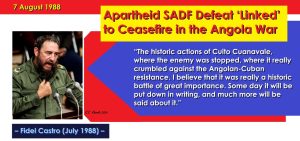
Apartheid SADF Defeat ‘Linked’ to Ceasefire in the Angola War
Apartheid SADF Defeat ‘Linked’ to Ceasefire in the Angola War On 7 August 1988, the People’s Republic of Angola, the Republic of Cuba and apartheid South Africa agreed to a formal ceasefire. Under the terms of the ceasefire and later treaty, Cuba was to withdraw its forces from Angola, and South Africa was to grant Namibia independence and withdraw its forces and elections were to be held in Namibia. The ceasefire was reached through a…