The Motshabi Commission Report
On 2 May 1975, the Motshabi Commission delivered an interim report on the condition of the African National Congress’s (ANC’s) existing People’s Army abroad. The “Commission on the State of Affairs in Umkhonto we Sizwe (MK) in East Africa” was established by the ANC Revolutionary Council on 17 April 1975, with a mandate to investigate the causes of and possible remedies for the “deterioration of the standard of military life and discipline in the MK establishment” in East Africa, which was the region where the vast majority of MK members abroad were based.
The Commission, which was chaired by John Pule Motshabi, started its work on 21 April 1975, when its three members met the MK East Africa Command, which consisted of Julius Maliba (Regional Commander), Julius Mokoena (Political Commissar), Joseph Shumo (Chief of Staff), Bunny Pinny (Medical Officer) and Morris Selabogo (Chief of Logistics). The commission presented its work on 2 May 1975, the same day Dingo Lamani, one of the Commission members passed on.
The difficulties experienced by the ANC leadership in exile in grappling with the changes of being in exile produced potentially disintegrative internal strains in the second half of the 1960s decade, which could be viewed as the main catalyst behind the call for a Consultative Conference in Morogoro in 1969. The Commission’s interim report confirmed that there was indeed a marked deterioration in the standard of military life and discipline in the regions, but said that what was discovered was nothing new, as some aspects had been voiced in the Hani Memorandum of 1968.
The picture painted by the report was that the glorious army that once fought the Wankie and Sipolilo campaigns was in urgent need of fresh blood at rank-and-file, and possibly also at officer corps level. The report said that it became abundantly clear that basically most of the problems that were being investigated were well-known to the leadership, as they had been discussed in the reports of no fewer than six previous commissions of inquiry, all but one of which had been headed by Motshabi.
The report recapitulated what the factors were. One, at a leadership level, the tensions concerned issues of organisational structure and political strategy. At the heart of the debate, was the progressive adjustment of the ANC to the armed struggle, which was made especially difficult by the continued separation of the military from political structures. Two, that by then, a number of cadres had grown up and some had established active families with local and exiled South African women, bringing responsibilities that often clashed with military commitments.
Another was that certain aspects of the Commission’s investigation, such as dishonesty and theft were well known. According to the report, these tendencies were features of the Movement as a whole, except that the Commission observed that in East Africa top officials encouraged them or were themselves active participants. There were also other complaints that 23 cadres in Lusaka had been suspended over corruption — the ‘pickpockets’ — in the Zambian capital city. Notwithstanding the hopeful note on which the Morogoro Conference had ended, there was, they insisted, a crisis in the movement.
Largely, the possible causes of low morale, apart from the frustration of not being deployed to South Africa as trained combatants, included discrepancies in the various levels of command, such as people who had records of dishonesty being promoted to leading positions – not only in MK but also in higher bodies of the Movement – and also the fact that the Regional Command was encouraging commercial private property which distracted some of the cadres from their responsibilities and duties as military practitioners. There were other problems in the camps, such as commanders having to deal with ill-discipline, men involved in sexual relations with women from surrounding villages, and the biggest elephant in the room, a disquieting degree of “tribalism”, and having to mete out corporal punishment.
Tribalism, which ANC Acting President Oliver Tambo preferred to call, “provincialism”, or what can be simply referred to as “regional differences”, was conceded to have had influenced material conditions and therefore perceptions within the Movement. For example, the commission heard of tensions that had also built up between the followers of Chris Hani and Joe Modise, and by 1972, despite the resolutions at Morogoro, these had still not been resolved. Those who were regarded as “Urban Transvaalers” were described as “thugs organised by Modise to destroy his enemies”, which was possibly a reference to Modise’s youthful career as a gang leader in Sophiatown. It was said that “Cape men” seemed to be unwilling to accept Modise’s authority, as they referred to Joe Modise as “the commander of Sothos” (Callinicos).
Outraged comrades gave clear evidence of these tendencies, as they outlined with greater or lesser diplomacy the grievances of the victims in the camps, who perceived the reshuffling of the offenders to other positions “as reward rather than chastisement”. They argued that this occurred because that the perpetrators were, like Tambo himself, “Cape men”. Xhosa-speaking instigators, such as Chris Hani and Ambrose Makiwane, were perceived to be relocated to other better positions despite their offences, which appeared to them to be clear evidence of Tambo’s bias in favour of his “home boys”.
Class differences also appeared to further compound the ethnic factor, which for historical reasons resulted in the so-called “Cape men” being largely better educated and having acquired professional qualifications. Accordingly, because of these qualifications, they gained dominance in the ANC, which at times revealed an unacceptable element of arrogance and an unwillingness to comply to the leadership of lesser-educated comrades. The perception was also that foot soldiers were being sacrificed in the process of promoting the image of the leadership, which featured conspicuously in relation to the misfortunes suffered in the Wankie and Sipolilo campaigns that were articulated in the Hani Memorandum.
Acting President Oliver Tambo fatefully had a difficult role to play as an intermediary, while at the same time having to respond to personal accusations, as he was perceived to belong to the ethnic group that dominated the leadership. Despite these overwhelming trials, Tambo consistently refused to acknowledge, at least publicly, that ethnicity had any influence on decisions in the ANC. The actual raison d’étre and policy stance of the Movement, Tambo argued, was that since its formation, it had been to unite all black groups throughout the country. According to Tambo, “What is called tribalism is one of the reasons that kept us apart. If you wanted to do anything, you had to show you were all suffering the same thing” (Callinicos).
In order to address these challenges, Tambo held a joint meeting with the Revolutionary Council, the Presidential Council and the Manpower and Development Department to discuss the restructuring of personnel, in what he referred to as “Operation de Move-On” (based on the ‘café dé move on’— a coffee cart – in the streets of Johannesburg, which had to be easily removed and closed down during police raids). Tambo was compelled to acknowledge ethnic weaknesses in the process of reshuffling of personnel, as he restructured command lines in order to increase accountability to the main structures and the top leadership.
Another challenge that the Motshabi Commission had to deal with was the gradual fermenting of anti-communist tendencies, which was basically a reaction to the South African Communist Party’s (SACP’s) strong alignment with the Soviet Union and the world socialist system that was perceived to have a strong influence within the Movement. This was also linked to the “endless speculation on who in the National Executive Committee might also be communists, the problem of primary accountability and uneasy notions about Stalinist manipulation of the direction of the struggle” (Callinicos). These challenges also had an impact on the clear articulation of revolutionary theory and the development of political perceptions, especially in relation to engagements with the progressive elements within the Western countries and in the ANC’s relationship with the People’s Republic of China.
The SACP’s reaction was that “Anti-Communism, within and outside our movement, stems, less now than ever before, from a mere disagreement about philosophy and political theory in general; it is an enemy instrument for doing battle with the revolutionary forces in the coming struggle for power. It serves, and is designed to appeal to, those elements within the national movement whose class interests make them receptive to a policy of reformism, tribalism and bourgeois forms of nationalism” (The African Communist, No. 64, First Quarter 1976).
Beyond the ANC itself, though committed to the principle of supporting liberation movements in African colonies, efforts of some African countries were limited by their economic weaknesses and dependence on their former colonial masters. This was based on condition that they did not support the ANC and MK activities within their borders. Despite these challenges, countries such as Tanzania and Zambia, and later Angola, Mozambique, and to a lesser extent, Zimbabwe, played an important role in supporting the South African liberation struggle.
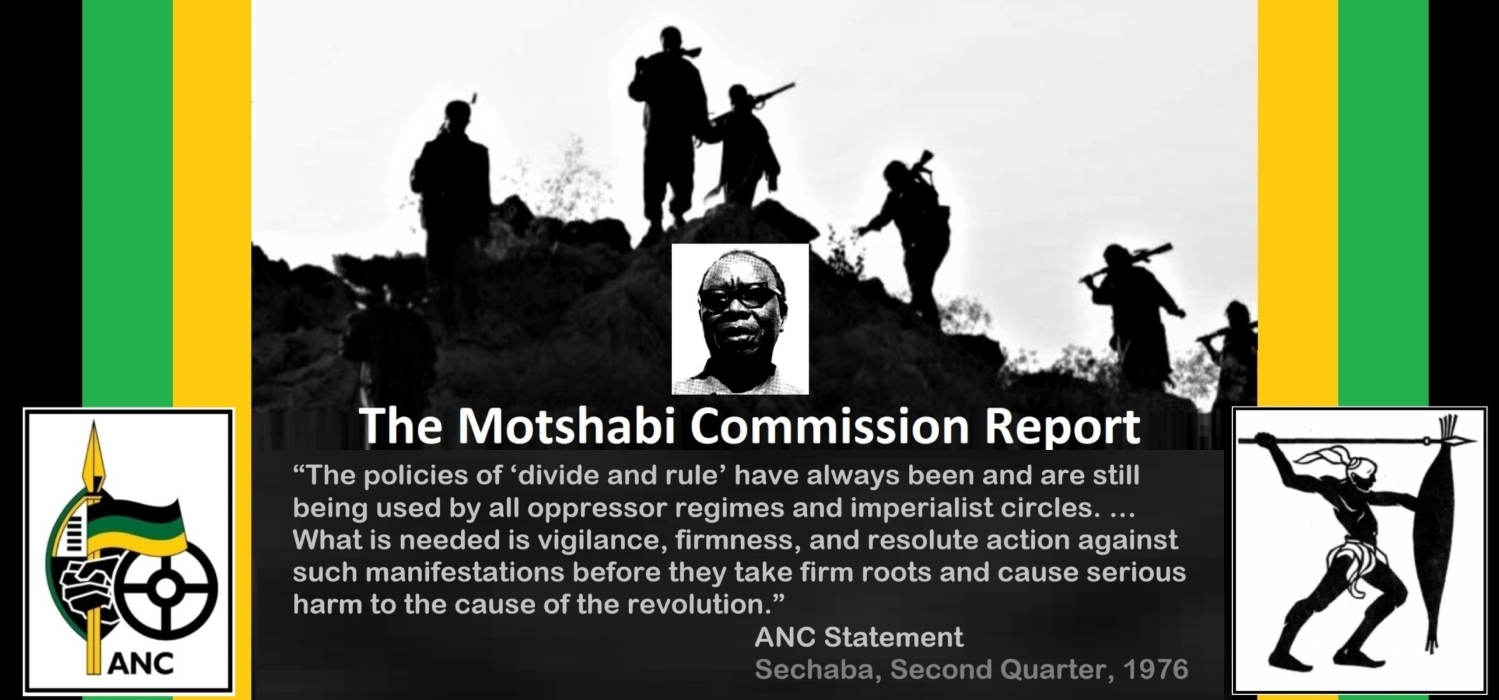
Ultimately, the position was that “the policies of ‘divide and rule’ have always been and are still being used by all oppressor regimes and imperialist circles. … What is needed is vigilance, firmness, and resolute action against such manifestations before they take firm roots and cause serious harm to the cause of the revolution” (Sechaba, Vol. 10 No. 2, Second Quarter, 1976).
Sources:
Thula Simpson, “Umkhonto we Sizwe: The ANC’s Armed Struggle”, Penguin, 2016.
Luli Callinicos, “Oliver Tambo: Beyond the Engeli Mountains”, David Philip, 2004.
SACP Central Committee Report, “Defeat Vorster and His Collaborators! Engage The Enemy on Every Front!”, The African Communist, No. 64, First Quarter, 1976.
ANC Statement, “Conspirators Expelled: ANC Statement on the Expulsion of Some of Its Members”, Sechaba, Vol. 10 No. 2, Second Quarter, 1976.
Castro Khwela
Good day fellow Compatriots!
Discover more from CASTRO KHWELA
Subscribe to get the latest posts sent to your email.