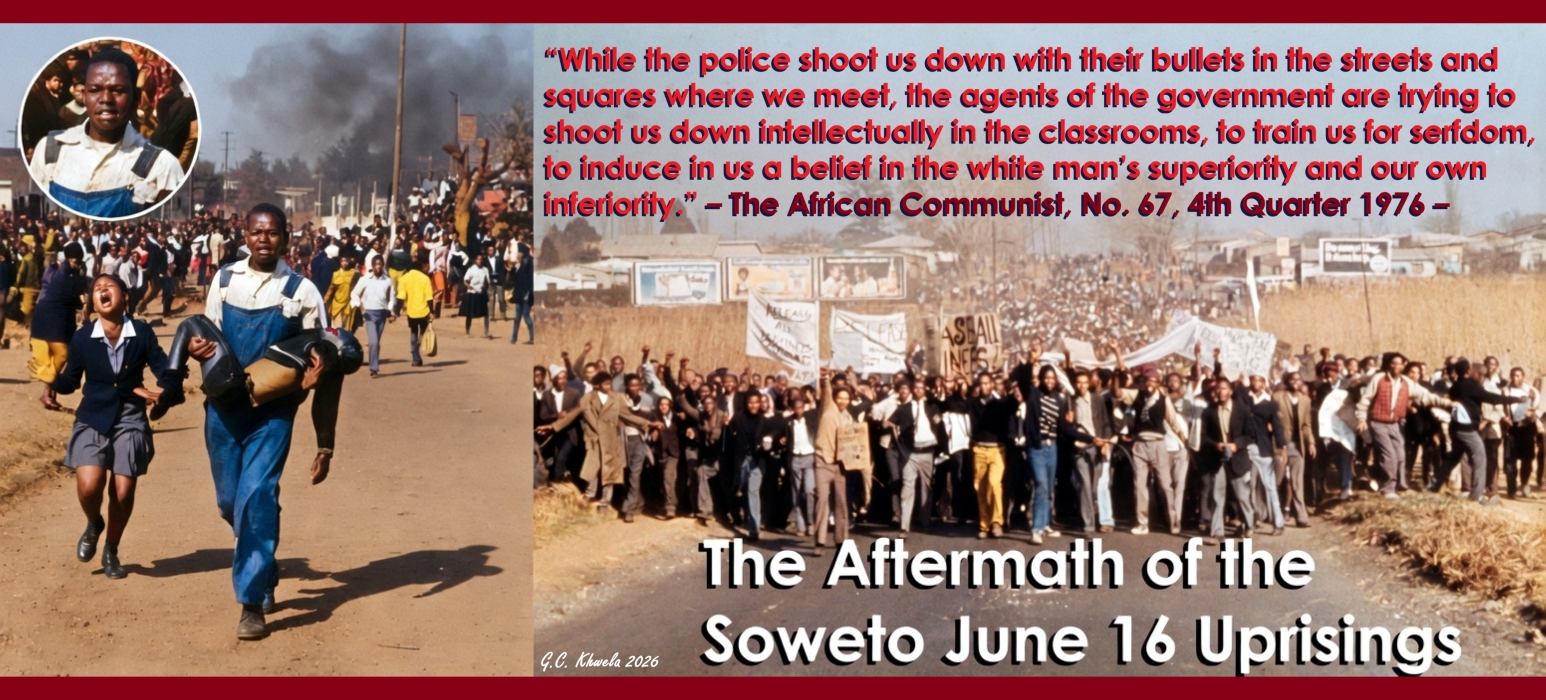
The Aftermath of the Soweto June 16 Uprisings
On 17 June 1976, the day after the 16 June 1976 Soweto uprisings, the revolts rapidly escalated, spreading beyond Soweto to other South African townships while sparking widespread political strikes and solidarity protests. Riots erupted in the black townships of other cities across South Africa. Government institutions, administration buildings and beer halls were looted and set on fire. A student solidarity protest in Kagiso (near Krugersdorp, west of Johannesburg) turned violent when apartheid police intercepted the retreating group, killing at least five people. Students in Thembisa organised a successful, non-violent solidarity march to express their anger over the previous day’s killings.
Black workers launched massive stay-aways and went on strike, joining forces with the student-led resistance. The combination of worker stay-aways and riots heavily disrupted businesses and industry in the Witwatersrand region. Around 400 white students from the University of the Witwatersrand marched through the Johannesburg city centre to publicly protest the apartheid government’s brutal actions and the killing of black school children. Moreover, the historic photograph of a dying 12-year-old Hector Pieterson, taken by Sam Nzima, was published by The World newspaper and quickly flashed across international media. The image sparked immediate international outrage, causing the Organisation of African Unity (OAU) and former allies of the regime to strongly condemn the apartheid administration.
The international condemnation of the apartheid regime acted as a powerful catalyst that crippled South Africa’s economy, deeply isolated its white minority population, and provided vital moral and financial support to the national liberation movements. While the National Party initially resisted global pressure, the combined weight of international backlash eventually forced the regime to reconsider the transition to democracy. The structural impact of this condemnation manifested across several key areas. For instance, the moral outrage of the international community shifted from verbal censure into devastating financial warfare, particularly after the 1976 Soweto Uprising.
Massive multinational corporations like IBM, Coca-Cola and General Electric withdrew entirely from the South African market. Global bans on key South African exports, such as gold Krugerrands, coal, iron and steel, drained the country’s foreign currency reserves. International banks refused to roll over South Africa’s short-term debts, pushing the economy into severe stagnation and making minority rule financially unsustainable. The embargo forced the regime to spend exorbitant amounts of capital to create its own domestic arms industry (Armscor), stretching state resources thin while it fought costly border wars in Namibia and Angola.
International condemnation heavily targeted the social and psychological identity of white South Africans through absolute isolation. South Africa was banned from the Olympic Games starting in 1964 and officially expelled from the movement in 1970. Cricket and rugby tours were halted or met with massive public disruption, such as the chaotic 1981 Springbok Tour of New Zealand. The United Nations enforced a voluntary code preventing international artists and academics from performing or working in South Africa, while local artists were barred from touring the globe. UN declarations officially designated apartheid as a “crime against humanity”, stripping the Pretoria regime of international legitimacy.
Global condemnation translated into direct humanitarian aid, providing educational scholarships and political funding for exiled liberation movements, such as the African National Congress (ANC) and the Pan African Congress (PAC). The realisation that South Africa had become a global pariah shattered the political confidence of the white minority. Business leaders and progressive politicians began pressuring the government to abandon apartheid, realising that economic survival required political compromise. This led Parliament on 17 June 1976 to meet in an Extraordinary Session at the request of the leader of opposition, the Progressive Reform Party, Colin Eglin. Eglin demanded the resignation of the minister of Bantu Administration and Development, M.C. Botha, and his deputy, Andries Treurnicht.
On the same day, 17 June 1976, the Minister of Justice and Police, J.T. Kruger, assigned a one-man judicial commission in the person of Justice Petrus Malan Cillié, Judge President of the Transvaal, to investigate the unrest in Soweto. The official mandate of the Cillié Commission of Inquiry was strictly to investigate and report on the factual timeline, immediate causes, and extent of casualties during the uprisings in Soweto and other parts of South Africa. The commission was explicitly instructed to avoid making any recommendations for political, social or economic reforms. Its narrow purpose was to chronicle what happened, evaluate whether black student grievances were justified, and determine if the youth had been “misled” by outside political agitators.
The mandate initially covered the immediate events of 16 June 1976, but its scope was eventually extended to investigate the ongoing unrest up to 28 February 1977. While triggered by the Soweto events, the mandate required investigating student revolts, strikes and clashes that rippled across the entire Republic of South Africa. The commission was mandated to compile an authoritative list of injuries, deaths and property damage resulting from the riots. It eventually recorded 575 deaths and over 2,300 injuries, though contemporary historians agree that the regime heavily undercounted the actual casualties.
Anti-apartheid leaders and later findings by the Truth and Reconciliation Commission (TRC) noted that the Cillié commission’s operational mandate functioned to protect and justify the actions of the state. By focusing heavily on the “illegality” of the student marches, the commission fulfilled its implicit political mandate to clear the apartheid South African Police (SAP) of criminal wrongdoing, concluding that officers had “acquitted themselves well”. It was thus concluded that the Cillié Commission of Inquiry was a mere whitewash of the brutality of the apartheid police in order to protect the apartheid regime.
On 17 June 1976, the apartheid regime reacted with immediate military force, institutional deflection, and a severe security crackdown to suppress the expanding uprising. Rather than seeking to de-escalate the tension or address student grievances, the state treated the events as “a law-and-order crisis” manufactured by underground political agitators. The regime’s multi-layered response on 17 June focused on several strategic and tactical actions, including the deployment of over 1,500 heavily armed police officers directly into Soweto. They patrolled the streets in armoured personnel carriers (known as “Hippos”) while army helicopters monitored the area from above.
The apartheid South African Defence Force (SADF), and particularly the South African Army, was placed on full tactical standby, ready to enter the townships with heavy military force if the police lost control. Paramilitary units were dispatched with orders to shoot to kill, firing on crowds with automatic rifles, carbines and stun guns both with and without explicit provocation. The police aggressively targeted emergency clinics and Baragwanath Hospital and the regime demanded that hospital administrators provide a comprehensive list of all patients treated for bullet wounds so the state could systematically arrest and prosecute the injured children for rioting. However, progressive doctors defied the regime, hiding the identity of victims by deliberately logging gunshot wounds as “abscesses or minor injuries” in the medical records.
The Security Branch Police initiated a sweep of political figures, student organisers and community activists. Hundreds of people were arrested, and detainees were held without trial under harsh security legislation and subjected to systemic torture to extract information regarding the leadership of the Soweto Students’ Representative Council (SSRC). In public statements, apartheid Minister of Bantu Administration and Development M.C. Botha and Prime Minister B.J. Vorster dismissed the idea that the policy of mandatory Afrikaans was the root cause of the crisis. They publicly blamed the Black Consciousness Movement (BCM) and communist subversives for manipulating school children.
Following the uprisings, the apartheid regime actively weaponised the socio-economic and cultural divisions between migrant workers living in single-sex hostels and the permanent township residents to orchestrate violent counter-revolutionary vigilante attacks. By exploiting the frustrations of hostel dwellers, the state successfully implemented a “divide-and-rule” strategy that pitted black South Africans against one another to weaken the student-led resistance. The regime used hostel vigilantes and the political leverage of Chief Mangosuthu Gatsha Buthelezi to frustrate the Soweto Students’ Representative Council (SSRC) call for a, series of highly effective mass worker stay-aways to cripple Johannesburg’s economy during the uprisings.
The regime used these stay-aways to create friction between the communities and migrant workers living in hostels – primarily Zulu men under severe financial pressure – who relied entirely on daily wages to send money back to rural homelands. The state highlighted that student enforcing of strikes was directly threatening the workers’ livelihoods, framing the youth as reckless disruptors. In late August 1976, the apartheid police actively incited migrant workers at Soweto’s Mzimhlophe hostel to launch a violent backlash against township residents. Apartheid police officers actively drove alongside armed hostel vigilantes (impis), urging them to attack residents and student activists. The police provided the vigilantes with logistical cover, stood by while they looted homes, and intervened only to arrest or shoot township residents who attempted to fight back.
Chief Gatsha Buthelezi, the leader of the KwaZulu homeland and founder of the Inkatha Cultural Liberation Movement, occupied a highly controversial and complex position during the 1976 crisis. While Buthelezi was a vocal critic of the regime’s Bantu Education and Bantustans “homeland independence” acts, he fiercely opposed the radical tactics of the Black Consciousness Movement (BCM) and the SSRC. He publicly condemned the students’ destruction of property and urged workers to ignore the stay-away calls. As the violence between hostel dwellers and township residents peaked in late August, Buthelezi travelled to Johannesburg to become involved in the upheavals.
He correctly alleged that the apartheid police were actively manipulation and inciting the hostel residents into violence. However, his intervention was focused heavily on restoring tribal authority and urging his followers to protect their jobs and hostels, which inadvertently aligned with the state’s desire to break the student strikes. While the violence between Inkatha-aligned hostel dwellers and liberation forces reached its most devastating, state-funded peak during the late 1980s and early 1990s (the “Third Force” era), the 1976 uprisings served as the exact blueprint. The apartheid regime realised that hostel vigilantes could be effectively weaponised as an auxiliary force to combat urban liberation movements under the guise of “inter-ethnic conflict”.
Nevertheless, despite the apartheid police’s gestapo tactics, the June 1976 Soweto uprisings transformed the anti-apartheid struggle, drawing profoundly different, yet highly symbiotic reactions from the affected communities and the national liberation movement in exile. While the communities translated their initial shock into an aggressive, sustained multi-class revolt, the liberation movement in exile weaponised the global outrage and absorbed a massive wave of new military recruits.
The immediate massacre of school children by the apartheid police broke any remaining illusions of peaceful coexistence within black townships, triggering a multi-generational escalation. Led by the SSRC, students shifted from peaceful marching to open urban warfare. They used stones and dustbin lids against bullets and aggressively targeted symbols of state control, burning down West Rand Administration Board (WRAB) buildings and government-run beer halls.
Initially, older generations were hesitant about the student strikes. However, the slaughter of their children galvanised parents and workers. Community member groups, parents’ action committees, and black trade unions organised massive stay-aways, crippling the economic engine of Johannesburg in support of the youth. The revolt quickly fractured along geographic boundaries. Driven by shared oppression under Bantu Education, historically black universities and communities across the country – particularly in the Eastern Cape and the so-called Coloured townships of the Western Cape – staged massive solidarity marches and violent clashes with the apartheid police.
The ANC and the South African Communist Party (SACP) were caught off-guard by the scale of the student-led uprising, as their internal networks had been severely crippled by state repression during the 1960s. However, they moved rapidly to capitalise on the moment. Acting ANC President Oliver Tambo issued powerful international statements expressing utter shock at the “inhuman massacre of children”. Tambo addressed the United Nations, positioning the ANC as the natural leader and legitimate voice of the domestic uprising.
Thousands of students fled South Africa to escape security police torture and arrests. The ANC systematically absorbed these highly motivated young exiles into its armed wing, Umkhonto we Sizwe (MK), and this massive influx of youth rejuvenated the military camps in Tanzania, Angola and facilities in Zambia. On the other hand, the SACP viewed the student uprising not just as a cultural fight against the Afrikaans language directive, but as an explosion of deep-seated capitalist exploitation and class struggle. The party issued underground leaflets declaring that the youth had exposed the fragile underbelly of the apartheid economy.
Operating alongside the ANC, SACP operatives like Joe Slovo, Moses Mabhida and Jack Simons worked to integrate Marxist political education into the MK training camps for the newly arrived Soweto youth. The SACP used its underground apparatus inside the country to build bridges between the Black Consciousness-oriented students and the non-racial liberation ideology of the Congress Alliance. The uprising effectively merged the raw, internal fury of the affected communities with the structured, diplomatic and military apparatus of the ANC-SACP-SACTU exile alliance, marking the beginning of the end for the apartheid regime.
In its journal, The African Communist, the SACP commented that, “While the police shoot us down with their bullets in the streets and squares where we meet, the agents of the government are trying to shoot us down intellectually in the classrooms, to train us for serfdom, to induce in us a belief in the white man’s superiority and our own inferiority. The African people have shown again and again that they will not submit to apartheid and oppression, and now the African youth are voicing their protest in the very places in which the Government was hoping to quell it – in the segregated schools and universities” (No. 67, Fourth Quarter 1976).
Sources:
Wikipedia.
South African History Online (SAHO).
Darryl C. Thomas, “United Nations Sanctions South Africa for Apartheid”, EBSCO, 30 November 1973.
Editorial, “South Africa in Revolt”, The African Communist, No. 67, Fourth Quarter 1976.
Craig Charney, “Vigilantes, Clientelism, and the South African State”, Transformation 16, 1991.
Milestones, “The End of Apartheid”, Milestones in the History of U.S. Foreign Relations, 1989–1992.
Truth and Reconciliation Commission, “Truth and Reconciliation Commission of South Africa Report, Vo. 3”, Truth and Reconciliation Commission (TRC), 29 October 1998.
Philip I. Levy, “Sanctions on South Africa: What Did They Do?”, Economic Growth Center: Center Discussion Paper No. 796, Yale University, February 1999.
Helena Pohlandt-McCormick, “‘I Saw a Nightmare…’ Doing Violence to Memory: The Soweto Uprising, June 16, 1976”, Columbia University Press, 2005.
Catherine Barnes, “International Isolation and Pressure for Change in South Africa”, Conciliation Resources Accord, Issue 19, 2008.
Mangosuthu Buthelezi, “We Need to Fight with One Hand and Build with the Other – Buthelezi”, Polity, 17 June 2016.
DSAC, “Youth Day – June 16”, Department of Sports, Arts and Culture, 2023.
Ebrahim Salie, “International Pressure on Apartheid South Africa, 1980-1989”, Ebrahim Salie, 2017.
United Nations, “The United Nations in South Africa – The UN: Partner in the Struggle against Apartheid”, United Nations, 2026.
Rebecca M. Kulik, “Soweto Uprising: South African History”, Encyclopedia Britannica, 16 June 2026.
SACP, “Fifty Fighting Years – Fighting Back Against Apartheid” South African Communist Party (SACP), https://www.sacp.org.za/content/fifty-fighting-years-fighting-back-against-apartheid-0
Castro Khwela
Good evening fellow Compatriots!🙏🏾✊🏾👊🏾
Discover more from CASTRO KHWELA
Subscribe to get the latest posts sent to your email.