
“In 1958, the General Assembly of the United Nations established a Commission on Permanent Sovereignty over Natural Resources, and instructed it to conduct a full survey of the status of permanent sovereignty over natural wealth and resources as a basic constituent of the right to self-determination. In 1962, after considering the final report, the General Assembly adopted a series of principles which declared, among other things:
- That the right of peoples and nations to permanent sovereignty over their natural resources must be exercised in the direction of their natural development and of the well-being of the people of the State concerned;
- That nationalisation, expropriation or requisitioning shall be based on grounds or reasons of public utility, security or the national interest which are recognised as overriding purely individual or private interests;
- That violations of the rights of peoples and nations to sovereignty over their natural resources and wealth is contrary to the spirit and principles of the Charter of the United Nations and hinders the development of international co-operation and maintenance of peace.”
“These declarations and resolutions were not adopted by a communist party congress, but by an Assembly of representatives of nations from various countries, member states of the United Nations.”
“The predecessors of our own principles of democracy in South Africa were therefore not moving at a tangent to these universally recognised principles on the right of nations to self-determination in the sphere of a country’s economy, when they stated that “the national wealth of our country, the heritage of all South Africans, shall be restored to the people”. It is against the background of this understanding that Comrade Oliver Tambo, the President of the African National Congress (ANC), told the United Nations General Assembly in October 1976, that:
“’We fight also for a South Africa whose wealth will be shared by its peoples equitably. We fight to abolish the system which obtains in our country today and which concentrates almost all productive wealth in the hands of the few while the majority exists and toils to enlarge that wealth.’”
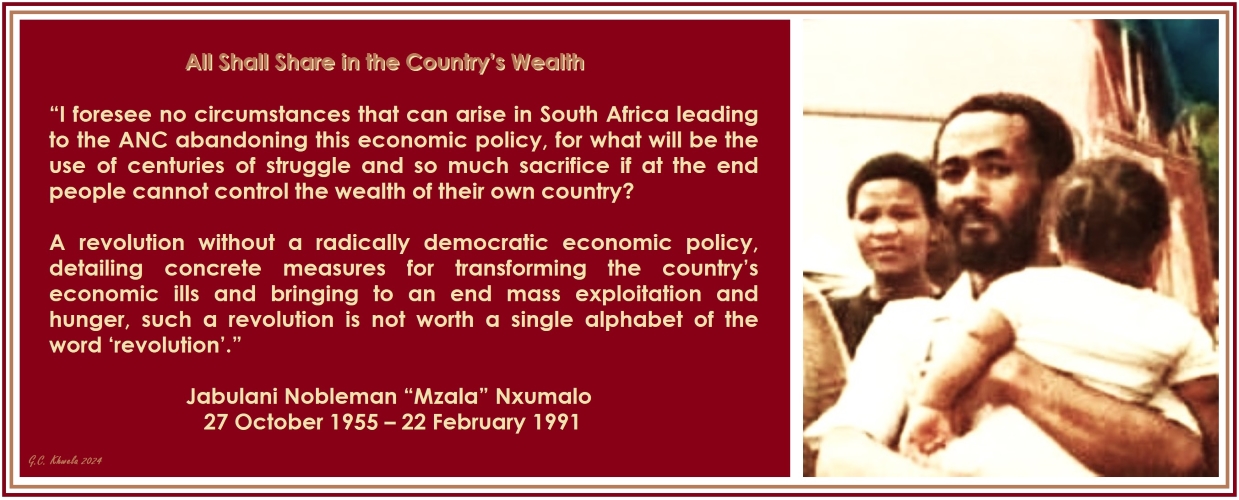
“I foresee no circumstances that can arise in South Africa leading to the ANC abandoning this economic policy, for what will be the use of centuries of struggle and so much sacrifice if at the end people cannot control the wealth of their own country? A revolution without a radically democratic economic policy, detailing concrete measures for transforming the country’s economic ills and bringing to an end mass exploitation and hunger, such a revolution is not worth a single alphabet of the word ‘revolution’.”
– Nobleman “Mzala” Nxumalo (1987): Can the Imperialists Abort Our Revolution?
Castro Khwela
Good morning fellow Compatriots!🙏🏾✊🏾👊🏾
Discover more from CASTRO KHWELA
Subscribe to get the latest posts sent to your email.
Thanks for sharing this deep researched content.