Sports Boycotts Apartheid: Commonwealth Games Bans SA Athletes
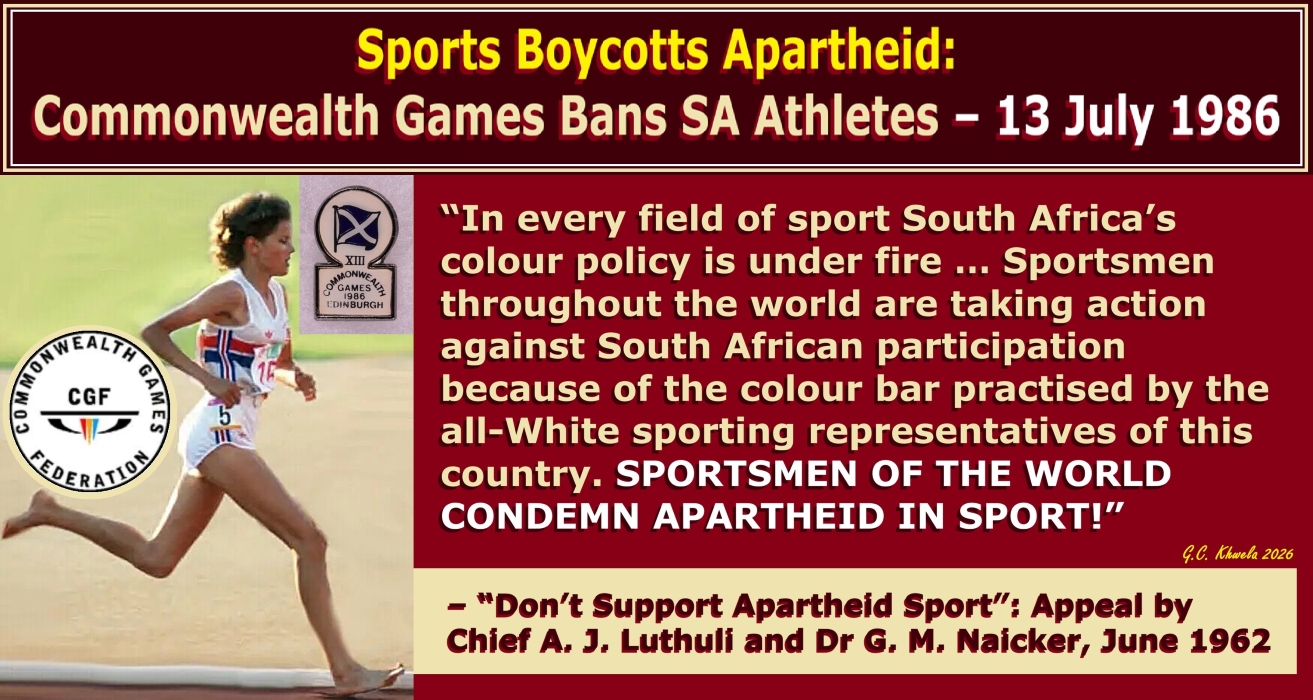
On 13 July 1986, exactly forty years ago, the Commonwealth Games officials in London ruled that two South African born athletes, Zola Budd and Annette Cowley, could not participate in the Commonwealth Games as athletes for England. The Commonwealth Games were to commence on 24 July 1986 in Edinburgh, Scotland. The governing body of the Games was already faced with the boycott of five black African nations – Nigeria, Ghana, Kenya, Uganda and Tanzania. This was a direct consequence of Britain’s refusal to support economic sanctions against the apartheid regime in South Africa.
This decision was in essence a political move to defuse a massive, multi-nation African boycott of the 1986 Edinburgh Games over South Africa’s system of apartheid. Prime Minister Margaret Thatcher’s British government consistently refused to impose rigid economic sanctions against the apartheid regime in South Africa. Led by Nigeria and Ghana, several black African nations withdrew from the Edinburgh Games in protest against Britain’s stance. Activists and boycotting nations, such as Zimbabwe, specifically weaponised the inclusion of South African-born athletes on the English team to showcase British hypocrisy.
Because international sports federations banned South Africa from global competition, both athletes sought alternative pathways to compete. Zola Budd had been fast-tracked for a British passport in 1984 through her paternal grandfather, while Annette Cowley held a British passport via her mother. To pacify the protesting nations, the Commonwealth Games Federation officially disqualified Budd and Cowley on residency grounds, declaring that they failed to meet the strict criteria required to represent England, despite holding valid British passports. However, the decision failed to save the event. The exclusion did not appease the boycotting states, and 32 of the 59 eligible nations ultimately withdrew from the 1986 Games, rendering it a logistical and financial disaster.
One of the most interesting aspects of this controversy was Zola Budd’s acquisition of a British passport in April 1984, which was an unprecedented fast-track process that took only 10 to 13 days, whereas normal naturalisation applications took years. The operation was orchestrated behind the scenes by a British tabloid and sparked a bitter row at the highest levels of Margaret Thatcher’s government. The British tabloid newspaper, ‘The Daily Mail’, initiated the strategy. They approached the Budd family and paid an estimated £100,000 for the exclusive rights to her life story.
At just 17 years old, Budd was breaking world records barefoot but was banned from international sport due to anti-apartheid sanctions against South Africa. ‘The Daily Mail’ aimed to bring her to the United Kingdom to secure her eligibility for the 1984 Los Angeles Olympic Games. They persuaded Zola Budd’s father to apply for her British citizenship on ancestral grounds, leveraging the fact that her paternal grandfather was born in Britain. Declassified files from the National Archives revealed that the application triggered a fierce internal war between key government ministers.
British Home Secretary Leon Brittan personally oversaw and pushed the application through at lightning speed. He argued that she was an exceptional talent and was legally entitled to apply due to her heritage. However, Foreign Secretary Sir Geoffrey Howe vehemently opposed the fast-track. He warned that giving a South African athlete “special treatment” would look like double standards, it would anger black African nations and actively undermine Britain’s anti-apartheid stance. The decision caused immediate political fury in Britain. Opposition Labour Party Members of Parliament signed a motion demanding an official inquiry, pointing out that thousands of other immigrants were forced to wait years for citizenship. Nevertheless, despite the political fallout, Brittan prevailed. Budd received her passport, moved to Guildford, and ran for Great Britain in the 1984 Los Angeles Olympics. This ultimately culminated in her infamous on-track collision with American star Mary Decker.
Looking back at history, the 1977 Gleneagles Agreement shifted the anti-apartheid sports boycott from a series of disjointed, activist-led protests into a formal, state-sanctioned policy of total international isolation against South Africa. By committing all 33 Commonwealth nations to “take every practical step” to discourage sporting contact with South Africa, it weaponised the white minority regime’s obsession with sport to attack the cultural legitimacy of apartheid. The broader impacts of the agreement unfolded across political, psychological and institutional dimensions.
What is interesting though about this Agreement, is that the Commonwealth dominated the sports that white South Africans cared about most – namely rugby and cricket. Being barred from competing against traditional rivals like New Zealand, Australia and the United Kingdom inflicted deep psychological damage on a white society that viewed sporting prowess as a core pillar of national identity. To appease international critics and to circumvent the agreement, the National Party regime was forced to relax domestic laws. They allowed mixed-race sports clubs and racially integrated national teams.
However, activists inside South Africa, under the banner of the South African Non-Racial Olympic Committee (SANROC), dismissed these moves as superficial. They popularised the phrase “No normal sport in an abnormal society”, arguing that true integration was impossible under the broader framework of apartheid. Blocked from official competition, South African sporting bodies used massive financial incentives to lure international athletes into “rebel tours”. Cricket and rugby players from England, Australia and the West Indies who accepted these secret payouts faced severe condemnation. Many received life bans from their home sporting boards for violating the spirit of Gleneagles.
The Agreement proved that multilateral international pressure could effectively target specific sectors of a country. The sporting isolation established by Gleneagles served as a highly visible precursor to the more devastating economic, trade and arms embargoes of the 1980s. Together, this multi-layered global siege directly contributed to the economic and political collapse of the apartheid state by the early 1990s. The international sports isolation of South Africa directly disrupted, divided and altered the careers of thousands of athletes worldwide.
Far from just punishing South Africans, the global anti-apartheid boycott forced international athletes to make career-defining moral, political and financial choices. To circumvent isolation, South African sports bodies offered vast sums of cash to lure international athletes for unsanctioned “rebel tours”. The athletes who accepted these payouts faced immediate and severe professional consequences. The West Indies Rebels (1982–1984), for instance, was a group of prominent Caribbean cricketers who took lucrative contracts to play in South Africa. Upon their return, the West Indies Cricket Board handed them life bans. They were widely vilified as traitors to the black liberation struggle and faced intense social ostracism at home.
Players like Mike Gatting (England) and Kim Hughes (Australia) led “rebel tours” in the 1980s. International bodies bowed to pressure from nations like India and Pakistan, issuing three-year to multi-year bans from official Test Cricket to prevent global sports associations from fracturing completely. Because the anti-apartheid boycott targeted any country maintaining ties with South Africa, hundreds of completely unrelated international athletes had their Olympic and Commonwealth dreams destroyed.
Take for example, the 1976 Montreal Olympics. More than 20 African and Arab nations boycotted the Olympics because the International Olympic Committee (IOC) refused to ban New Zealand, since the country’s rugby team had toured South Africa earlier that year. As a result, world-class African athletes, such as Tanzanian Filbert Bayi, were denied their peak competitive moments. With regard to the 1986 Edinburgh Commonwealth Games, 32 nations boycotted the event over Margaret Thatcher’s stance on South Africa. Hundreds of athletes from across Africa, the Caribbean and Asia trained for years only to be ordered home by their governments.
For South African athletes themselves, isolation split an entire generation along racial lines. Talented white athletes who wanted global glory were forced to change their allegiance and emigrate. Aside from Zola Budd, athletes like Kepler Wessels emigrated to play cricket for Australia, and tennis star Johan Kriek became a United States’ citizen to compete in Grand Slams. Black, Coloured and Indian South African athletes bore the heaviest burden. Domestic apartheid laws prevented them from accessing proper training facilities, funding or integrated trials. Even if they achieved world-class times or scores in non-racial sporting unions, they were completely invisible to international scouts and lacked the financial means or passports to flee the country.
The second interesting aspect is the 1984 Los Angeles Olympics boycott, which was a massive Soviet-led Eastern Bloc retaliation against the United States for leading a multi-nation boycott of the 1980 Moscow Olympics four years prior. Occurring at the height of Cold War tensions, it resulted in 14 Soviet-aligned nations withdrawing from the Games, severely depleting the talent pool in sports traditionally dominated by the Eastern Bloc. While the Eastern Bloc and the United States were playing out their Cold War superpower rivalry, South Africa remained firmly locked out of global sport due to its internal apartheid policies. However, the 1984 Games – and the geopolitical chaos surrounding them – did intersect with the anti-apartheid sports boycott in several ways. The most direct connection between South Africa and the 1984 Games was runner Zola Budd.
Because South African athletes were banned, the British tabloid ‘The Daily Mail’ and the British Home Office fast-tracked a British passport for Budd based on her grandfather’s heritage so she could run in Los Angeles. While the Soviet Union and East Germany boycotted the Games, claiming “safety concerns”, their absence actually cleared the field for Budd. Had the Eastern Bloc participated, Budd would have faced the formidable Soviet distance runners. Instead, her inclusion became the primary political controversy of the Los Angeles track events, culminating in her infamous collision with American Mary Decker.
By 1984, the anti-apartheid sports isolation campaign was far more structurally sound and permanent than the temporary political boycotts of the superpowers. The Soviet-led boycott of 1984 and the US-led boycott of 1980 were temporary, single-event protests. In contrast, South Africa’s Olympic ban – which began with expulsion from the Tokyo 1964 Games and formal expulsion from the International Olympic Committee (IOC) in 1970 – was an absolute baseline rule that would not lift until the collapse of apartheid ahead of the 1992 Barcelona Games. The 1984 Cold War boycott temporarily fractured the international coalitions that usually united against South Africa.
During the 1976 Montreal Olympics, African nations had mass-boycotted the Games to protest apartheid ties. However, in 1984, the Soviet Union heavily pressured African and Non-Aligned nations to join their anti-American boycott. The vast majority of African nations refused the Soviet request and chose to send their athletes to Los Angeles anyway. They recognised that maintaining their own athletic visibility on the global stage was more crucial for their national development than participating in a proxy battle between Washington and Moscow.
Nonetheless, the 1986 ban marked the beginning of the end for both Zola Budd’s and Annette Cowley’s attempts to bypass the anti-apartheid sports boycott, leaving them reeling from major athletic setbacks before both eventually returned to represent a newly democratic South Africa in the 1990s. The sports boycott campaign itself proved entirely victorious, maintaining total pressure until apartheid was formally dismantled. For example, after being physically removed from the athletes’ village on the eve of her 1986 event, Cowley-Nel sat in the stands and watched the 100m swimming freestyle final. The gold medal was won with a time slower than she had posted in her trials.
When South Africa was readmitted to world swimming in 1991, Cowley came out of retirement to qualify for the 1992 Barcelona Olympics. Despite finishing second in the 50m and 100m freestyle national trials, selectors refused to name her to the squad, a decision she believed was lingering political punishment for previously adopting a British flag of convenience. She retired from swimming, established a marketing agency in Cape Town, and watched her twin daughters, Olivia and Georgia Nel, carry on the family legacy by earning college swimming scholarships in the United States.
Regarding Zola Budd, in 1988, the International Association of Athletics Federations (IAAF) suspended her from international track events again. They claimed she had broken boycott protocols simply by attending a cross-country event in South Africa as a spectator. Exhausted by the relentless media and political pressure, she broke ties with British athletics and moved back to South Africa. Following the release of Nelson Mandela and the lift of international sanctions, Budd finally competed under her native apartheid flag. She represented South Africa at the 1992 Barcelona Olympics in the 3,000-metre event. She transitioned into ultra-marathon running, famously winning the gruelling South African Comrades Marathon in 2014 under the veteran category.
The sports boycott remained completely unyielding until the white-minority government began negotiating the transition to democracy. The International Olympic Committee (IOC) and other sports federations refused to lift the bans until South Africa established completely unified, non-racial sports’ governing bodies. The campaign officially concluded at the 1992 Barcelona Games, where South Africa was welcomed back to global sports as an integrated, non-racial team.
Sources:
Wikipedia.
South African History Online (SAHO).
Mark Burton, “Runner Zola Budd Finally Takes to the Track In…”, United Press International, 13 April 1984.
Alar Lipping, “Olympic Boycotts”, EBSCO, 21 March 1980 and 8 May 1984.
L.A. Times Archives, “African Boycott Trips Zola Budd”, Los Angeles Times, 14 July 1986.
Leo Barnard and Cobus Raderneyer, “The Role of the English Rebel Cricket Tour to South Africa, 1989/1990, As A Factor in the Dismantling of Apartheid in South African Sport”, Journal for Contemporary History, Vol. 27, No. 3, 2002.
Graham Fraser, “Boycotts and Broken Dreams: The 1986 Commonwealth Games”, British Broadcasting Corporation (BBC), 14 July 2014.
Sky News Reporter, “Files Show Zola Budd Fast-Track Citizenship Row Split Government”, Sky News, 24 August 2016.
BBC Correspondent, “Ex-runner Zola Budd Triggered Government Row, Archives Show”, British Broadcasting Corporation (BBC), 24 August 2016.
Claire Ellicott, “How Zola Budd Split the British Cabinet”, Independent Online, 25 August 2016.
Matthew Llewellyn, “Sport, Thatcher and Apartheid Politics: The Zola Budd Affair”, Journal of Southern African Studies, Vol. 44, No. 4, 2018.
Cobus Rademeyer, “‘No Normal Sport in an Abnormal Society’ – Sports Isolation and the Struggle Against Apartheid in South African Sport, 1980-1992”, Southern Journal for Contemporary History, Vol. 44, No. 1, 2019.
Toby C. Rider and Matthew P. Llewellyn, “‘Every Practical Step’: The Gleneagles Agreement and Sporting Links with Apartheid South Africa During the Thatcher Years”, Journal of Policy History, Vol. 38, No. 2, 2026.
Marc Dyreson, “The 1984 Los Angeles Olympic Boycott”, Journal of Olympic Studies, Vol. 7, Issue 1, Spring 2026.
Swim History, “Annette Cowley”, Swim History 2026, https://swimhistory.co.za/index.php/international-champions/annette-cowley
Graham Fraser, “Banned Swimmer’s Daughters to Realise Family’s Commonwealth Games Dream”, British Broadcasting Corporation (BBC), 24 June 2026.
Castro Khwela
Good evening fellow Compatriots!🙏🏾✊🏾👊🏾
Discover more from CASTRO KHWELA
Subscribe to get the latest posts sent to your email.