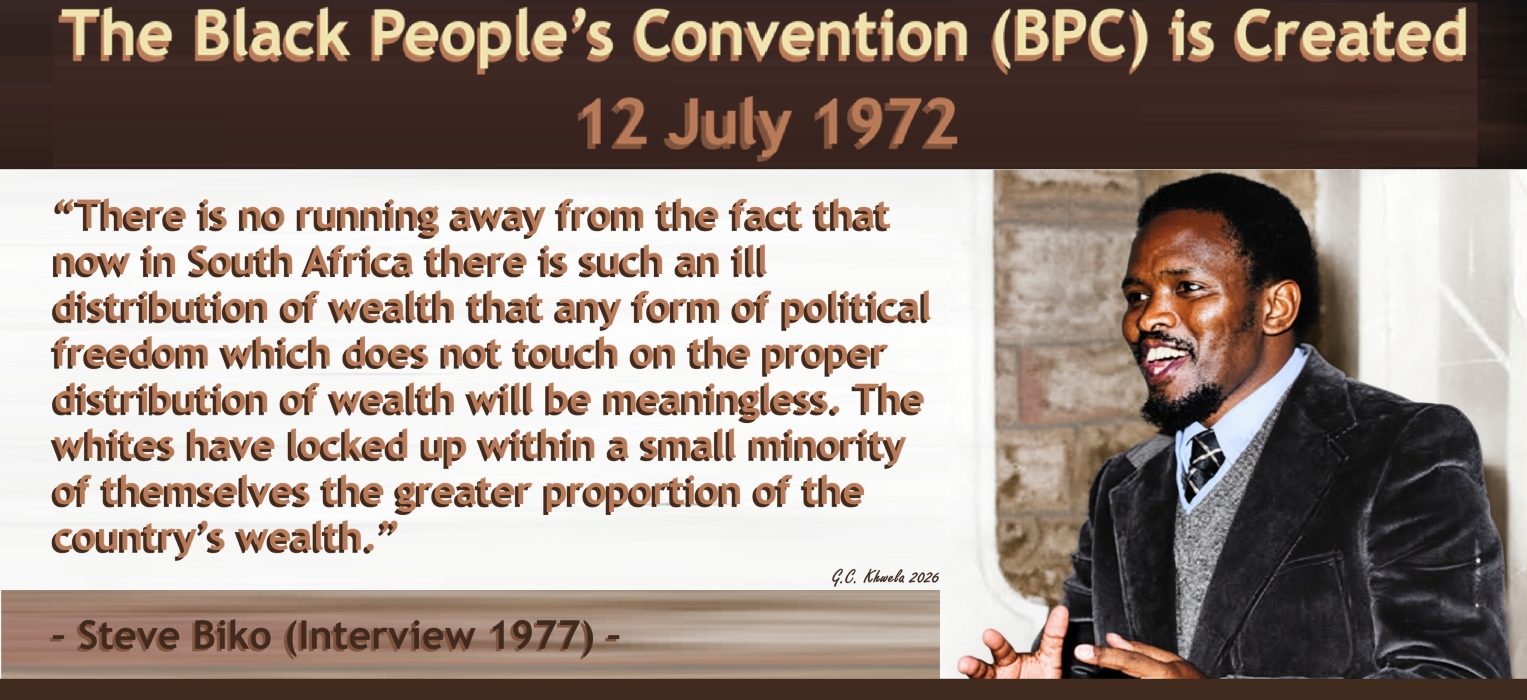
The Black People’s Convention (BPC) is Created
On 12 July 1972, the Black People Convention (BPC) was established after a three-day long conference at the Edendale Lay Ecumenical Centre in Edendale, Pietermaritzburg. This became a new political movement twelve years after the banning of the African National Congress (ANC) and the Pan Africanist Congress (PAC). Black students under the guiding principle that they identified themselves firstly as Black before being students formed this movement. The movement was established to bring together about seventy different black consciousness groups and associations under one umbrella.
The conference, which concluded on 12 July 1972, was an inaugural meeting organised by the South African Students’ Organisation (SASO). It brought together representatives and delegates from roughly 27 to 70 distinct Black Consciousness groups, cultural associations and church bodies to build a unified national political front. SASO, was the primary student driver of the Black Consciousness Movement (BCM), led by figures like Steve Biko and Barney Pityana.
It included the Black Community Programmes (BCP), which was the community development wing of the BCM that ran welfare, health and literacy initiatives; the South African Students’ Movement (SASM), a student body representing high school youth who adopted Black Consciousness principles; the Natal Indian Congress (NIC), whose local branches and progressive activists who pushed for broader Black solidarity; and various African Independent Churches and Ecumenical Groups. These included progressive church bodies and delegates connected with Black Theology initiatives who utilised the Edendale Centre for local mobilisation.
Because of its racial exclusivity, the government initially welcomed it as an endorsement of racial segregation and apartheid policies. However, when the movement assumed a radical anti-apartheid political agenda the government began to restrict its activities. The movement elected Winnie Kgware as its first president and Steve Biko was named honorary president in 1977. It was officially inaugurated in December 1972 and banned in October 1977.
The primary objective of the Black People’s Convention (BPC) was to liberate Black South Africans from both psychological and physical oppression by acting as an umbrella political front for the Black Consciousness Movement (BCM). However, it failed to survive as a legal organisation due to state suppression, but it highly succeeded as a psychological and political catalyst that fundamentally transformed the anti-apartheid liberation struggle. The BPC’s foundational goals were explicitly outlined in its constitution and the later 1976 “Mafikeng Manifesto”, which fostered Black Political Unity. Its intention was to unite African, Coloured and Indian South Africans into a single political bloc under the inclusive definition of being “Black”.
The BPC intended to eradicate the internalised inferiority complex or “slave mentality” induced by apartheid, substituting it with Black cultural pride, dignity and self-reliance. This was to be done through non-cooperation with apartheid, that is to completely reject state-sponsored institutions, such as the Bantustan “homelands” system and segregated local councils. To advocate for an egalitarian society structured around “Black Communalism” – a socialist system utilising state custodianship of all land and equitable sharing of corporate wealth – and to extend the intellectual ideas developed by university students in SASO directly into broader working-class civic society.
The operational success of the BPC is historically viewed through a dual lens. Firstly, the BPC was systematically crushed by the state. The apartheid regime banned its top leadership – including its honorary president Steve Biko, in 1973. Following the fallout of the Soweto Uprising and Biko’s murder in detention, the apartheid government permanently banned the BPC on 19 October 1977, effectively ending its legal existence. It was never able to directly implement its long-term policy goals, such as re-engineering the South African economy or directly negotiating the end of white-minority rule.
Secondly, the BPC successfully decentralised its philosophy, directly inspiring high school student structures like the South African Students’ Movement (SASM). This shift in consciousness was the ideological bedrock of the 1976 student uprisings, which shattered the illusion of apartheid stability. Following the banning of the ANC and PAC in 1960, the internal liberation movement was paralysed by fear and the BPC successfully revitalised open domestic resistance during the darkest period of apartheid state terrorism.
Moreover, the banning of the BPC directly paved the way for internal groups like the Azanian People’s Organisation (AZAPO) and provided highly politicised cadres who later re-energised the United Democratic Front (UDF) in the 1980s working in conjunction with the external liberation movements. However, the relationship between the Black People’s Convention (BPC) and the exiled liberation movements was deeply complex, evolving from initial suspicion and ideological rivalry into strategic cooperation and mass absorption.
Because the African National Congress (ANC), the Pan Africanist Congress (PAC), and the South African Communist Party (SACP) were banned in the 1960s, the BPC originally emerged to fill the vacuum of internal resistance. When the BPC’s ideas and cadres spilled over into exile – particularly after the 1976 Soweto Uprising – it fundamentally shifted its dynamic with the older liberation movements. The relationship with the African National Congress (ANC), for instance, evolved through distinct phases. It initially kept its distance from the ANC, as BPC leaders criticised the “Congress Alliance” model for relying heavily on white liberals and communists, which they argued watered down Black leadership.
They also viewed the ANC’s non-racial terminology as premature, arguing that Black people first needed independent psychological liberation. Nonetheless, despite this ideological friction, BPC leaders like Steve Biko recognised the ANC’s immense historical legitimacy and underground military infrastructure. By 1976, Biko was actively attempting to broker unity talks between the internal Black Consciousness structures and the external ANC leadership under Oliver Tambo. Following the Soweto Uprising, thousands of young, BPC-inspired Black Consciousness youth fled South Africa into exile. While some sought to remain independent, the vast majority were absorbed by the ANC due to its superior diplomatic networks, financial backing and military training camps run by Umkhonto we Sizwe (MK).
With regard to the Pan Africanist Congress (PAC), on paper, the two shared a natural ideological alignment, yet their relationship was heavily fractured in practice. Both movements shared an exclusively African/Black nationalist focus and a mutual rejection of white-led liberal or communist groups. The PAC’s foundational philosophy of Africanist self-determination deeply mirrored the BPC’s definition of Black solidarity. The PAC eagerly tried to co-opt and absorb the fleeing BPC youth into its exile military wing, the Azanian People’s Liberation Army (APLA).
However, the PAC in exile was crippled by severe internal factional infighting, poor leadership under Potlako Leballo, and logistical instability. Disillusioned by this chaos, the majority of incoming BPC youth rejected the PAC and joined the ANC instead, despite the ANC’s conflicting stance on non-racialism.
Most difficult, was the relationship with the Communist Party. The BPC maintained a strictly adversarial and suspicious relationship with the SACP due to irreconcilable foundational principles. The SACP viewed the anti-apartheid struggle primarily through the lens of Marxist-Leninist class struggle, arguing that the enemy was racial capitalism. The BPC, conversely, prioritised race over class, arguing that white supremacy affected all Black people regardless of their economic standing. In addition to this concern was that the SACP’s leadership featured prominent white intellectuals, such as Joe Slovo. This directly violated the BPC’s strict policy of psychological self-reliance, which dictated that Black liberation must be conceptualised and led solely by Black people without white paternalism.
While the BPC advocated for a socialist economic model under the banner of “Black Communalism”, they explicitly rejected the Soviet-aligned, mainstream Marxist perspectives championed by the SACP, viewing them as foreign European imports unsuited to the African context. Ultimately, when the apartheid regime permanently banned the BPC in late 1977, the remaining Black Consciousness structures fractured over these exile relationships.
Many former BPC members inside South Africa fully embraced the ANC’s Freedom Charter, eventually forming the UDF. These were a consequence of the ANC and its internally aligned structures popularising the Freedom Charter through effective propaganda and mobilisation efforts. Those who refused to align with either the ANC or PAC formed the Black Consciousness Movement of Azania (BCMA) in exile and the Azanian People’s Organisation (AZAPO) domestically, keeping the distinct, uncompromised Black Consciousness tradition alive.
What was also prominent in the history of the BPC, was the establishment of the Black Community Programmes (BCP), which was conceived as the developmental, grassroots arm of the Black Consciousness Movement (BCM), and can be assessed as a highly effective vehicle for practical and psychological liberation. While political bodies like the BPC focused on national mobilisation, the Black Community Programmes (BCP) translated abstract philosophy into concrete, everyday survival and defiance. Its contribution to the broader anti-apartheid and anti-imperialist struggle in Southern Africa could be measured across several specific dimensions.
The defining slogan of the Black Consciousness Movement (BCM) was “Black man, you are on your own” and the BCP was the structural proof of this concept. It successfully demonstrated that oppressed people could survive and build infrastructure completely independent of both the apartheid state and paternalistic white liberal charities. For example, the BCP established independent medical facilities like the Zanempilo Community Health Centre in the Eastern Cape and Solempilo in Natal. These centres did not just treat illnesses; they proved that Black professionals could manage high-tier medical infrastructure despite systematic underfunding by the regime.
Through home-based industries, leather-craft workshops and sewing collectives, the BCP provided employment to marginalised workers, actively fighting the economic dependency created by the migrant labour system. Anti-imperialist struggles required the colonised to reject the culture and mindset of the coloniser. The BCP operated as an internal engine for de-colonial thought. For instance, the BCP launched extensive adult literacy campaigns. These programmes did not utilise state-approved curricula; they were designed to raise political consciousness, teaching people to critically analyse their socio-economic exploitation.
By financing independent research, publications, and Black art journals, the BCP wrestled control of the historical narrative away from white academic institutions, enabling Black South Africans to define their own realities, culture and heritage. Additionally, the BCP explicitly bridged the gap between community welfare and radical underground politics. The Zimele Trust Fund, for example, created by the BCP in 1975, provided direct financial aid, clothing and basic necessities to political prisoners, banned activists and their families. BCP offices and clinics served as vital legal cover. They functioned as safe spaces where activists could gather, organise, hide underground cells and coordinate logistics without immediately triggering the suspicion of the apartheid Security Branch.
Though geographically bound within South Africa, the BCP and wider BCM heavily influenced the geopolitics of Southern Africa. When the Marxist Frelimo movement successfully overthrew Portuguese colonial rule in Mozambique, BCM/BCP networks defied state bans to organise massive celebratory rallies – The Viva Frelimo Rallies of 1974 – inside South Africa. This explicitly tied the domestic anti-apartheid struggle to the broader pan-African war against Western imperialism. Accordingly, the political awareness raised by BCP community programmes directly fed the ranks of exiled liberation movements.
The youth who grew up inside BCP youth clubs, clinics, arts and literacy projects were the exact demographic that fled after 1976 to pick up arms in training camps located in Angola, Tanzania and Zambia. In the history of Southern African liberation, the BCP was not merely a “charity” or a “welfare society”. It was a strategic intervention that proved development could be weaponised as resistance. By showing that Black communities could educate, heal and employ themselves outside “the system”, the BCP shattered the core justification of apartheid – the myth of Black inferiority – and built the very psychological foundation required to sustain a long-term revolution.
Taking over power in 1994, the ANC should have learned from the workbook of the Black People’s Convention (BPC), especially in moulding self-sustaining Black societies. When asked in an interview about the type of society BPC was struggling for, as the honorary President, Steve Biko replied, “I think there is no running away from the fact that now in South Africa there is such an ill distribution of wealth that any form of political freedom which does not touch on the proper distribution of wealth will be meaningless. The whites have locked up within a small minority of themselves the greater proportion of the country’s wealth.”
“If we have a mere change of face of those in governing positions”, he continued, “what is likely to happen is that black people will continue to be poor, and you will see a few blacks filtering through into the so-called bourgeoisie. Our society will be run almost as of yesterday. So for meaningful change to appear there needs to be an attempt at reorganising the whole economic pattern and economic policies within this particular country.”
According to Biko, “BPC believes in a judicious blending of private enterprise which is highly diminished and state participation in industry and commerce, especially in industries like mining – gold, diamonds, asbestos and so on – like forestry, and of course complete ownership of land. Now in that kind of judicious blending of the two systems we hope to arrive at a more equitable distribution of wealth. … We see a completely non-racial society. … We believe that in our country there shall be no minority, there shall be no majority, just the people. And those people will have the same status before the law and they will have the same political rights before the law. So, in a sense it will be a completely non-racial egalitarian society.”
Sources:
Wikipedia.
South African History Online (SAHO).
African American Registry, “The Black People’s Convention is Formed”, African American Registry, 16 April 1972.
Steve Biko, “I Write What I Like, 1946 – 1977”, Oxford: Heinemann, 1987.
Motena Jonas Dhlamini, “The Relationship Between the African National Congress and the Pan Africanist Congress, 1959-1990”, Ph.D.: History, North-West University, 2006.
Julie Frederikse, “Against White Domination and Black Domination: The Unbreakable Thread: Non-Racialism in South Africa”, South African History Archive (SAHA), September 2015.
Ramathate T. Dolamo, “The Legacy of Black Consciousness: Its Continued Relevance for Democratic South Africa and Its Significance for Theological Education”, HTS Theological Studies, Vol. 73, No. 3, 2017.
Tricontinental, “Black Community Programmes: The Practical Manifestation of Black Consciousness Philosophy”, Tricontinental, 10 September 2021.
Ashwin Desai and Goolam Vahed, “A Fool’s Errand? Black Consciousness and the 1970s Debate Over the ‘Indian’ in the Natal Indian Congress”, New Contree, Vol. 2021, No. 86, 1 July 2021.
Roland Martin, “Black Consciousness Movement: South African Social Movement”, Encyclopaedia Britannica, 8 July 2026.
Padraig O’Malley, “Pan Africanist Congress (PAC)”, https://omalley.nelsonmandela.org/cis/omalley/OMalleyWeb/03lv02424/04lv02730/05lv03188/06lv03214.htm
Sethuthuthu Lucky Vuma, “The Role of Black Consciousness in the Struggle Against Apartheid: An Afrocentric Historical Analysis”, Frontiers in Political Science, 9 July 2026, www.frontiersin.org/journals/political-science/articles/10.3389/fpos.2026.1822510/full.
Castro Khwela
Good evening fellow Compatriots!🙏🏾✊🏾👊🏾
Discover more from CASTRO KHWELA
Subscribe to get the latest posts sent to your email.