MK Mutiny in Angola: The Stuart Commission Report
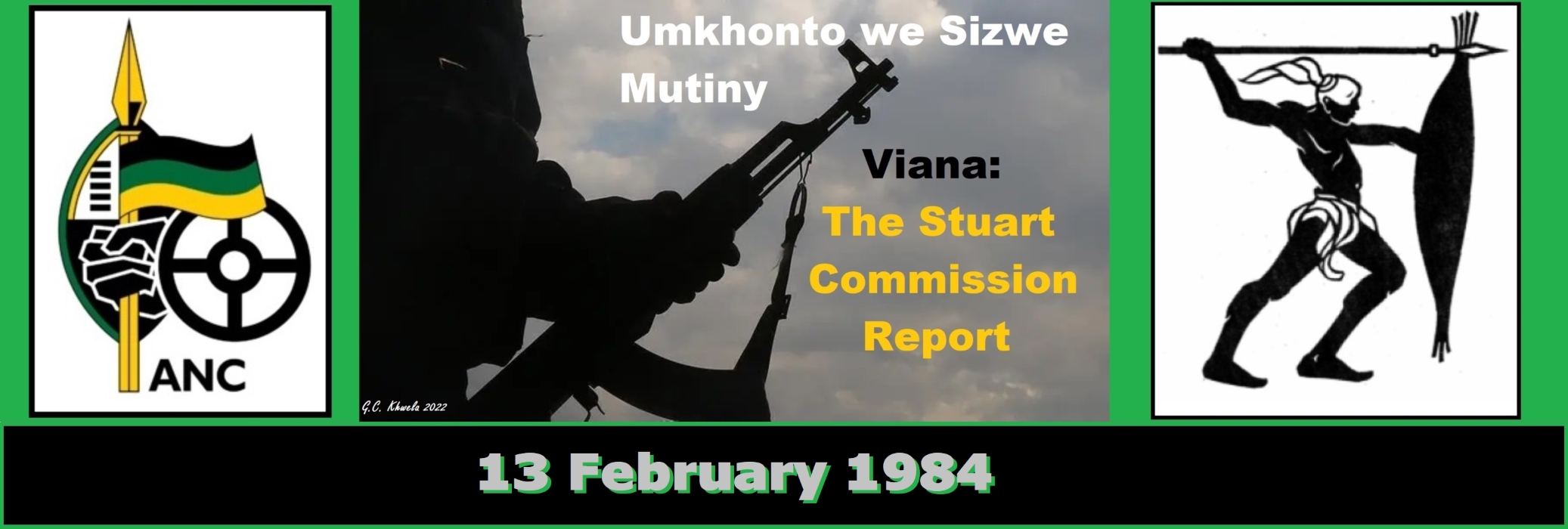
Following the acts of mutiny in the Viana Transit Camp, on 13 February 1984, the Working Committee of the African National Congress (ANC) appointed a Commission of Inquiry chaired by James Stuart (real name “Hermanus Loots”), an Umkhonto we Sizwe (MK) Luthuli Detachment Veteran.
The members of the Commission flew to Luanda and went straight to work, and they consisted of Aziz Pahad, Sizakele Sigxashe, Antony Mongalo and Mbuyiselo Mntu Dwyili, all of whom were non-NEC (National Executive Committee) members. For a period of three weeks, members of the Stuart Commission visited and interviewed practically all the occupants of the Viana Transit Camp, as well as the other camps affected by the mutiny.
Meanwhile, on the same day, 13 February, the Headquarters of the ANC in Lusaka had received a message that the Committee of Ten and approximately 23 MK cadres were arrested and taken to Luanda’s Maximum-Security Prison under Angolan military escort. Moreover, all the Viana protestors were reported to have been disarmed, and most were transported to the two camps north of Luanda, Quibaxe and Pango.
The Commission also interviewed the 33 cadres, including the members of the Committee of Ten, who had been arrested by Angolan government forces, and submitted its report on 14 March 1984. The conclusions reached by the Commission were that there was no reason to believe that the mutiny was the result of a plot by enemy agents, though agents and ‘suspects’ who had been dumped in Angola without hope of deployment may have exploited real grievances.
According to the Commission, there had been a steady deterioration of conditions in the camps since 1979 and the position had been exacerbated by the conversion of the security department, which came to be known as “iMbokodo” (the grinding stone), from its proper role as “the eyes and ears” of the ANC into an arbitrary and violent disciplinary arm, which used “the methods of the Boers”.
The return of disgruntled cadres from a camp at Nampula in Mozambique, as well as men from Zimbabwe, had inflamed discontent. There was a lack of proper food, fresh meat, vegetables and fruit, and of doctors and medicines, in an area where malaria was rife. In addition, there was little or no provision of welfare, recreational facilities, political education, information or reading materials. What also made matters worse, was that the MK High Command spent most of its time in Lusaka and Maputo, while the Regional Command neglected the camps and spent more time in Luanda.
A growing division between the camp administration, including the security apparatus, and the rank and file had been marked by hugely differential access to food, cigarettes and liquor. The division was so extreme that some cadres spoke of two armies: an Imperialist Army, presided over by the National Commissar, Andrew Masondo, and the Head of security, Mzwai Piliso; and a Revolutionary Army, led by Chris Hani and Joe Slovo.
The report described the situation as a “nearly total collapse of the political, military and moral organisation in Angola” with “resultant confusion, fear and lawlessness”. It suggested that the “People’s Army” seemed to be placed on “the lowest, or nearly the lowest, rung” of the movement’s priorities. There had been a growing demand for a national consultative conference, which became the rallying cry of the mutineers, who at Viana elected their own representative Committee of Ten.
The detailed notes that ANC President OR Tambo elicited from the report indicated that he was shocked and, at times, skeptical about what he read. Nevertheless, Tambo was impressed by the conclusion that there was no evidence that the first of the mutinies had been planned by enemy agents and he noted that the members of the Committee of Ten had all been elected by their comrades. Tambo also made a special note of the report’s recommendations on the need for a cadre development policy.
The NEC decided to implement the Commission’s recommendations immediately, including the need to ameliorate the living and welfare conditions in the camps. The position of National Commissar was abolished and Mzwai Piliso was redeployed to the Department of Manpower Development (DMD) in Lusaka. Andrew Masondo, who had been the National Commissar, was deployed to Solomon Mahlangu Freedom College (SOMAFCO), as part of the Education Department, since he had considerable experience in this field, as a former mathematics lecturer at the University of Fort Hare.
It can be surmised that although the Stuart Commission had to do a lot of work within a short space of time, it played a major role in exposing the difficulties that were faced by MK in Angola and in building morale and confidence in the leadership of the Movement. Efforts were undertaken to address the various concerns raised by the general membership in the camps, including the restructuring of the Security Department. Nonetheless, some of these efforts were later undermined and several of the concerns that had been raised persisted into the future, resulting in cases of continued disgruntlement and serious misdemeanour.
Sources:
Luli Callinicos, “Oliver Tambo: Beyond the Engeli Mountains”.
Stephen Ellis, “External Mission: The ANC in Exile”.
Paul Trewhella, “Inside Quatro: Uncovering the Exile History of the ANC and SWAPO”.
Hugh Macmillan, “The Lusaka Years: The ANC in Exile in Zambia”.
Vladimir Shubin, “ANC: A View from Moscow”.
James Ngculu, “The Honour to Serve: Recollections of an Umkhonto Soldier”.
Janet Smith and Beauregard Tromp, “Hani: A Life Too Short”.
Castro Khwela
Good morning fellow Compatriots!
Discover more from CASTRO KHWELA
Subscribe to get the latest posts sent to your email.