Stephen Bantu Biko: Brutally Murdered in Detention
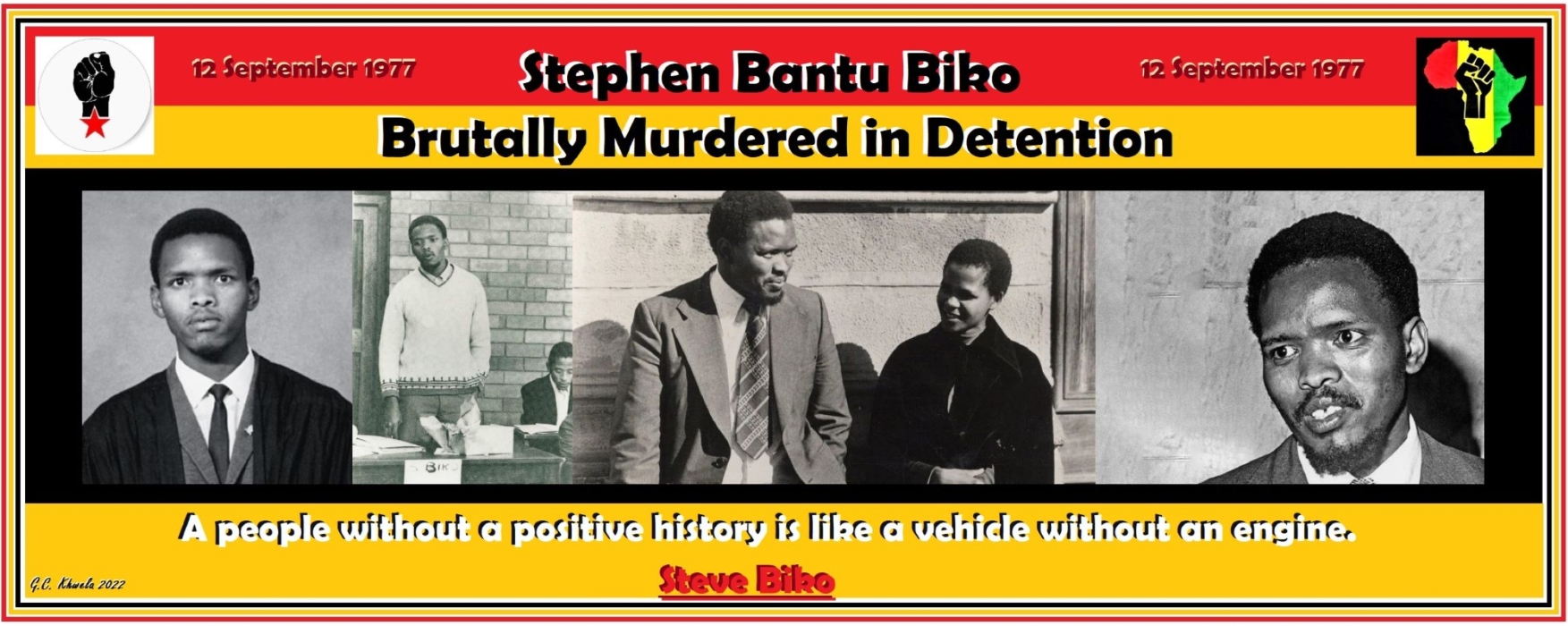
On 12 September 1977, Stephen Bantu Biko died alone in a cell after having been driven in the back of a Land Rover, naked and manacled, for 1 190 kilometres from Walmer Police Station in Port Elizabeth (now Gqeberha) to the Pretoria Prison hospital on 11 September 1977. On 12 September 1977, Biko died of injuries sustained during interrogation. His death stunned and shocked the world. But not Jimmy Kruger, the apartheid Minister of Justice, who stated that Biko’s death “left him cold”.
In August 1977, Biko broke his banning order by travelling to Cape Town, hoping to meet Unity Movement leader Neville Alexander and deal with growing dissent in the Western Cape branch of the Black Consciousness Movement (BCM), which was dominated by Marxist, like Johnny Issel. Biko drove to the city of Cape Town with his friend Peter Jones on 17 August, but Alexander refused to meet with Biko, fearing that he was being monitored by the police.
Biko and Jones then drove back toward King William’s Town, and on their way back on 18 August, they were stopped at a police roadblock near Grahamstown. Biko was arrested for having violated the order restricting him to King William’s Town. Unsubstantiated claims were that the security services were aware of Biko’s trip to Cape Town and that the road block had been erected to catch him. Jones was also arrested at the roadblock; and he was subsequently held without trial for 533 days, during which time he was interrogated on numerous occasions.
The security services took Biko to the Walmer police station in Port Elizabeth, where he was held naked in a cell with his legs in shackles. On 6 September, he was transferred from Walmer to room 619 of the security police headquarters in the Sanlam Building in central Port Elizabeth, where he was interrogated for 22 hours, handcuffed and in shackles, and chained to a grille. Exactly what happened has never been ascertained,but during the interrogation he was severely beaten by at least one of the ten security police officers. He suffered three brain lesions that resulted in a massive brain haemorrhage on 6 September.
Following this incident, Biko’s captors forced him to remain standing and shackled to the wall. The police later said that Biko had attacked one of them with a chair, forcing them to subdue him and place him in handcuffs and leg irons. Later on, Biko was examined by a doctor, Ivor Lang, who stated that there was no evidence of injury on Biko. However, scholarship had suggested Biko’s injuries must have been obvious. He was later on examined by two other doctors, Benjamin Tucker and Ivor Lang, who, after a test showed blood cells to have entered Biko’s spinal fluid, agreed that he should be transported to a prison hospital in Pretoria.
According to an autopsy report, an “extensive brain injury” had caused “centralisation of the blood circulation to such an extent that there had been intravasal blood coagulation, acute kidney failure, and uremia”. He was the twenty-first person to die in an apartheid South African prison in twelve months, and the forty-sixth political detainee to die during interrogation since the government introduced laws permitting imprisonment without trial in 1963.
News of Biko’s death spread quickly across the world and became symbolic of the abuses of the apartheid system. His death attracted more global attention than he had ever attained during his lifetime. Protest meetings were held in several cities throughout the world; many were shocked that the apartheid security authorities would kill such a prominent dissident leader, who was barely 31 years old. Biko’s funeral service, held on 25 September 1977 at King William’s Town’s Victoria Stadium, took five hours and was attended by around 20,000 people.
Speaking publicly about Biko’s death, the apartheid Police Minister Jimmy Kruger stated that Biko had been on a hunger strike. Speaking at the Transvaal Congress of the Nationalist Party, Kruger stated that Biko had been plotting violence, a claim repeated in the apartheid pro-government press. South Africa’s attorney general initially stated that no one would be prosecuted for Biko’s death. Following International pressure that forced apartheid Prime Minister, Mr B.J. Vorster, to promise a full enquiry, the 1977 inquest accepted the police account that Biko sustained injuries when he hit his head against the wall and no one was prosecuted for the death.
Two weeks after the funeral, in October 1977, the government banned all Black Consciousness organisations, such as the South African Students’ Organisation (SASO) and the Black People’s Convention (BPC), with thousands of students and Black Consciousness leaders being incarcerated or going into exile. Some newspapers which were aligned to Black Consciousness Movement were also banned.
An official inquest into Biko’s death, despite evidence to the contrary, found in favour of the police, stating that his death could not have been brought about “by any act or omission involving an offence by any person.” It was only at the Truth and Reconciliation Committee (TRC) that the truth of Biko’s death was revealed. Four security policemen admitted to the killing of Biko during interrogation. The commanding officer, Gideon Nieuwoudt was denied amnesty on the grounds that he did not prove that his crime was politically motivated. The TRC also refused to grant amnesty to the other officers, ruling that they lied in their evidence and failed to prove a political motive for killing Biko.
According to Steve Biko’s comrade and friend, N. Barney Pityana, “It is because we live in a society so wedded to materialism, glitz and glamour that Biko’s values of caring, sacrifice, courage and truth have only been honoured in the breach. With Steve’s martyrdom has gone the entire project of human worth and the spirit of ‘Ubuntu’: the gift of discovering our shared humanity.”
Sources:
Wikipedia.
South African History Online (SAHO).
Heike Becker, “Black Consciousness and Anti-Capitalism: The Legacy of Steve Biko”, Review of African Political Economy, 20 September 2021.
Norman McFarlane, “Biko on Black Consciousness”, Bolander, 21 September 2016.
Alexander Habibi, “Steve Biko: The Intellectual Roots of South African Black Consciousness”, Proceedings of the National Conference on Undergraduate Research (NCUR), University of Kentucky, Lexington, 3 – 5 April 2014.
Tricontinental Institute for Social Research, “Programmes: The Practical Manifestation of Black Consciousness Philosophy”, Tricontinental Institute for Social Research, Dossier No. 44, September 2021.
Mubarak Aliyu, “Steve Biko and the Philosophy of Black Consciousness”, London School of Economics and Political Science, Black Forgotten Heroes – Firoz Lalji Institute for Africa, 19 August 2021.
AZAPO, “A Steve Biko Journey to Martyrdom”, AZAPO Voice, Vol. 1 Issue 28, 6 September 2018.
Emilia Potenza, “Biko – The Quest for a True Humanity”, An Exhibition Commemorating the 30th Anniversary of the of Bantu Stephen Biko, The Apartheid Museum and The Steve Biko Foundation, September 2007.
Sapa, “Biko’s Killers Step Out of Shadows for Amnesty Hearing”, South African Press Association, 5 September 1996.
SAHA, “Death of Biko”, The Future is Ours: Commemorating Youth in Struggle, South African History Archives, Youth in Action, 1986.
N. Barney Pityana, “Chapter 26 – Steve Biko: Philosopher of Black Consciousness”, in Adekeye Adebajo (Ed.), The Pan-African Pantheon, Manchester University, 2021.
Ramathate T.H. Dolamo, “Stephen Bantu Biko: An Agent of Change in South Africa’s Socio-Politico-Religious Landscape”, HTS Teologiese Studies/Theological Studies Vol. 75, No. 4, 29 July 2019.
The Guardian Staff, “South Africa to Reopen Steve Biko Inquest 48 Years After Death in Police Custody”, The Guardian, 10 Sep 2025.
Ẹniọlá Ànúolúwapọ́ Ṣóyẹmí, “Rightful Power and an Ideal of Free Community: The Political Theory of Steve Biko”, Political Theory, Vol. 52, No. 3, 2024.
Sydney Kentridge, “Evil Under the Sun: The Death of Steve Biko”, The 12th Annual Steve Biko Memorial Lecture – 12 September 2011, Advocate, December 2011
Truth and Reconciliation Commission, “Truth and Reconciliation Commission of South Africa Report, Vol. 2”, Truth and Reconciliation Commission, 29 October 1998.
Truth and Reconciliation Commission, “Truth and Reconciliation Commission of South Africa Report, Vol. 3”, Truth and Reconciliation Commission, 29 October 1998.
Truth and Reconciliation Commission, “Truth and Reconciliation Commission of South Africa Report, Vol. 6”, Truth and Reconciliation Commission, 21 March 2003.
Castro Khwela
Good evening fellow Compatriots!
Discover more from CASTRO KHWELA
Subscribe to get the latest posts sent to your email.