BPC and SASO-Organised “Viva Frelimo” Rallies
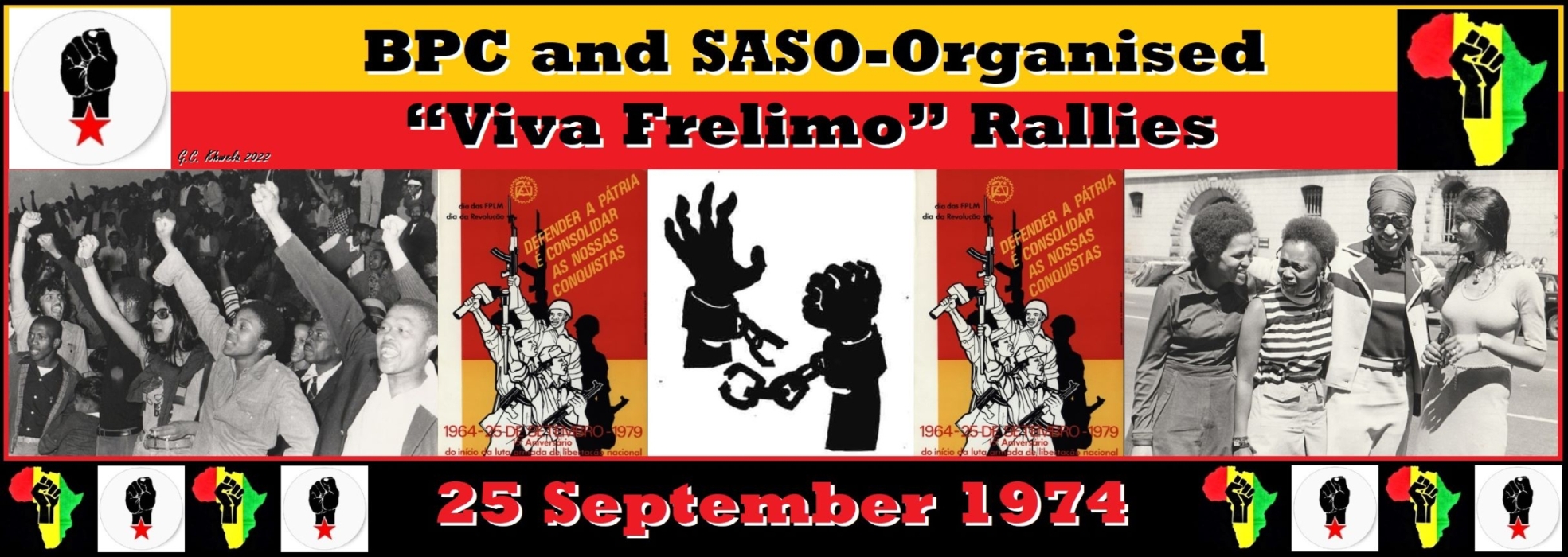
On 25 September 1974, “Viva Frelimo” rallies were held in Durban and Turfloop inspired by the establishment of an Interim Authority towards the achievement of independence in Mozambique. These rallies were organised by South African Black Consciousness Movement organisations, the Black People’s Convention (BPC), the South African Students’ Organisation (SASO) and the Black Allied Workers’ Union (BAWU). The intention was to highlight that if Portuguese colonialism could be defeated in Mozambique, so could apartheid-colonialism in South Africa.
The idea was conceived by the SASO Secretary General at the time, Muntu Myeza who released a press statement on 9 September 1974, acclaiming the successes of FRELIMO (“Front for the Liberation of Mozambique”, which fought to achieve the independence of Mozambique) and congratulating them on their imminent assumption of power. The statement in which it was said, for “black South Africans”, the victory of FRELIMO was “a revelation that every bit of Africa shall be free … The dignity of the Black Man has been restored in Mozambique, and the white people are turning out to be what they truly are – violent people”.
Following the release of this statement, Myeza discussed the possibility of organising a rally with Saths Cooper – an activist associated both with SASO and the BPC. Subsequently, both Myeza and Cooper approached other leaders and on 15 September 1974 the representatives of SASO, the BPC and BAWU met in Durban and came to an agreement to coordinate multiple rallies across the country, with the aim of celebrating FRELIMO’s victory. These rallies resulted in the acceleration of tensions between these organisations and the apartheid South African government. Consequently, the apartheid Minister of Justice, Jimmy Kruger, banned the rally planned for 25 September 1974. However, much publicity had already gone out, and the image of the Black Consciousness Movement was at stake.
Despite the banning order, on 21 September 1974, Myeza publicly announced that SASO would hold rallies on 25 September 1974 and these rallies were intended, he said, “to show our solidarity with the people of Mozambique who have been freed by FRELIMO”. Myeza also said that FRELIMO leaders would be asked to address the rally in Durban. On the day of the rally people turned up in large numbers, at the Curries Fountain stadium, in Durban, and at Turfloop, the University of the North campus. However, on the morning of 25 September, with police being deployed at these venues, it became clear that these rallies had indeed been banned, and the organisers were faced with the problem of what to do with the people who had turned up as invited. Those arrested and charged for organising the rallies were subsequently charged under the Terrorism Act.
After breaking up two pro-FRELIMO demonstrations, the police began a nationwide wave of arrests, searches and interrogations. The police activity was aimed primarily at the SASO and the BPC, two groups that had provided at least a faint voice for discontented urban activists during those years. The birth of the Black Consciousness Movement (BCM) in South Africa played out against the backdrop of the Pass Resistance Campaign, the Sharpeville Massacre, the banning of the South African Communist Party (SACP), the Pan Africanist Congress (PAC) and the African National Congress (ANC). The end of the Rivonia Trial in June 1964 heralded a discernible hiatus in the politics of resistance. The subsequent establishment of SASO in 1968, followed by the creation of the Black Community Programmes (BCP) in 1972, could be seen as a response to these political doldrums.
The organisers of the rally in Durban had misleadingly announced that FRELIMO speakers would be present to take part in the process. However, days before the rally, the organisers, who were only just beginning their publicity campaign, decided to try and arrange for FRELIMO speakers. Accordingly, Harri Singh, Nkwenkwe Nkomo and Haroon Aziz were sent to Lourenco Marques to engage with FRELIMO for speakers at their rally. Nevertheless, the trip became a fiasco, as they returned empty handed on the morning of the rally. People were looking forward to representatives of the FRELIMO-led Interim Government in Mozambique, which provided inspiration to black militants within the Black Consciousness Movement.
As a result of a pamphlet issued by Muntu Myeza, the media got to hear of the coming of FRELIMO speakers, and on Monday, 23 September 1974, the papers carried stories that SASO were smuggling FRELIMO speakers into the country. This was bound to inflame the apartheid government’s indignation, which perceived the new government of Mozambique as nothing more than “a set of terrorists”. The mention that FRELIMO was to form part of the rallies caused the apartheid government to panic. On Tuesday, 24 September, The World newspaper carried a report saying that a SASO spokesperson in Durban had claimed that four FRELIMO leaders were already in South Africa.
Apparently, Muntu Myeza was at this point intentionally vague in his dealings with the press, implying that the FRELIMO leaders were already in Durban and this rumour fanned the flames of fear within the apartheid establishment. Following the banning of the rallies by the apartheid Justice Minister Kruger, BPC and SASO issued a joint statement on the night of 24 September, which said, “We are not aware of any banning. We couldn’t care less if it is banned. We are going ahead at all costs with all the rallies nationally. The People’s Will shall not be suppressed by a foreign settler regime.” Later, Myeza told Nat Serache of the Rand Daily Mail that “We are going ahead with the rallies nationally … these fools, they cannot tell us what to do, man”.
The English‐language press, meanwhile, continued to protest over that weekend about the arrest of John O’Malley, the editor of The Daily News newspaper of Durban, which had reported that the organisers of the pro-FRELIMO rally would go ahead with the demonstration after it had been prohibited. Apartheid government officials said this constituted illegal advertising of a banned meeting; and O’Malley was arrested and was later released on bail following fellow editors signing a petition of protest that called the affair an attempt to intimidate the press. Even some of the Afrikaans — language papers, which generally supported the apartheid government, called the treatment of O’Malley an overreaction.
At Curries Fountain, however, the rally turned out to be a non-event, for the police charged the crowd just after Muntu Myeza’s arrival, dispersing them from the venue, thus averting the rally from taking place. An apartheid police officer, Colonel Jordaan, ordered the crowd to disperse just before Myeza arrived to an enthusiastic welcome. According to Myeza, and a number of eyewitnesses, he tried to lead a good-natured crowd away from Curries Fountain. However, the apartheid police maintained that there was an aggressive attempt to enter the stadium. Muntu Myeza was, in any event, at Curries Fountain for less than five minutes, and the crowd dispersed quickly once the police took action.
At Turfloop, on the other hand, it was the events subsequent to the rally that created alarm, as opposed to the situation in Durban, where the anticipation of the rally was the cause of the problem. On the morning of the rally, the campus in Turfloop was covered with posters, some of which used “extreme” language. Apparently, the university authorities were not worried by the rally, and indeed, Nefolovhodwe confirmed that the Rector had told them that the rally could go ahead, provided that there was no interference with morning lectures. However, when the meeting began, the apartheid police arrived, with the brief that it was a SASO meeting designed to inflame the relationship between blacks and whites. The police ordered the meeting to disperse, but when students gathered on the grass outside, the police charged.
The students responded by throwing stones and thus the conflict intensified. The police claimed that the stones were thrown before they had charged, yet it was clear that when they charged, the Students’ Representative Council (SRC) was trying to negotiate with them and to get the students to return to their hostels. The police had arrived fully prepared for trouble, having collected a large force at Mankweng Police Station that was mustered from far flung areas such as Messina and Phalaborwa, with the white policemen armed with revolvers and shotguns. The police charge was swift and effective. As a result, three people were arrested, and others were injured. The situation seemed very inflamed, but after a discussion between the SRC, the Black Staff Association, the Rector and the police, the latter agreed to withdraw.
In the afternoon, after calm had returned, various white staff members who arrived on campus later in the day, were attacked by students. Conflict continued during the night resulting in some white staff members being injured. The day after the rally, the Disciplinary Committee of the university met, wherein the SRC denied any responsibility for the violent posters, the graffiti on the walls and the attacks on white staff.
On 27 September, the university closed for a short vacation, which was extended to 15 October because of a threatened student sit-in over the disciplinary issue. Meanwhile, however, arrests were undertaken – Pandelani Nefolovhodwe, the National President of SASO, on 27 September, and Gaborone Sedibe, President of the Turfloop SRC on 11 October – and this escalated tensions. Following a march to Mankweng Police Station on 15 October, to demand the release of the SRC President, one of the leaders of the march, Cyril Ramaphosa, the SASO local Chairperson, was himself arrested under the Terrorism Act.
When 43 members of SASO were arrested in 1974 for planning these rallies, Brigitte Mabandla was one of them. During her arrest she was tortured by the Security Branch and was barred from seeing her five-month-old baby. Vino Reddy of the BCP was also arrested while trying to assist a man who was being bitten by a dog at the Curries Fountain rally in Durban. She was taken to the Smith Street Police Station and charged with leading a Riotous Assembly and held in a cell for 48 hours under the General Law Amendment Act. On the evening of 27 September 1974, the Security Police arrived and informed her that she was detained under Section 6 of the Terrorism Act.
Of those arrested, only nine were charged for organising the rallies and for terrorism – according to apartheid’s definition – and these were: Sathasivan Saths Cooper, who was Public Relations Officer of the BPC until his banning order in March 1973; Lindani Muntu Myeza, Secretary General of SASO; Mosioua “Terror” Lekota, Permanent Organiser of SASO; Aubrey Maitshe Mokoape, a founder member of BPC; Nkwenkwe Nkomo, Chairman of the Daveyton Branch of BPC; Pandelani Nefolovhodwe, the National President of SASO; Gaborone Sedibe, President of the Turfloop SRC; Nyangana Zithulele Absolom Cindi, Secretary General of BPC; and Strini Moodley, former Publications Director of SASO.
During their trial, in 1976, Steve Biko was called by the defence, as a leader of the Black Consciousness Movement, to give testimony about the Black Community Programmes (BCP), since the defendants were charged with organising the Viva Frelimo rally in Durban and in Turfloop, and were subsequently charged under the Terrorism Act. Biko explained how black people tended to alienate themselves through self-rejection as they believed that only that which is white is good. Moreover, Biko also explained the nature of the oppression of black people through heavy working conditions, through poor wages, poor education and poor living conditions.
When judgment was handed down on 15 December 1976, it became apparent that Judge Boshoff’s social prejudices on matters of fundamental assumption had swung the case for the prosecution. The judge concluded that, “Considered in its totality, the method used was designed to foster hostility between the races, and thus to create amongst the blacks a hostile power bloc orientated for action, more particularly for political violence.” In his conclusion, the judge found that the rallies had succeeded in bringing together a group of persons of sufficient size and cohesiveness, sufficiently orientated towards action, as to endanger law and order. These acts, he said, “had and were also likely to have had at Durban and Turfloop the result of encouraging forcible resistance to the government on the part of all the persons who attended the rallies … of causing serious bodily injury and of endangering the safety of persons attending the rallies, or persons enforcing the law.”
The lengthy trial of nine leaders from the Black People’s Convention (BPC) and the South African Students’ Organisation (SASO) ended with all accused being found guilty under the Terrorism Act and sentenced to periods of imprisonment, three for six years and six for five years. Seven out of the nine men, which excluded Cindi and Moodley, were convicted of terrorism for planning rallies that never took place, and where the police had always been in full control. The next day, all nine of them were driven from Pretoria to Cape Town in the back of a police van, and from there taken to Robben Island. Following these arrests, after the Soweto June 1976 Uprisings, most remaining activists either fled into exile or refocused their activities on the new civics or the emerging trade union movement.
In 1974 FRELIMO became a rallying point among the young who strove to bolster black pride and the spirit of black power and also provided students and activists in the Black Consciousness movement with the opportunity to experiment with new forms of protest and confrontation. At a time of despondency, the Frelimo victory over Portuguese colonialists proved to SASO and other Black Consciousness organisations that black people could overcome colonial dominance. These developments were crucial in the battle against the psychological defeat of the black person who not only was unsure about his blackness but also despised it. The example of what was achieved in Mozambique clearly demonstrated that with the right programme and will, victory was certain. These events also showed that the oppressed black people could shirk colonialism and restore hope.
Sources:
Wikipedia.
South African History Online (SAHO).
Truth and Reconciliation Commission, “Truth and Reconciliation Commission of South Africa Report, Vol. 2”, Truth and Reconciliation Commission (TRC), 29 October 1998.
Truth and Reconciliation Commission, “Truth and Reconciliation Commission of South Africa Report, Vol. 3”, Truth and Reconciliation Commission (TRC), 29 October 1998.
Rod Amner, “Black Community Programmes: From Ideas to Action”, Tricontinental: Institute for Social Research, 3 October 2021.
Charles Mohr, “South Africa Is Arresting Black Militants”, The New York Times, 1 October 1974.
Vuyisile Msila, “Chissano to Honour Biko’s Great Legacy”, Pretoria News, 10 November 2015.
Saths Cooper, “Facing the Enemy”, Post, 21 December 2016.
Zaza Hlalethwa, “BCM Women Led from the Front”, Mail & Guardian, 24 August 2018.
Mwelela Cele, “Steve Biko Spearheaded Black Community Programmes in SA that Transformed Theory into Uplifting Practice”, Daily Maverick, 12 September 2022.
Michael Lobban, “Black Consciousness on Trial: The BPC/SASO Trial, 1974-1976”, African Studies Seminar Paper No. 276, African Studies Institute, University of the Witwatersrand, August 1990.
Julian Brown, “An Experiment in Confrontation: The Pro-Frelimo Rallies of 1974”, Journal of Southern African Studies, Vol. 38, No. 1, 2012.
Gregory Houston, et. al, “The National Liberation Heritage Route”, Paper Presented at the Human Sciences Research Council’s Social Sciences and Humanities Conference, Birchwood Conference Centre, Johannesburg, 26-27 September 2013.
Gregory Houston, et. al, “The Liberation Struggle and Liberation Heritage Sites in South Africa”, Democracy, Governance, and Service Delivery (DGSD), Human Sciences Research Council (HSRC), 15 November 2013.
Gregory Houston, et. al, “Transcripts of Interviews with Unsung Heroes and Heroines of the South African Liberation Struggle, Vol. 1”, Democracy, Governance, and Service Delivery (DGSD), Human Sciences Research Council (HSRC), 23 March 2015.
Castro Khwela
Good evening fellow Compatriots!
Discover more from CASTRO KHWELA
Subscribe to get the latest posts sent to your email.