Culture and the National Struggle
“The point is that, as (Vladimir Ilyich) Lenin pointed out, in every culture there are to be found progressive elements which can be harnessed to progressive aims. It is here that the cultural workers such as writers and other artists can play a big role, because they are working in the area of culture where it is possible consciously to introduce new ways of thinking and perceiving. Because in their work the writers can look at the present day in terms of the past and also show, in the realm of the imagination, a new and different future, they play a vital role in cultural transformation.
“This is what is meant when the President of the ANC, Comrade OR Tambo, describes the cultural workers as the ‘midwives of the future’.
“A song or a poem can make us feel how it will be to live in a free South Africa, even before such a thing is a reality. And a writer or artist can show people how to ‘re-think’ their own past, bringing out what is positive and progressive and consigning to the shadows those attitudes and values that are opposed to change, or that stand in the way of a unified cultural identity on the lines indicated in the Freedom Charter.
“Let us take three examples from three different cultural traditions. In his Zulu epic ‘Emperor Shaka the Great’ Mazisi Kunene rewrites the story of Shaka to bring out the progressive aspects of that great African ruler. In his novels about the history of the Western Cape, the Afrikaans novelist Jan Rabie reinterprets the relations between the trekkers, their slaves and the Khoi people. And in her novel ‘Burger’s Daughter’, Nadine Gordimer, writing in the English tradition, tries for the first time to take into account the history and contribution to the national life of the liberation movement and the Communist Party.
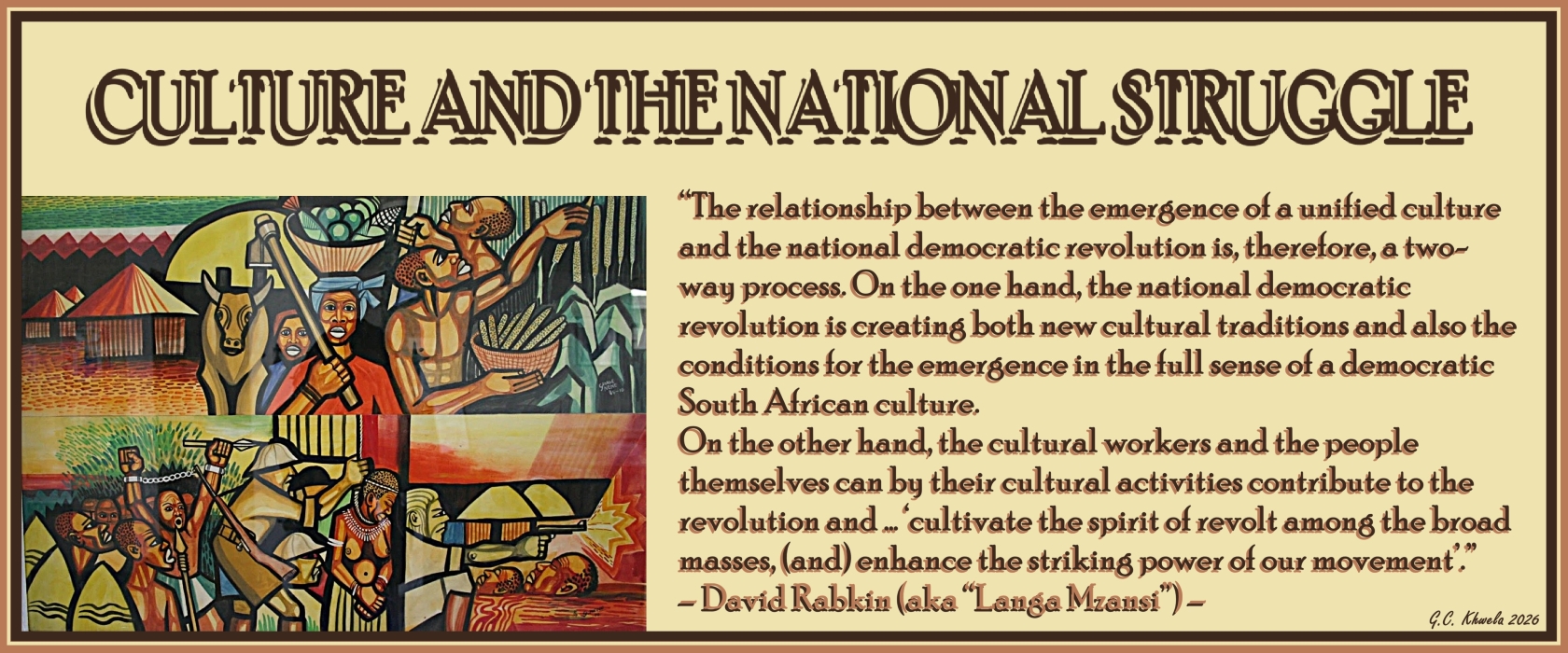
“The relationship between the emergence of a unified culture and the national democratic revolution is, therefore, a two-way process. On the one hand, the national democratic revolution is creating both new cultural traditions and also the conditions for the emergence in the full sense of a democratic South African culture.
“On the other hand, the cultural workers and the people themselves can by their cultural activities contribute to the revolution and, as Comrade Tambo puts it, ‘cultivate the spirit of revolt among the broad masses, (and) enhance the striking power of our movement’.
“Or, in the words of (Amilcar) Cabral: ‘A reciprocal relationship between culture and the struggle develops. Culture, as a foundation and source of inspiration, begins to be influenced by the struggle; and this influence is reflected more or less clearly in the changing behaviour of social categories and individuals, as well as in the development of the struggle itself.’”
– David Rabkin (aka “Langa Mzansi”) –
(1948 – 22 November 1985)
(Extracts from an article by David Rabkin, “Culture and the National Struggle”, The African Communist, No. 105, Second Quarter 1986, pp. 49 – 55. David Rabkin passed on in a training accident in Pango Camp, Angola, 22 November 1985).
Castro Khwela
Good morning fellow Compatriots!🙏🏾✊🏾👊🏾
Discover more from CASTRO KHWELA
Subscribe to get the latest posts sent to your email.