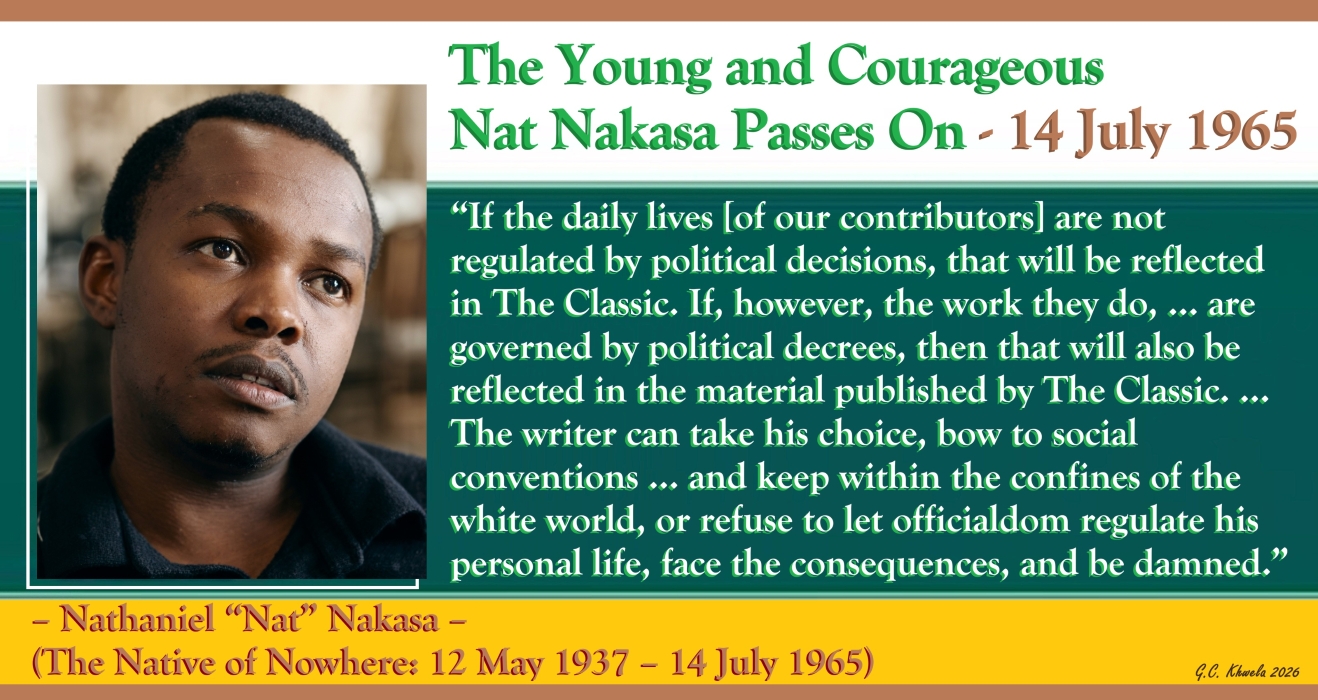
The Young and Courageous Nat Nakasa Passes On
On 14 July 1965, the highly influential anti-apartheid and non-racialism champion journalist and writer, Nathaniel Nat Nakasa, tragically died at the age of 28 after falling from a high-rise building in New York. Nakasa was stripped of his citizenship by the apartheid government to take up a Nieman Fellowship at Harvard. Nathaniel “Nat” Nakasa was denied a passport by the apartheid regime because his high-profile journalism openly exposed racial atrocities, defied state censorship, and directly threatened the government’s narrative of racial segregation.
Internal state security documents revealed that authorities feared his sharp, cross-racial writings would “stimulated disaffection and unrest among the Bantu population”. He was ultimately forced to accept a one-way exit permit to attend the Nieman Fellowship at Harvard University, rendering him a stateless exile. As a prominent reporter and assistant editor for Drum Magazine, Nakasa belonged to a legendary generation of black writers who used satire, investigative journalism, and vivid urban storytelling to capture the reality of black lives under apartheid.
Born into a working-class family, he overcame poverty-induced disruptions to his education to become the first Black columnist for a major white daily newspaper and the founder of a groundbreaking literary journal. Nathaniel “Nat” Ndazana Nakasa was born on 12 May 1937 in Chesterville, a township informally known as “Blackass”, just outside Durban, Natal. He was born to Alvina, a teacher, and Chamberlain Nakasa, a typesetter and writer. Growing up with parents in education and print media heavily shaped his passion for literacy and writing. Nakasa attended the Zulu Lutheran High School (a mission school) located in Eshowe, Zululand and successfully completed his Junior Certificate there.
However, due to severe financial hardships and poverty, he was forced to leave school in 1954 at the age of 17 without obtaining his formal matriculation. He then developed his legendary voice at age 17, as a junior reporter for ‘Ilanga Lase Natal’, a prominent weekly Zulu-English newspaper founded by John Langalibalele Dube. This is where he first mastered the basics of news reporting. Looking for a larger platform, he moved to Johannesburg in 1957 where he wrote for the and Golden City Post. He was quickly scouted by the legendary, widely circulated Drum Magazine. Working alongside icons like Can Themba and Lewis Nkosi, Nakasa sharpened his signature style of ironic, sharp, and highly humanising urban prose. He rapidly rose to become Drum’s assistant editor.
By 1963, his prominence peaked. He launched ‘The Classic’, a non-racial literary quarterly to foster Black creative talent. Simultaneously, in 1964 he began his historic weekly column “As I See It” for the white-read ‘Rand Dail Mail’, fully establishing him as a top-tier national intellectual. As the first black columnist for the leading white, liberal anti-apartheid newspaper, the ‘Rand Dail Mail’, writing for a predominantly white readership Nakasa directly challenged white complacency by humanising the black South African experience and critiquing the regime’s daily injustices.
Defying state efforts to suppress black intellectual expression, Nakasa had founded ‘The Classic’ in 1963, a groundbreaking literary quarterly that was the first in sub-Saharan Africa dedicated to showcasing black writers, preserving a counter-archive against state propaganda. While the apartheid state sought to keep races strictly separated, Nakasa’s writing championed a unified, non-racial South African identity. His ability to navigate and critique both black townships and elite white circles made him a uniquely dangerous intellectual voice to a regime built entirely on forced segregation.
When Nakasa was awarded the prestigious Nieman Fellowship in 1964, he expected little trouble because he was a journalist rather than a political militant. However, the government saw his international recognition as a threat. By refusing his passport, they presented him with a brutal ultimatum: abandon the opportunity or sign a one-way exit permit. He chose the permit, stripped of his citizenship, and tragically died by suicide in New York just a year later at age 28, famously mourning his status as a “native of nowhere”.
The apartheid regime feared Nat Nakasa because his writing was deeply humanising, intellectual, and unaligned with state-enforced racial boundaries. While the state could easily dismiss angry, overt political rhetoric as subversion, Nakasa’s style was far more elusive and dangerous to their ideology. Nakasa mastered a sophisticated, ironic prose style. He frequently treated the bureaucracy of apartheid – like the absurdity of pass laws and race classifications – as bizarre “material curiosities”. This stripped the regime of its terrifying authority by exposing its logical flaws and hypocrisies.
Rather than leaning heavily on theoretical propaganda, he wrote intensely personal, autobiographical journalism that captured the mundane, vibrant texture of everyday black township life. By humanising black citizens to the white readership of the ‘Rand Dail Mail’, he eroded the psychological foundation of apartheid: the myth that the races were fundamentally distinct and unequal. Nakasa completely rejected the segregation framework, famously writing, “My people are South Africans. Mine is the history of the Great Trek… and the dawn raids”. His insistence on a single, shared South African identity directly undermined a regime attempting to balkanise the population into isolated ethnic homelands.
Unlike many activists, Nakasa was not a member of any liberation party. The apartheid government viewed an independent Black intellectual who commanded respect across racial lines and international boundaries as an unmanageable wild card that threatened their tight grip on the flow of information. His tragic death in exile at age 28 transformed him into a powerful symbol of the psychological toll exacted by statelessness and institutionalised oppression. His structural impact, however, left a lasting blueprint for writers across various regions.
His name is immortalised in the annual Nat Nakasa Award for Courageous Journalism, South Africa’s premier media accolade for journalists who display exceptional bravery, integrity, and commitment to the public interest despite severe risks. By proving that a Black journalist could write a mainstream column for a white audience without compromising his integrity, Nakasa paved the way for future generations of Black South African columnists, investigative reporters, and media executives. Through his creation of ‘The Classic’, South Africa’s first Black-edited literary quarterly, he established a “counter-archive” to state censorship. He demonstrated to future generations that when mainstream channels suppress your voice, you must build your own platforms to preserve your culture.
‘The Classic’ did not limit itself to South Africa; it actively sought and published writers from across sub-Saharan Africa. Nakasa’s legacy inspired post-colonial African writers to recognise literature as an interconnected, continent-wide vehicle for liberation and self-definition. Alongside his peers, Nakasa helped craft a distinct, modern African literary voice that blended American cultural influences, such as jazz and the Harlem Renaissance, with local street slang and folklore. This hybrid style broke away from colonial literary constraints and heavily influenced subsequent generations of urban African writers.
Nakasa’s famous self-description as a “native of nowhere” became a cornerstone concept for diasporic literature. His struggles with displacement, loss of identity, and homesickness are widely cited by modern writers exploring the psychological complexities of the African diaspora. During his brief time in the United States, Nakasa immediately plugged into diasporic networks, writing for The New York Times and collaborating on a biography with Miriam Makeba. He proved that the struggle for African freedom was intimately linked to global civil rights movements, leaving a legacy of intellectual solidarity that bridges Africa and its diaspora to this day.
Nat Nakasa died on 14 July 1965 after falling from a high-rise window in New York City. The official clinical cause of his death was listed as multiple fractures and internal injuries sustained from a fall from a height. While investigators officially ruled his death a suicide, the broader consensus among historians and his peers is that he was ultimately driven to take his own life by the psychological trauma of forced apartheid exile. On the morning of his death, 28-year-old Nakasa was staying at the Central Park West apartment of his friend, Jack Thompson. He plunged from the seventh-floor window of the apartment and was rushed to Harlem’s Knickerbocker Hospital, where he was pronounced dead.
Because the South African government refused him a passport, Nakasa had to sign a one-way exit permit to take up his Nieman Fellowship at Harvard. This meant he was stripped of his South African citizenship and legally barred from ever returning home. As his visa drew closer to expiration, the reality of being a permanently stateless person—a “native of nowhere” – deeply tormented him. In the weeks leading up to his death, Nakasa suffered from intense homesickness, isolation, and financial stress. He turned to heavy drinking and confessed to his close friend, the author Nadine Gordimer, that he felt he was losing his mind.
Two days before his death, he despondently told a friend, “I can’t laugh any more, and when I can’t laugh, I can’t write”. Because of the brutal tactics used by the apartheid regime to silence dissidents abroad, some of Nakasa’s contemporaries openly questioned the suicide verdict at the time, speculating whether he might have been pushed or assassinated. However, no evidence was ever found by the New York Police Department to support foul play. For 49 years, Nakasa lay buried at Ferncliff Cemetery in New York, near the grave of Malcolm X. In 2014, the South African government successfully negotiated the repatriation of his remains. He was finally brought home and reburied in Heroes’ Acre in “Ezinkawini”, Chesterville, Durban, symbolising an official end to his statelessness.
Sources:
Wikipedia.
South African History Online (SAHO).
Essop Patel (Ed.), “The World of Nat Nakasa”, Ravan Press, 1975.
Staff Reporter, “The Legacy of Nat Nakasa”, Mail & Guardian, 19 July 2006.
Ryan Lenora Brown, “A Native of Nowhere: The Life of South African Journalist Nat Nakasa, 1937-1965”, Kronos, Vol. 37, No.1, January 2011.
Tiisetso Makube, “Nat Nakasa: Writing to the Beat of a Different Drum”, Mail & Guardian, 26 June 2014.
Fatima Asmal, “‘Welcome Back Home’ – The Return of Nat Nakasa”, Mail & Guardian, 20 August 2014.
SA Government, “Opportune Time to Tell Our Stories of Freedom”, South Africa Government Communications, 2 September 2014.
Matt Keaney, “The Resurrection of Nat Nakasa”, Africa is a Country, 13 September 2014.
Forbes Africa, “The Native of Nowhere Is Home”, Forbes Africa, 1 October 2014
Cedric Van Dijck, “Out of Africa: Nat Nakasa’s Exit Paperwork”, Open Library of Humanities, Vol. 11, No. 1, 2025.
Estelle Bester, “Finding the Grave of Nat Nakasa in New York”, The Heritage Portal, 4 March 2025.
Castro Khwela
Good evening fellow Compatriots!🙏🏾✊🏾👊🏾
Discover more from CASTRO KHWELA
Subscribe to get the latest posts sent to your email.