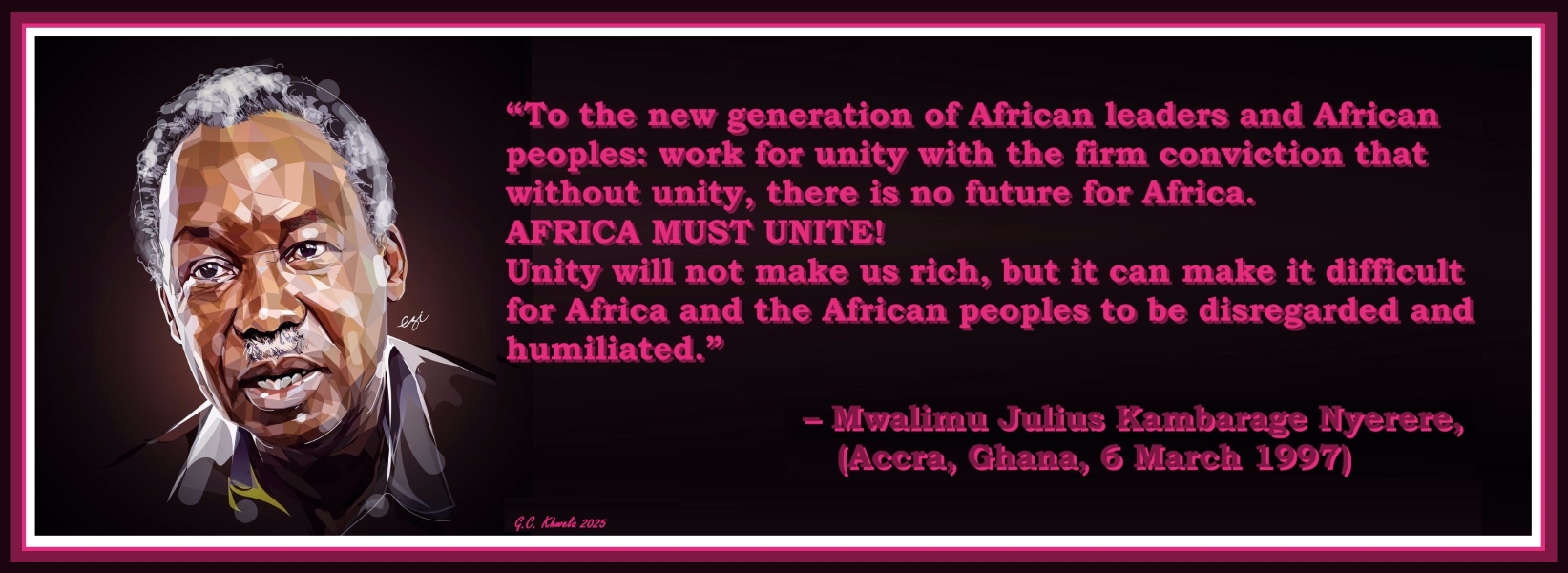
(Extracts from a speech given by Tanzania’s founding president, Mwalimu Julius Kambarage Nyerere, in the Ghanaian capital, Accra, on 6 March 1997)
For centuries, we had been oppressed and humiliated as Africans. We were hunted and enslaved as Africans, and we were colonised as Africans. The humiliation of Africans became the glorification of others. So we felt our Africanness. We knew that we were one people, and that we had one destiny regardless of the artificial boundaries which colonialists had invented.
Since we were humiliated as Africans, we had to be liberated as Africans. So 40 years ago, we recognised [Ghana’s] independence as the first triumph in Africa’s struggle for freedom and dignity. It was the first success of our demand to be accorded the international respect which is accorded free peoples. Thirty-seven years later – in 1994 – we celebrated our final triumph when apartheid was crushed and Nelson Mandela was installed as the president of South Africa. Africa’s long struggle for freedom was over.
… in May 1963, 32 independent African states met in Addis Ababa, founded the Organisation of African Unity (OAU), and established the Liberation Committee of the new organisation, charging it with the duty of coordinating the liberation struggle in those parts of Africa still under colonial rule. The following year, 1964, the OAU met in Cairo [Egypt]. The Cairo Summit is remembered mainly for the declaration of the heads of state of independent Africa to respect the borders inherited from colonialism.
In 1965, the OAU met in Accra [Ghana]. … The founding fathers of the OAU had set themselves two major objectives: the total liberation of our continent from colonialism and settler minorities, and the unity of Africa. The first objective was expressed through immediate establishment of the Liberation Committee by the founding summit [of 1963]. The second objective was expressed in the name of the organisation – the Organisation of African Unity.
… What the founding fathers – certainly a hardcore of them – had in mind was a genuine desire to move Africa towards greater unity. We loathed balkanisation of the continent into small unviable states, most of which had borders which did not make ethnic or geographical sense. … Nkrumah was opposed to balkanisation as much as he was opposed to colonialism in Africa. To him and to a number of us, the two – balkanisation and colonialism – were twins. Genuine liberation of Africa had to attack both twins. A struggle against colonialism must go hand in hand with a struggle against the balkanisation of Africa.
Kwame Nkrumah was the great crusader of African unity. He wanted the Accra Summit of 1965 to establish a union government for the whole of independent Africa. But we failed. … The major reason was … already too many of us had a vested interest in keeping Africa divided. … we of the first generation leaders of independent Africa have not pursued the objective of African unity with the vigour, commitment and sincerity that it deserved.
With our success in the liberation struggle, Africa today has 53 (54 now with South Sudan’s independence in 2011) independent states, 22 more than those which met in Addis Ababa in May 1963. If numbers were horses, Africa today would be riding high! Africa would be the strongest continent in the world, for it occupies more seats in the UN General Assembly than any other continent. Yet the reality is that ours is the poorest and weakest continent in the world. And our weakness is pathetic. Unity will not end our weakness, but until we unite, we cannot even begin to end that weakness. … TO THE NEW GENERATION OF AFRICAN LEADERS AND AFRICAN PEOPLES: WORK FOR UNITY WITH THE FIRM CONVICTION THAT WITHOUT UNITY, THERE IS NO FUTURE FOR AFRICA.
I reject the glorification of the nation-state [that] we inherited from colonialism, and the artificial nations we are trying to forge from that inheritance. We are all Africans trying very hard to be Ghanaians or Tanzanians. Fortunately for Africa, we have not been completely successful. The outside world hardly recognises our Ghanaian-ness or Tanzanian-ness. What the outside world recognises about us is our African-ness.
… ACCEPTING THE FACT THAT WE ARE AFRICANS, GIVES YOU A MUCH MORE WORTHWHILE CHALLENGE THAN THE CURRENT DESPERATE ATTEMPTS TO FOSSILISE AFRICA INTO THE WOUNDS INFLICTED UPON IT BY THE VULTURES OF IMPERIALISM. Do not be proud of your shame. Reject the return to the tribe, there is richness of culture out there which we must do everything we can to preserve and share.
But it is utter madness to think that if these artificial, unviable states which we are trying to create are broken up into tribal components and we turn those into nation-states, we might save ourselves. That kind of political and social atavism spells catastrophe for Africa. It would be the end of any kind of genuine development for Africa. It would fossilise Africa into a worse state than the one in which we are.
THE FUTURE OF AFRICA, THE MODERNISATION OF AFRICA THAT HAS A PLACE IN THE 21ST CENTURY IS LINKED WITH ITS DECOLONISATION AND DETRIBALISATION. Tribal atavism would be giving up any hope for Africa. And of all the sins that Africa can commit, the sin of despair would be the most unforgivable. Reject the nonsense of dividing the African peoples into Anglophones, Francophones, and Lusophones. This attempt to divide our peoples according to the language of their former colonial masters must be rejected with the firmness and utter contempt that it richly deserves.
… A new generation of self-respecting Africans should spit in the face of anybody who suggests that our continent should remain divided and fossilised in the shame of colonialism, in order to satisfy the national pride of our former colonial masters. … AFRICA MUST UNITE! … TOGETHER, WE, THE PEOPLES OF AFRICA WILL BE INCOMPARABLY STRONGER INTERNATIONALLY THAN WE ARE NOW WITH OUR MULTIPLICITY OF UNVIABLE STATES. The needs of our separate countries can be, and are being, ignored by the rich and powerful. The result is that Africa is marginalised when international decisions affecting our vital interests are made.
UNITY WILL NOT MAKE US RICH, BUT IT CAN MAKE IT DIFFICULT FOR AFRICA AND THE AFRICAN PEOPLES TO BE DISREGARDED AND HUMILIATED. And it will, therefore, increase the effectiveness of the decisions we make and try to implement for our development. My generation led Africa to political freedom. The current generation of leaders and peoples of Africa must pick up the flickering torch of African freedom, refuel it with their enthusiasm and determination, and carry it forward.
– Mwalimu Julius Kambarage Nyerere, (Accra, Ghana, 6 March 1997)
Castro Khwela
Good morning fellow Compatriots!🙏🏾✊🏾👊🏾
Discover more from CASTRO KHWELA
Subscribe to get the latest posts sent to your email.