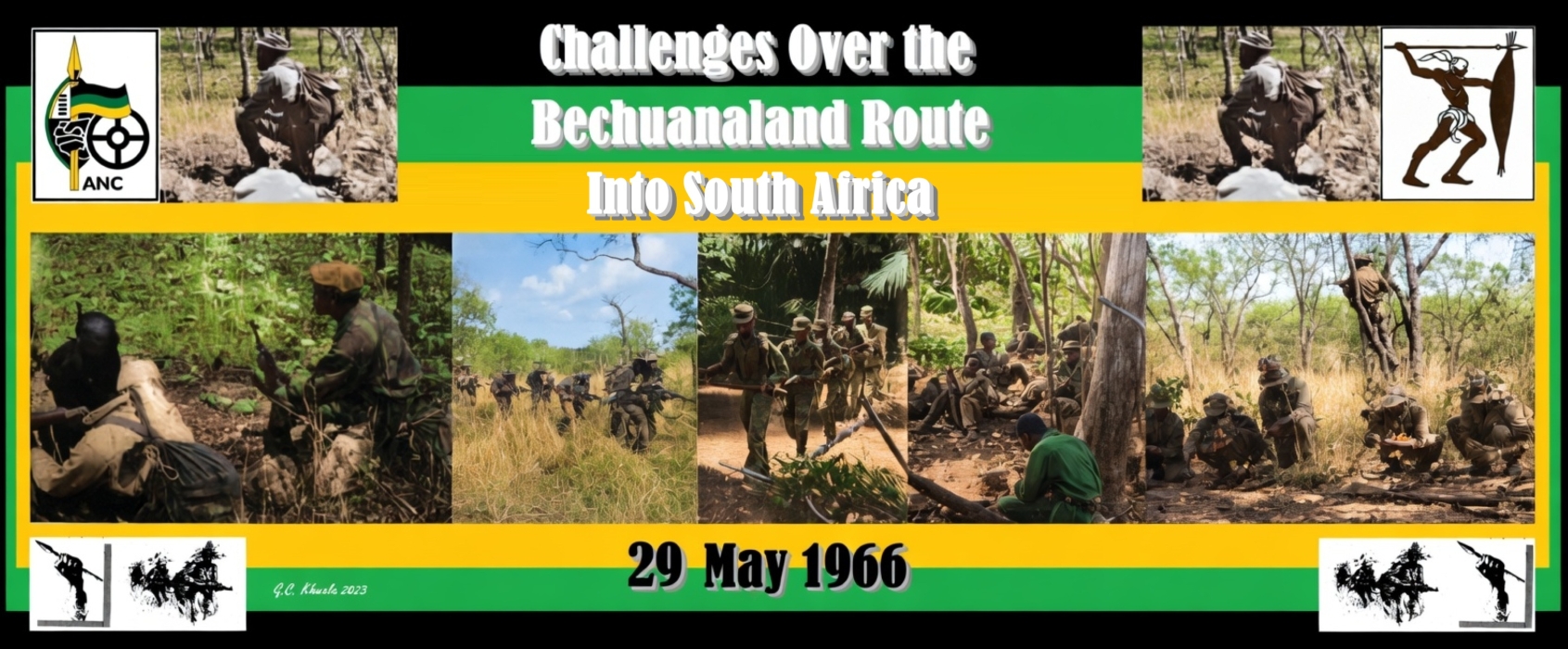
Challenges Over the Bechuanaland Route Into South Africa
Exactly sixty years ago, on 29 May 1966, Mack Futha, an Umkhonto we Sizwe (MK) operative, was deported to Zambia, which implied that his mission to establish a pipeline into South Africa through Bechuanaland was proven to be abortive. The day before, on 28 May 1966, Futha, was brought in for questioning in Francistown by a Bechuanaland Special Branch Officer, after he had survived arrest three days before, on 25 May, in Maun, when he disembarked from a flight that had landed from Livingstone.
Following his disembarking from a Livingstone flight, Futha had produced a British passport issued in the name of Stephen Hliziyo, and completed his Declaration of Arrival Form using that name. The suspicious immigration officers took him aside and began questioning him. Futha told the officer that his reason for travelling was to see his mother in Francistown, who was staying at the house of Simeon Richard Mutshekwane, the Francistown assistant town clerk.
Being further interrogated by the immigration officers, Futha eventually admitted that he was sent to establish an infiltration route for the Zimbabwe African People’s Union (ZAPU) personnel that were seeking access into Rhodesia from Zambia, through Bechuanaland. After the confession, Futha was allowed to leave Maun, without being arrested.
On 28 May, when Futha was brought in for questioning again in Francistown by the Bechuanaland Special Branch officer, he admitted that his real identity was Mack Futha and even confessed that his mission was to organise a route to be used by trained African National Congress (ANC) combatants in Zambia that were attempting to infiltrate South Africa.
South African and Rhodesian refugees were really finding it difficult to survive under the conditions that were imposed on them by countries that had recently obtained independence in the southern African region. For example, Zambia’s policy of allowing refugees fleeing South Africa and Rhodesia to settle in or transit through the country on a conditional basis was not extended to exiles that underwent military training abroad and wanted to return home to fight. As a consequence, an accumulation of guerrilla fighters in Tanzania was becoming untenable, and this led the authorities there to impose a moratorium on further refugee entries.
On 1 February 1966, the “Rand Daily Mail” newspaper reported that Zambia’s Minister of Home Affairs, Mainza Chona, had on 30 January 1966 denied Ben Turok entry into Zambia, while he was based in Bechuanaland. Turok was not allowed to stay in Zambia since the country only accepted people that were fleeing from adjacent lands as refugees. Chona maintained that Turok could only be allowed to enter Zambia on transit, if he could prove that he was on transit to another country.
Turok had to be assisted out of the Kazungula Refugee Camp in northern Bechuanaland by Tennyson Makiwane, who drove all the way from Lusaka to collect him to a river ferry that took them across the Zambezi into Zambia. When driving northwards towards Lusaka, Turok informed Makiwane that even SWAPO (South West African People’s Organisation) refugees were experiencing several difficulties with the Khoisan (derogatorily referred to as “Bushmen”), who became easy targets for bribery by the police to give away any travelling refugees.
Another example was that of Chris Hani, on 17 February 1966, when he disembarked from a plane that had flown from Zambia to Francistown, as he was taken into custody and interrogated, when he produced a Tanzanian identity certificate issued to “Chris Nkosana” to the immigration officials. Hani claimed that the purpose of his trip was to enquire into facts surrounding Michael Dingake’s disappearance, which did not convince the immigration officials, as they felt that he appeared to display a complete lack of understanding about Dingake’s case. Within a few days, Hani was deported to Zambia and he exited Bechuanaland on a flight to Livingstone.
A month after Hani was deported to Zambia, a facility near Livingstone, called Cindes Plot, was raided by Zambian police, where they arrested Lambert Moloi and Steve Belle, while the rest of Umkhonto we Sizwe (MK) guerrillas managed to escape and returned to Lusaka in a Land Rover. Cindes Plot had housed several groups of guerrillas that had been taken from Kongwa to Morogoro.
The guerrillas who were at Cindes Plot were there to be briefed by MK Army Commander, Joe Modise, on the impending joint Wankie Campaign with the Zimbabwe People’s Revolutionary Army (ZIPRA), the armed wing of the Zimbabwe African People’s Union (ZAPU). These MK guerrillas included internal regional commanders, such as Lawrence Phokanoka (aka “Peter Tladi”), Julius Maliba (aka “Goodman Moloi”), Justice Mpanza (aka “Reuben Ntlabati”), Theophilus Mkalipi (aka “Victor Dhlamini”) and Gladstone Mose (aka “Jackson Mlenze”).
On 25 April 1966, Zambia’s restrictive refugee policy came under scrutiny from a pan-African perspective, and, as a consequence, the Zambian High Commissioner in Tanzania wrote to his Foreign Affairs Ministry regarding these concerns by the Liberation Committee of the Organisation of African Unity (OAU).
An “Action Group” of the Liberation Committee went to Lusaka to discuss the question of freedom fighters with the Zambian government, since most of the liberation movement based in Tanzania experienced difficulties when they transited Zambia en route to their home countries. Accordingly, the Liberation Committee was reluctant to provide material support to guerrillas that had returned from military training due to Zambia’s stance towards returning refugees.
The same day, on 25 April 1966, Futha had been approached by Tennyson Makiwane at a plot known as Farm B on the Old Mumbwa Road, approximately five kilometres out of Lusaka. Makiwane showed Futha a birth affidavit, which was issued by a tribal authority in Rusape, Rhodesia, with the name of Stephen, and Makiwane had replaced the surname with “Hliziyo”. He had obtained the affidavit from ZAPU, and this was to be used by Futha, who thenceforth was to be known as “Stephen Hliziyo”.
A few days later, they met again at Farm B, and Makiwane informed Futha to depart to Bechuanaland on 25 May 1966, where he was going to fly from Livingstone to Maun, and then get the first available transport to Francistown. The reason given by Makiwane for Futha not to fly directly to Francistown was to avoid police detention when he landed, as his real mission was to enduringly stay in Bechuanaland in order to establish an infiltration pipeline into South Africa.
The plan was that when Futha arrived in Maun, he was to contact Chief Letsholothebe for accommodation, then go to Mochudi to ask Chief Lentswe for permission to stay there. He was then to contact Basil Mokone and Ismail Matlaku and tell them he was sent by Makiwane, as Matlaku ran a transport service in Mochudi that would assist in establishing the route into South Africa. During his stay in Bechuanaland, Futha had to avoid Lobatse or contacting anybody from there, and the completed pipeline was to enable transporting guerrillas from the Zambian border to Francistown, where they would be taken southwards to a border crossing point that Futha had to identify.
Mack Futha was a well-trained MK combatant, who was part of a group of forty youngsters that in December 1963, were sent for training in guerrilla warfare at the Military Academy of the Soviet Union, eight kilometres east of Odessa’s Black Sea harbour. In February 1964, they were joined by Joe Modise, who became their Commander, Moses Mabhida, who was the Commissar, as well as Ronnie Kasrils, Patrick Molaoa and Michael Phoo. After they completed their training in September 1964, the group, which was then led by Eleazor Maboya, were sent to Umkhonto we Sizwe’s (MK’s) Kongwa camp, near Dodoma, in Tanzania.
The engagement of Mack Futha was a result of an incident that occurred on 24 January 1966, when the Bechuanaland Police Commissioner sent a savingram to the Senior Permanent Secretary in the Ministry of Home Affairs, regarding a visit by Tennyson Makiwane of the ANC to the Kasane Police District. According to the Commissioner, Makiwane expressed a desire to visit the Home Affairs Ministry on 28 January 1966 to discuss the possibility of obtaining large-scale employment of ANC “refugees” in Bechuanaland due to the increasing negative attitude of both Tanzania and Zambia towards South African refugees. However, the Commissioner felt that the proposed visit was not useful and thus recommended that Makiwane should be refused permission to enter Bechuanaland again.
The circumstances that national liberation movements faced in Bechuanaland were not unique, since many obstacles faced the newly independent countries in their struggle to loosen their ties with their former colonial powers. It was not only the economic and financial grip that operated as a brake on national self-determination and assertion. In many instances, important aspects of administration were still in the hands of the same people long after the foreign flag had been lowered. This was of special significance in the security services which, as history did show, could often operate as a government within a government.
With the Zambian situation, the South African Communist Party noted the following, “Many genuine political refugees from South Africa and elsewhere have often been disturbed to find that at the end of their life-and-death flight to the haven of an independent African state, they are met with hostility, or with a reception which is less than generous. In most cases the explanation is rooted in the fact that it is the same old imperialist secret police operating within the new framework, and which is both psychologically and emotionally more ready to respond to the needs of the imperialist country and the settler community than to those of independent Africa and the liberation movement”, (The African Communist, No. 27, Fourth Quarter 1966).
In Bechuanaland, from February 1965 until his arrest in December 1965, Michael Dingake was responsible for receiving MK trainees and organising infiltration routes into the country. During this period, only three cadres used this route to enter South Africa, which included Josiah Jele, McDonald Masala and Benjamin Ramotse. Around April and May 1966, ZAPU and SWAPO operatives returned to Bechuanaland to create return routes back into South West Africa and Rhodesia. This was done with the assistance of an established network inside Bechuanaland amongst the local population.
Most of the ANC and MK cadres who went through Bechuanaland had hoped that the once the country gained its complete independence, it would be led by the Bechuanaland People’s Party (BPP), which was largely led by Batswana who were sympathetic to their cause. Some of them had worked in Johannesburg and became active members of the ANC. Unlike the Bechuanaland Democratic Party (BDP), which was led King Seretse Khama, who had been in Britain making preparations to return and takeover power from the British colonial authorities in Bechuanaland.
Leaders of the BPP, such as Fish Keitseng, Mpho Motsamai and the party’s president, Ntate Motsete Mpho, had attempted to assist the national liberation movements in southern Africa, such as ZAPU, SWAPO and in particular, the ANC, to establish routes through Bechuanaland into their own countries, despite the fact that their country’s security services were still predominantly run by the British, including their police’s Security Branch. Hence, some of these attempts failed, such as those of the ANC and MK with Mack Futha, Attwell Bokwe, Chris Hani and Tennyson Makiwane being deported back to Zambia.
Sources:
Sol Dubula, “Africa: Notes on Current Events”, The African Communist, No. 27, Fourth Quarter 1966.
Gregory Houston, “The Post-Rivonia ANC and SACP Underground”, ResearchGate, January 2004.
Patrick Ricketts, “The Pipeline to Freedom: Botswana & the Liberation Struggles in Southern Africa – People, Places & Events”, 2015.
Thula Simpson, “Umkhonto we Sizwe: The ANC’s Armed Struggle”, Penguin, 2016.
Ronnie Kasrils and Fidelis Hove, “Comrade & Commander: The Life and Times of Joe Modise”, Jacana, 2024.
Sandi Sijake, “Fighting for My Country: The Testimony of a Freedom Fighter”, Jacana, 2024.
Castro Khwela
Good evening fellow Compatriots!🙏🏾✊🏾👊🏾
Discover more from CASTRO KHWELA
Subscribe to get the latest posts sent to your email.