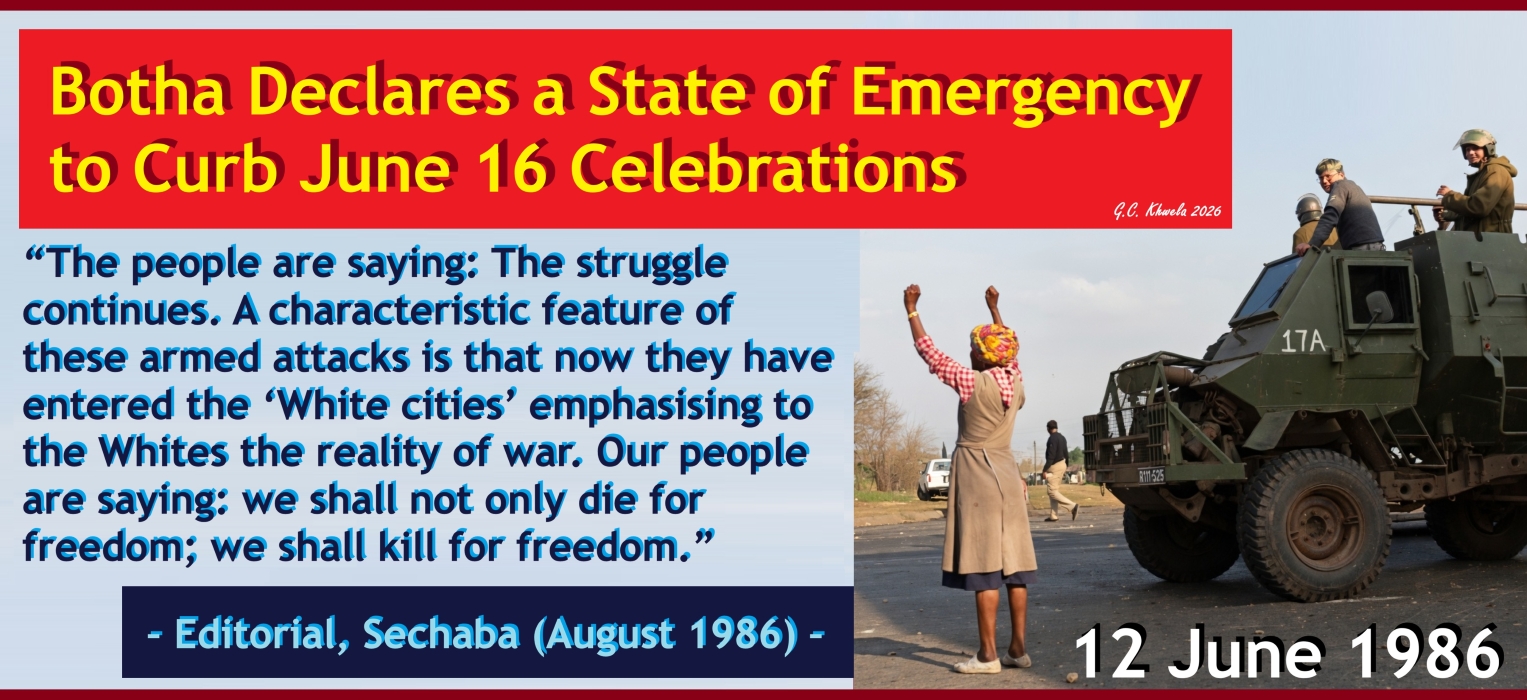
Botha Declares a State of Emergency to Curb June 16 Celebrations
On 12 June 1986, apartheid State President P.W. Botha declared a national State of Emergency to curb June 16 10th Anniversary celebrations. In an Editorial in its Official Organ, ‘Sechaba’, the African National Congress (ANC) wrote, that “The racists have been running mad since the beginning of June, or even earlier. They detained and arrested more than 4 000 people. The aim of this swoop – bigger than the post Sharpeville arrests in 1960 or the post-Soweto detentions in 1976 – was to immobilise Black opposition and then attack the leaderless Black masses. The removal of ‘agitators’ meant the arming of vigilantes – Black puppets – who caused havoc in places like Crossroads where the police were seen turning a blind eye to the attacks on the UDF (United Democratic Front) activists.
“The words ‘return to peaceful conditions’ means the use of coercion and punishment against all political opponents of the regime. This state of emergency”, the Editorial added, “is directed against political opposition and not against active unrest itself. The racist regime pinned its hopes on the belief that the state of emergency would ‘correct’ a ‘misconception’ overseas that South Africa is on the verge of a revolution. If that perception could be changed and a semblance of ‘normality’ restored to the country, then the reform process would be able to continue and relations with South Africa’s trading partners could improve. But the racist regime shot itself in the head. Internationally it is more isolated than before.”
Botha declared a nationwide National State of Emergency on 12 June 1986 primarily to crush escalating anti-apartheid uprisings, suppress a looming general strike and hide state-sanctioned police brutality from the international media. The declaration was a desperate political and military escalation designed to counter several internal and external threats to the white-minority regime. The apartheid government had gathered intelligence that massive, coordinated anti-apartheid demonstrations, marches into white suburbs, and nationwide stay-aways (strikes) were planned between 16 and 26 June 1986. These actions were organised to mark the 10th anniversary of the 16 June 1976 Soweto Uprising.
Botha implemented the decree four days early to proactively arrest activists and pre-emptively paralyse liberation networks. By mid-1986, grassroots resistance under umbrella organisations like the United Democratic Front 9 (UDF) had rendered parts of South Africa completely ungovernable. Militants and civic groups successfully boycotted municipal rents and white-owned businesses; dissolved the state-sanctioned Black Local Authorities by forcing puppet community councillors and township police to flee; and replaced government structures with localised “organs of people’s power” systems, such as street committees and people’s courts.
Botha had previously declared a partial State of Emergency in July 1985, which covered only 36 magisterial districts. This regional approach failed to halt the momentum of the liberation movement. Resistance quickly spilled over into areas not covered by the original decree, forcing the regime to implement a far more sweeping, countrywide crackdown. Under Botha’s military doctrine of “Total Strategy”, the regime epitomised all anti-apartheid resistance as a communist-backed threat (“total onslaught”) that required maximum state force.
The June 1986 decree effectively turned South Africa into a police state by granting the security forces sweeping powers, including warrantless arrests and detentions, as over 26,000 people were detained without trial over the following year. There was a Strict Media Blackout, as television cameras, local journalists, and international news crews were strictly banned from entering or filming in “unrest areas”. This effectively hid images of extreme police violence and human rights abuses from the global public, shielding the regime from further international sanctions.
The 1986 State of Emergency ultimately failed to achieve P.W. Botha’s long-term objectives. While the decree provided a temporary, violent pause in open township rebellions, it fundamentally accelerated the collapse of the apartheid regime. Botha’s strategic goals yielded a mix of short-term suppression and long-term catastrophic failure. The massive military deployment prevented the planned 10th-anniversary marches of the Soweto Uprising from reaching white suburbs. Mass detentions of over 26,000 activists and the banning of major bodies like the Congress of South African Students (COSAS) severely crippled the organisational capacity of the UDF.
Strict censorship initially succeeded in keeping footage of state-sanctioned brutality off international television screens, temporarily dampening immediate global media outrage. However, rather than crushing the liberation movement, the emergency pushed anti-apartheid groups to adopt more sophisticated, underground cellular networks. It also forced white establishment figures—including top business executives and liberal politicians—to bypass Botha entirely and begin secret talks with the exiled ANC. The blatant transformation of South Africa into a military police state backfired globally. It forced international banks to freeze South Africa’s credit lines and catalysed a massive wave of global corporate disinvestment and punishing trade sanctions.
Botha intended to clear out “radicals” so he could co-opt moderate Black leaders into his reformed, segregated political structures – like the Tricameral Parliament. Instead, the violence completely alienated moderates, leaving the state with no credible Black partners to negotiate with. By the time Botha left office in 1989, his “Total Strategy” doctrine was entirely bankrupt. The state of emergency proved that while the military could hold the townships by force, it could not deliver a lasting political or economic solution. This stalemate directly forced Botha’s successor, F.W. de Klerk, to abandon the emergency framework, unban liberation movements, and begin the transition to democracy.
For the white minority, the emergency initially brought a superficial sense of law and order, but it quickly exposed deep ideological and economic fractures. Most white South Africans, conditioned by state propaganda, welcomed the decree. They felt a sense of relief that the “unrest” was being contained outside their suburbs, trusting Botha’s narrative that the army was fighting a “total communist onslaught”. White corporate leaders and captains of industry were deeply alarmed. They recognised that the emergency was destroying South Africa’s international credit rating, prompting foreign banks to pull out. This led top white business executives to break ranks with Botha and travel to Lusaka to hold secret meetings with the exiled ANC leadership.
A growing minority of progressive white South Africans openly opposed the state. The “End Conscription Campaign” (ECC) saw an influx of young white men refusing their mandatory military service in the townships. Liberal politicians, church leaders and groups like the Black Sash actively protested the detentions. Hardline right-wing groups, such as the Afrikaner Weerstandsbeweging (AWB), felt Botha was not going far enough. They reacted by forming heavily armed vigilante groups, believing the government was losing control and that white citizens needed to prepare to defend themselves by force.
For the majority Black population, the decree turned everyday township life into a militarised zone, eliciting a mix of fierce resistance and survival tactics. With public meetings banned and leadership detained, activists formed highly organised underground cells. Street committees, clandestine communication channels, and shadow networks were replaced by the public structures of the UDF. Black communities weaponised their economic power. They initiated highly successful boycotts of white-owned businesses and refused to pay township municipal rents, severely straining local municipal budgets. Despite the ban on political strikes, Black trade unions – under the banner of the Congress of South African Trade Unions (COSATU) – launched massive industrial stay-aways. Labour strikes became a proxy for political protests that were otherwise outlawed.
Frustration led to an increase in internal violence. “People’s courts” were established to try suspected police informants, often resulting in brutal “necklacing” executions, while the armed wing of the ANC, Umkhonto we Sizwe, intensified sabotage campaigns. The sheer scale of police brutality, combined with the detention of an estimated 10,000 children and teenagers, left township communities deeply traumatised, fearful, yet profoundly embittered against the state.
Black Local Authorities (BLAs) and Bantustan “homeland” leaders acted as crucial local enforcement arms for P.W. Botha’s regime during the State of Emergency. Because both entities depended entirely on the Pretoria government for their political survival and funding, they used municipal police, homeland armies and state-sanctioned vigilante groups to suppress anti-apartheid resistance within their respective territories. Black Local Authorities were government-created municipal councils meant to manage Black townships. By 1986, they were widely rejected as puppet structures. To survive the uprisings, remaining councillors collaborated directly with the state.
The apartheid state heavily armed BLA municipal police forces. Informally known in the townships as “Greenflies” (due to their green uniforms), these forces acted as brutal, highly localised paramilitaries. Operating alongside the apartheid South African Police (SAP), they enforced curfews, broke up local rent boycotts, and conducted warrantless raids on activists’ homes. BLA officials covertly backed and funded conservative, older township residents to form violent vigilante groups. The most notorious were the “Witdoeke” in Crossroads (Cape Town) and the “A-Team” in the Free State.
These groups acted as proxy forces for the state, launching bloody attacks on youth activists, burning down the informal settlements of anti-apartheid sympathisers, and helping the police identify UDF leaders and activists. BLA structures served as administrative eyes and ears for the state’s Joint Management Centres (JMCs) – the regional military-civilian bodies of the National Security Management System (NSMS) running Botha’s “Total Strategy”. Councillors provided the apartheid police and military with lists of local student leaders, unionists and civic organisers to be targeted for detention under the emergency regulations.
In addition, the leaders of the nominally independent and self-governing Bantustans, such as the Transkei, Ciskei, Bophuthatswana, Venda, KwaNdebele and KwaZulu, viewed grassroots democratic movements as a direct threat to their own autocratic power. They supported the emergency through localised tyranny. Many Bantustan leaders did not just rely on Pretoria’s decree; they declared their own local states of emergency or used draconian internal security laws. For example, in Bophuthatswana (under Lucas Mangope) and the Transkei (under Kaiser Matanzima), political meetings were completely banned, and UDF-aligned organisations were prohibited.
Bantustans maintained their own military and police forces, trained and funded by the apartheid police and the South African Defence Force (SADF). During the 1986 emergency, these forces violently crushed rural uprisings, school boycotts and labour strikes within the homelands. To protect the business interests of white investors in the homelands, leaders like Mangope banned independent Black trade unions (such as COSATU affiliates) from operating within Bantustan borders, effectively outlawing the labour strikes that were crippling the rest of South Africa.
In KwaZulu, Chief Gatsha Mangosuthu Buthelezi and the Inkatha Freedom Party (IFP) actively opposed the UDF and the ANC’s strategy of making the country “ungovernable”. This ideological divide escalated into a bloody proxy war. Backed covertly by the apartheid state’s security forces, a collaboration later exposed as “Operation Marion”, Inkatha impis clashed violently with UDF activists in Natal, acting as a massive counter-revolutionary force that aligned perfectly with Botha’s goals. The ANC even commented about this, saying, “During this state of emergency, Gatsha Buthelezi once more unashamedly revealed his true colours”.
According to the ANC, Gatsha Buthelezi “addressed a rally, ‘the biggest political rally since the state of emergency’ in Soweto. The police authorities gave special permission for the rally to take place waiving a ban on all outdoor gatherings of this kind. In Soweto, Buthelezi said nothing except to expose himself as one of the puppets. He did say that he had come to Soweto to be with the people in the hour of need. But the problem is that he arrived at the stadium in a helicopter accompanied by two White men in plain clothes. After the rally he was whisked away in the same helicopter. The people he addressed were bussed in from as far afield as Natal.”
“This provocation of the people of Soweto – for this is what it was – was meant to terrorise our people and to bring back the ugly memories of the 1976 clash between hostel dwellers and the residents of Soweto”. For the ANC, “The racist regime wanted to impose a ‘Buthelezi solution’ on our people. This explains why Buthelezi was heavily protected by the South African police and guarded by the armed thugs of Inkatha. This incident took place a few weeks after a church service in Elsies River was broken up by police and all those who were present arrested. If there was any proof needed that Gatsha Buthelezi is on the other side of the fence, this is it!”
“Our people have reacted to these developments”, the ANC continued. “Strikes by thousands of miners were reported in many parts of the country; the leaders of the democratic movement have decided to go underground and units of Umkhonto we Sizwe, the People’s Army, have intensified their armed attacks. The people are saying: The struggle continues. A characteristic feature of these armed attacks is that now they have entered the ‘White cities’ emphasising to the Whites the reality of war. Our people are saying: we shall not only die for freedom; we shall kill for freedom.”
In conclusion, the ANC said, “These people who are sacrificing everything need to be supported. Internationally there is a lot of good will. This good will should be reinforced by a clear understanding of the politics of armed struggle in the South African context. The liberation struggle in South Africa is causing a crisis for racists and before things have come to the crunch, the racists have run mad and those whom the Gods wish to destroy, they first make mad.”
Sources;
Wikipedia.
South African History Online (SAHO).
South African History Archive (SAHA).
Lawrence Schlemmer, “South Africa in Mid-1986 Stress and Stalemate”, INDICATOR SA, Vol. 4, No. 1, Winter 1986.
Editorial, “Those Whom the Gods Wish to Destroy They First Make Mad”, Sechaba, August 1986.
Murphy Morobe, “No Pussyfooting Will Change Nat Thinking”, Sunday Times, 24 August 1986.
Judy Seidman, “Red on Black: The Story of the South African Poster Movement”, South African History Archive, 2007.
S.F. Khunou, “Traditional Leadership and Independent Bantustans of South Africa: Some Milestones of Transformative Constitutionalism Beyond Apartheid”, PER, Vol. 12, No. 4, 2009.
Castro Khwela
Good evening fellow Compatriots!🙏🏾✊🏾👊🏾
Discover more from CASTRO KHWELA
Subscribe to get the latest posts sent to your email.