Talking to the Enemy – Nelson Mandela Engages PW Botha
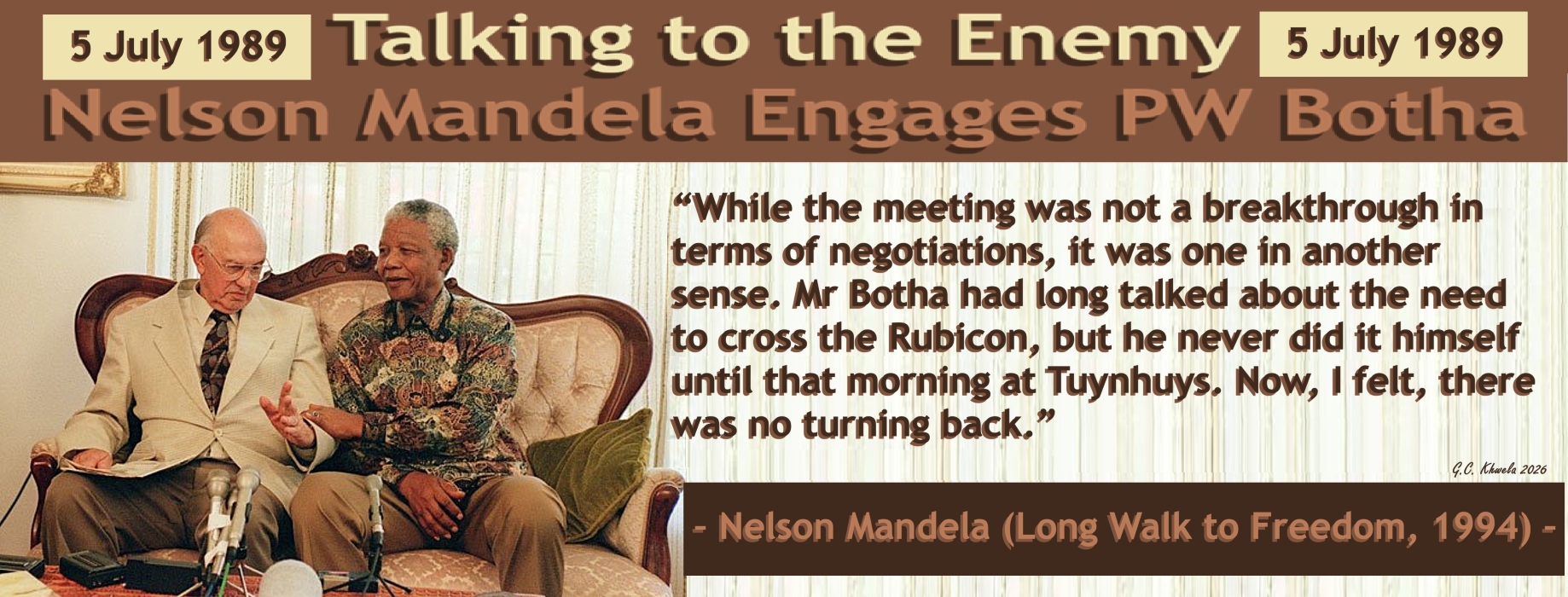
On 5 July 1989, Nelson Mandela was taken in the middle of a five-car convoy to apartheid President P.W. Botha’s office at Tuynhuys, the early Cape Dutch home that is situated alongside the Houses of Parliament in Cape Town. When Mandela entered the room, there were the Justice Minister, Kobie Coetsee and Niël Barnard, the Head of the National Intelligence Service (NIS), along with a host of prison officials. A while later the door to the adjoining office opened, where Mandela was ushered in and apartheid President Botha walked from the other side, smiling broadly with his hands outstretched. They met halfway and posed for a picture shaking hands, as everybody left except for General Willemse, Kobie Coetsee and Niël Barnard, who joined Botha and Mandela at the long table for tea.
Mandela began by saying he read an article in an Afrikaans magazine about the occupation of a town in the Free State during the 1914 Afrikaner Rebellion. He said that he saw parallels between that struggle and that of Black South Africans. They then got to discussions about the rebellion. According to Mandela, “South African history, of course, looks different to the black man and the white man. Their view was that the rebellion had been a quarrel between brothers, whereas my struggle was a revolutionary one. I said that it could also be seen as a struggle between brothers who happen to be different colours.”
Passionately, Botha elucidated the role Afrikaners could play in Africa to help in the development of the continent, especially in the fields of education, transport, health, agriculture, employment, welfare and the advancement of Africa’s enormous human potential. He then mentioned the relationships he had with African leaders and heads of state, in particular mentioning President Kaunda. He told Mandela that the Zambian leader had said that if “the people of southern Africa came to an agreement with the Afrikaners this would lead to far better conditions in the region”. However, Botha was adamant about not allowing outsiders to interfere in South African matters, saying that they should hold hands together to solve their own problems.
After about half-an-hour the discussions were finalised, and Mandela began reiterating his viewpoint that the African National Congress (ANC) had not wished to take the route of violence but was left with no other choice with the refusal of previous National Party (NP) Prime Ministers to meet with ANC leaders. Furthermore, he indicated that he was very pleased with the discussions undertaken between him and the government team, viewing the process as “laying the foundation for fruitful negotiations”.
Botha reassured Mandela that as Afrikaners they were “ready to talk…to participate in real discussions”. Mandela then began raising substantive issues, in particular the unconditional release of all political prisoners, including himself. Botha said he was afraid that he couldn’t do that. Then Mandela asked him to release Walter Sisulu on compassionate grounds, which Botha referred to Barnard to look into it.
Both leaders then began a brief discussion on what they were going to say if news of the meeting happened to leak out, which both agreed would be interpreted as having met for tea in an effort to promote peace in the country. After the statement was agreed upon, Botha then arose, shook Mandela’s hand and said it had been a pleasure. Mandela thanked him and headed for the door.
On Monday, 10 July 1989, Botha circulated the photos of the meeting with Mandela at the meeting of the State Security Council (SSC). According to Niël Barnard, “Anyone who had the slightest inkling of the importance of the meeting realised that regardless of what the future held, a bridge had been crossed”. Barnard maintained that “from the beginning of the talks, Mandela had made it clear that neither of the parties should set conditions for the other party. He and the ANC were prepared to talk to the government but only if they were not bound to any preconditions.”
Furthermore, Barnard asserted that “Mandela admitted that the ANC did not have the military might to overthrow the South African government and agreed that the ANC was ‘not doing so well’ militarily. On the other hand, he was convinced that the government would in the long run not be able to counter the ANC by force. His viewpoint was that once the negotiation process was underway, the need for violence as a means of solving problems would disappear. In other words, the momentum of the peace process would make the use of force redundant.”
For Mandela, the meeting was not a breakthrough in terms of negotiations, but to a certain extent it was a step in the right direction, as Botha had been talking about the need to cross the Rubicon, and the meeting at Tuynhuys was that Rubicon. Accordingly, Mandela felt that since then, that there was no turning back.
While no concrete political agreements or policy concessions were made, the meeting irreversibly breached the psychological and political barrier to future dialogue. Botha had previously vowed never to negotiate with the African National Congress (ANC) unless they renounced violence, making the meeting a symbolic point of no return – or as Mandela noted, it was Botha finally crossing his own “Rubicon”. The specific breakdown of this statement translates to several real-world realities. Botha refused to dismantle apartheid laws, lift the State of Emergency, or unban the ANC during this discussion. Moreover, Mandela’s unconditional release from prison was not secured or formally scheduled during the 45-minute talk.
On the other hand, Mandela firmly refused Botha’s demands to renounce the ANC’s armed struggle or sever ties with the South African Communist Party (SACP). In addition, Mandela attended strictly in his personal capacity as a prisoner, explicitly stating he did not yet have the official mandate to negotiate on behalf of the ANC leadership in Lusaka. Nevertheless, Botha was unexpectedly courteous, friendly and respectful. This shattered the regime’s propaganda machine that demonised Mandela as a “terrorist”. It established the precedent that the Apartheid government and the liberation movement could – and eventually must – sit at the same table to resolve South Africa’s crisis.
Mandela successfully hand-delivered a strategic memorandum (The Mandela Document) directly to President Botha, laying out the precise roadmap for future constitutional negotiations. By physically hosting the face of the anti-apartheid struggle at the presidential Tuynhuys residence, the regime crossed a line from which it could never politically retreat. This paved the direct path for F.W. de Klerk to unban the ANC and release Mandela just seven months later in February 1990.
The engagement with apartheid President P.W. Botha had been preceded by several meetings with leading apartheid politicians and bureaucrats, which began in 1987, wherein Minister Kobie Coetsee had suggested that the apartheid government would appoint a committee of senior officials to conduct private discussions with Mandela. This was done with the full knowledge of the apartheid state president and him (Coetsee) was to chair that committee. The officials that were to be part of the discussions were Lieutenant-General WH Willemse, the commissioner of prisons, Fanie van der Merwe, the director general of the Prisons Department and Dr Niël Barnard.
Before Mandela acceded to such a meeting with Minister Coetsee’s special committee, he requested to first meet with his comrades, which was initially refused, but was conceded to when the apartheid government realised that it might not succeed with secret talks with Mandela if it denied him his request. He was then allowed to meet with his comrades, not as a group, but on a one-to-one basis.
The first meeting was with his close confidant, Walter Sisulu, whose opinion and wisdom he trusted more than anyone else. Sisulu was not against or supportive of the talks with Coetsee’s special committee but indicated that he had wished that talks were initiated by the apartheid regime with the National Executive Committee (NEC) of the ANC. Mandela, however, managed to convince Sisulu that he thought that they should move forward with negotiations and not worry about who initiated them.
The follow-up meetings were with Raymond Mhlaba, Andrew Mlangeni and Ahmed Kathrada, who all agreed to the proposal, except for Kathrada, who was resolutely against the idea and felt that Mandela was going down the wrong path. Nevertheless, they all agreed that Mandela should continue with what he had initiated. The next stop was to respond to ANC President Oliver Tambo’s concerns that were raised in a letter that had been smuggled into prison by one of Mandela’s lawyers.
Mandela’s reply to Tambo was that he was “talking to the government about one thing and one thing only: a meeting between the National Executive of the ANC and the South African government”. However, he could not spell out the details, as he could not trust the confidentiality of the communication, but that “the time had come for such talks and that I would not compromise the organization in any way”.
During the early meetings held with Coetsee’s secret committee, Mandela discovered that the apartheid government had a limited understanding about the ANC, as they were victims of naked propaganda that made them to have a distorted version of who the ANC was and what it was about. Hence, Mandela had to first provide them with accurate facts about the ANC and to make them understand its positions on the primary issues that divided the movement from the apartheid government.
After he had clarified these preliminaries, Mandela had to deal with the critical issues, which included the decision to embark on the armed struggle; the ANC’s alliance with the South African Communist Party (SACP); the goal of majority rule; and the idea of racial reconciliation. His positions on the four critical aspects were structured as follows.
On the Armed Struggle, Mandela adamantly refused to unconditionally call off the armed struggle as a precondition for talks. He argued that the ANC did not initiate violence; it was forced to resort to arms in 1961 only after the Apartheid regime banned all forms of peaceful protest and used state violence to crush dissent. According to Mandela, the cessation of violence could only be the result of a successful negotiation, not the starting point. Once the government lifted the State of Emergency, unbanned political parties, and agreed to fair talks, the armed struggle would naturally end.
On the alliance with the South African Communist Party (SACP), Mandela flatly rejected the government’s demand that the ANC sever its alliance with the SACP. He told the committee that no self-respecting freedom movement would allow its enemy to dictate who its allies should be. He defended the SACP by reminding the committee that when the nationalist regime banned and persecuted the ANC, communist members fought, bled and went to prison alongside them. He reassured the committee that the ANC was not controlled by Moscow and emphasised that the ANC’s official policy blueprint was the Freedom Charter – a document advocating for a multi-party democracy and a mixed economy, not a communist state.
On Majority Rule, Mandela maintained that a true democracy required a ‘one person, one vote’ system and refused the National Party’s proposals for “group rights” or a race-based veto mechanisms designed to entrench white political control. To ease the regime’s existential fears of a “black takeover”, Mandela clarified that majority rule did not mean the domination of black people over white people, instead he insisted that the ANC’s goal was a non-racial democracy where everyone was equal before the law.
On Racial Reconciliation, Mandela explained that any sustainable constitutional solution must address two core realities: the black majority’s demand for full political rights, and the white minority’s fears of domination and retribution. He assured the committee that post-apartheid South Africa would actively protect white citizens’ cultural, linguistic and religious identities. He further positioned reconciliation not as a sign of weakness, but as a practical necessity to prevent a racial civil war, emphasising that both black and white South Africans were inextricably bound to share the country.
Sources:
Wikipedia.
South African History Online (SAHO).
Jack Reed, “Mandela meets with Botha”, United Press International, 8 July 1989.
Nelson Mandela, “Long Walk to Freedom”, Abacus, 1994.
Waldimar Pelser, “An Historic Meeting”, Beeld/News24, 20 May 2009.
SAHA News, “The Tuynhuys Effect”, South African History Archive (SAHA), 5 July 2010.
Niël Barnard, “Secret Revolution: Memoirs of a Spy Boss”, Tafelberg, 2015.
Thula Simpson, “Umkhonto we Sizwe: The ANC’s Armed Struggle”, Penguin, 2016.
Castro Khwela
Good day fellow Compatriots!🙏🏾✊🏾👊🏾
Discover more from CASTRO KHWELA
Subscribe to get the latest posts sent to your email.