Tripartite Agreement Signed: Towards Resolution 435 Implementation
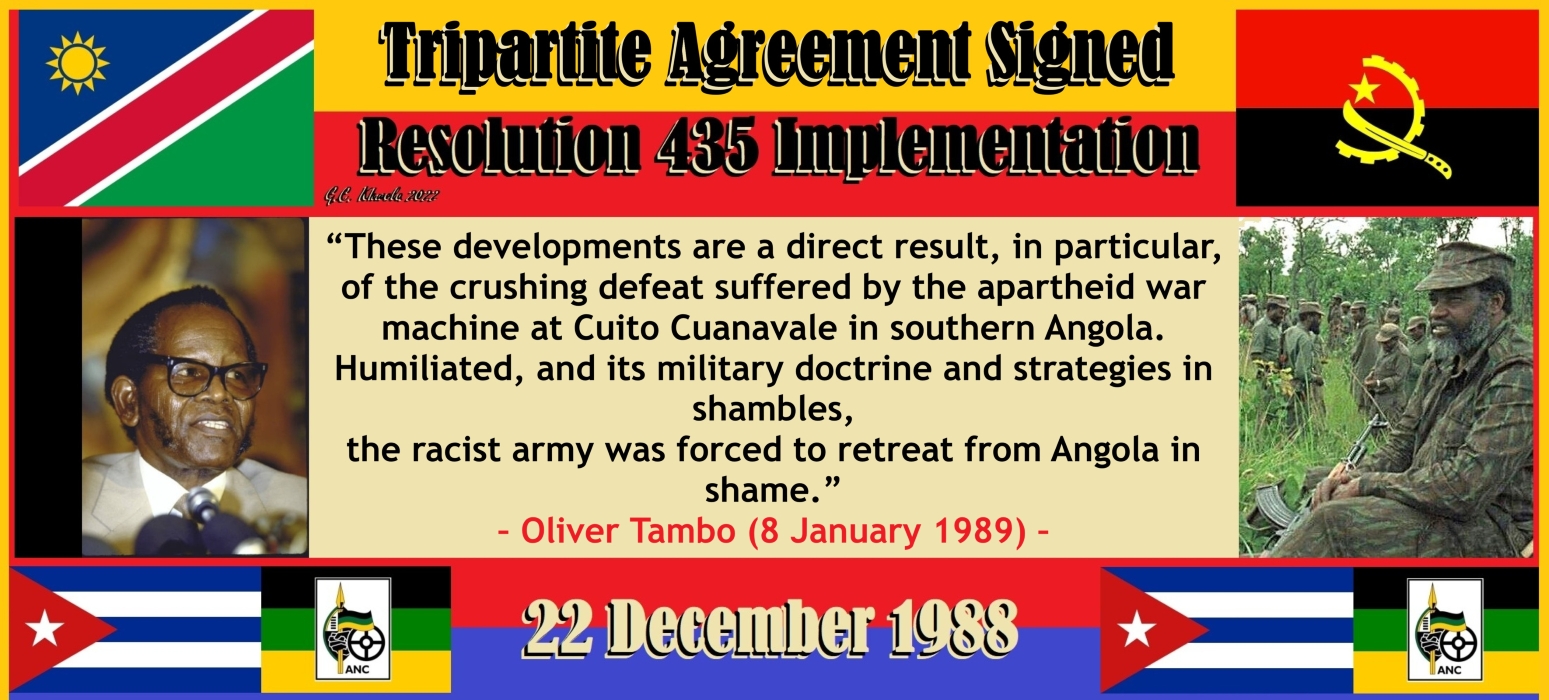
On 22 December 1988, representatives of Angola, Cuba and South Africa signed a final Tripartite Agreement in New York City which called on the parties to request the United Nations (UN) Secretary-General to seek authority from the UN Security Council to commence the implementation of Resolution 435.
The Resolution was in terms of the Accord delayed to the date of 1 April 1989, and the signatories also pledged, in line with the Geneva Protocol, that “Consistent with their obligations under the Charter of the United Nations, the Parties shall refrain from the threat or use of force, and shall ensure that their respective territories are not used by any state, organization, or person in connection with any acts of war, aggression, or violence, against the territorial integrity, inviolability of borders, or independence of any state of south-western Africa.”
Under the terms of the agreement, Cuba was to withdraw its forces from Angola, and South Africa was to grant Namibia independence and withdraw its forces. Cuba agreed to a phased withdrawal of its forces from Angola, to be completed by July 1991 and South Africa agreed to implement UN Security Council Resolution 435, which led to the independence of Namibia. The apartheid SADF would withdraw from Angola and Namibia, paving the way for Namibian independence in 1990.
Accordingly, the Accord marked an end for Umkhonto we Sizwe (MK) presence in Ang


