
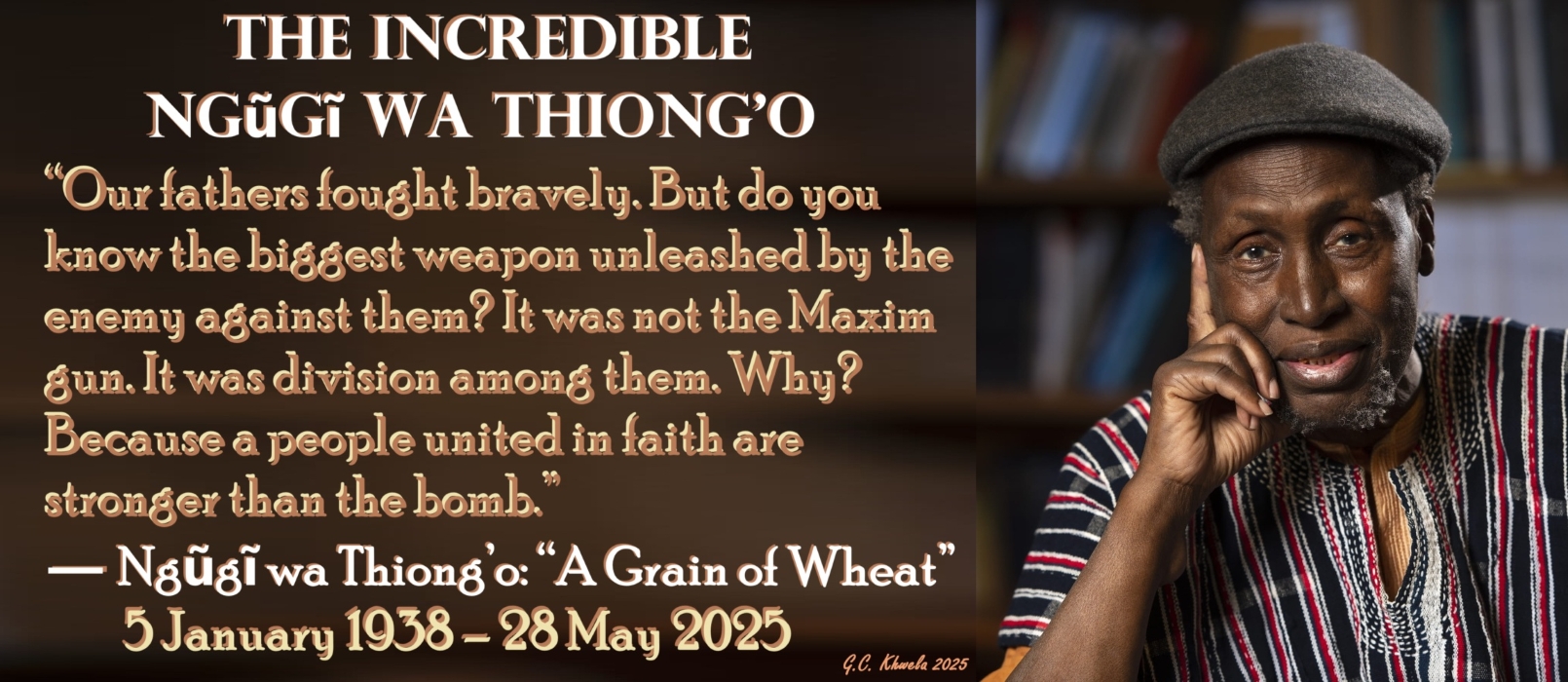
The Incredible Ngũgĩ wa Thiong’o
“Our lives are a battlefield on which is fought a continuous war between the forces that are pledged to confirm our humanity and those determined to dismantle it; those who strive to build a protective wall around it, and those who wish to pull it down; those who seek to mould it and those committed to breaking it up; those who aim to open our eyes, to make us see the light and look to tomorrow … and those who wish to lull us into closing our eyes.” ― Ngũgĩ wa Thiong’o
Ngũgĩ wa Thiong’o born James Ngugi (5 January 1938 – 28 May 2025), an African, a Revolutionary and an Internationalist. Ngũgĩ was a Kenyan author and academic, who was described as one of Africa’s leading novelists. “A Grain of Wheat”, Ngũgĩ’s 1967 novel marked his embrace of Fanonist Marxism, which also led him to subsequently renounce writing in English, and began to write in his native Gikuyu, and to reject the name James Ngugi as colonialist, changing his name by 1970 to Ngũgĩ wa Thiong’o. In the same year, Ngũgĩ also began teaching at the University of Nairobi as a professor of English literature.
During the time as a professor, Ngũgĩ was the engineer of the discussion to abolish the English department. For Ngũgĩ, after the end of colonialism, it was imperative that a university in Africa teach African literature, including oral literature, with the realisation of the richness of African languages. In the late 1960s, such


