The Incredible Ngũgĩ wa Thiong’o
“Our lives are a battlefield on which is fought a continuous war between the forces that are pledged to confirm our humanity and those determined to dismantle it; those who strive to build a protective wall around it, and those who wish to pull it down; those who seek to mould it and those committed to breaking it up; those who aim to open our eyes, to make us see the light and look to tomorrow … and those who wish to lull us into closing our eyes.” ― Ngũgĩ wa Thiong’o
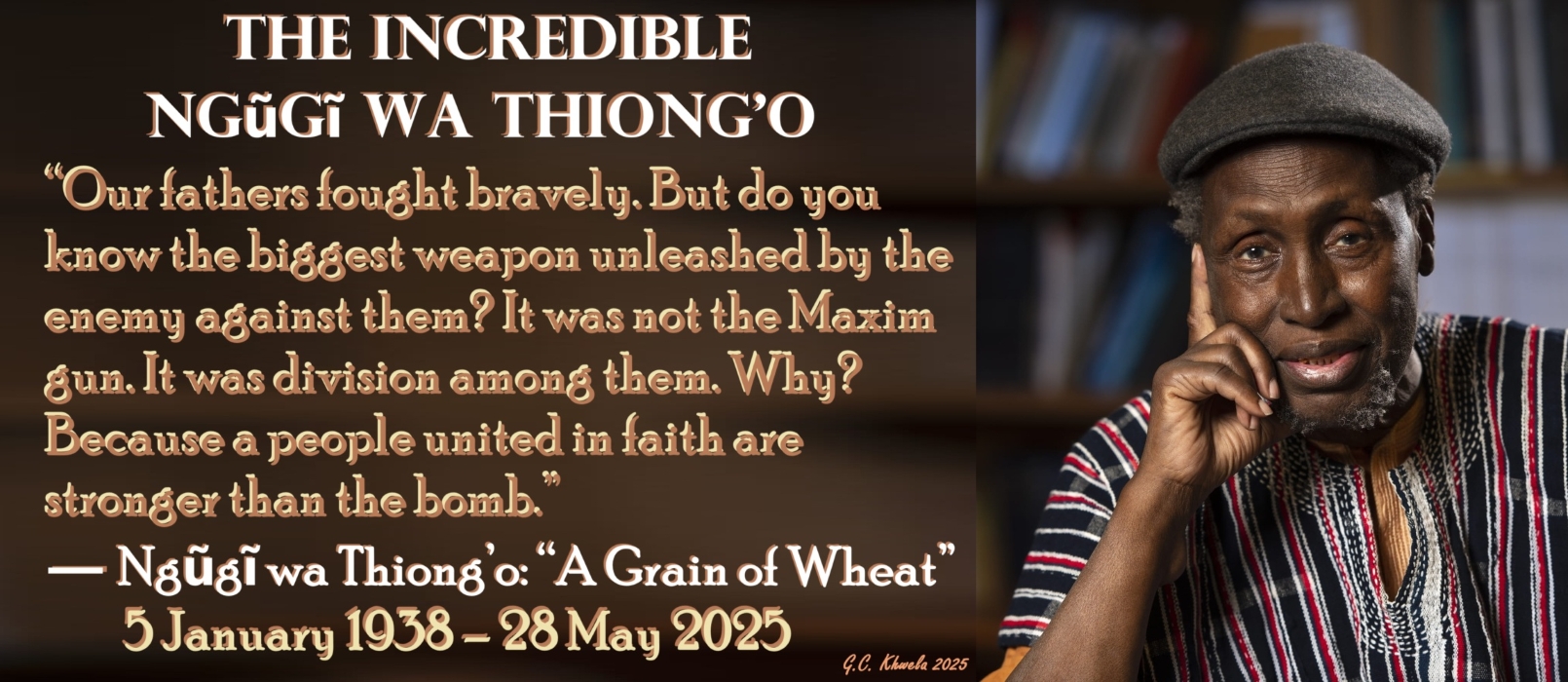
Ngũgĩ wa Thiong’o born James Ngugi (5 January 1938 – 28 May 2025), an African, a Revolutionary and an Internationalist. Ngũgĩ was a Kenyan author and academic, who was described as one of Africa’s leading novelists. “A Grain of Wheat”, Ngũgĩ’s 1967 novel marked his embrace of Fanonist Marxism, which also led him to subsequently renounce writing in English, and began to write in his native Gikuyu, and to reject the name James Ngugi as colonialist, changing his name by 1970 to Ngũgĩ wa Thiong’o. In the same year, Ngũgĩ also began teaching at the University of Nairobi as a professor of English literature.
During the time as a professor, Ngũgĩ was the engineer of the discussion to abolish the English department. For Ngũgĩ, after the end of colonialism, it was imperative that a university in Africa teach African literature, including oral literature, with the realisation of the richness of African languages. In the late 1960s, such efforts led the university to drop English Literature as a course of study, and replacing it with one that positioned African Literature, oral and written, at the centre.
The Kamiriithu Community Education and Cultural Centre, which in 1976 Ngũgĩ helped to establish, among other things, organised African Theatre in the area. The “Petals of Blood”, with its strong political message, and that of his play “Ngaahika Ndeenda” (I Will Marry When I Want), co-written with Ngũgĩ wa Mirii, provoked the then Kenyan Vice-President Daniel arap Moi to order his arrest, when he was sent to Kamiti Maximum Security Prison and kept there without trial for nearly a year. During part of his imprisonment, he found solace in writing and wrote the first modern novel in Gikuyu, “Devil on the Cross” on prison-issued toilet paper and his time in prison also inspired the play “The Trial of Dedan Kimathi” in collaboration with Micere Githae Mugo.
After his release in December 1978, he was not reinstated to his job as professor at Nairobi University and his family was harassed. Because he wrote about the injustices of the dictatorial government at the time, Ngũgĩ and his family were forced to live in exile. Only after Arap Moi retired in 2002, was it safe for them to return. While in exile, Ngũgĩ worked with the London-based Committee for the Release of Political Prisoners in Kenya (1982–1998).
On 8 August 2004, Ngũgĩ returned to Kenya as part of a month-long tour of East Africa. On 11 August, robbers broke into his high-security apartment: they assaulted Ngũgĩ, sexually assaulted his wife and stole various items of value. When Ngũgĩ returned to the United States at the end of his month-long trip, five men were arrested on suspicion of the crime, including one of his nephews.
In 1995, Ngũgĩ wa Thiong’o was diagnosed with prostate cancer and later recovered. In 2019, he had triple bypass heart surgery, and began to struggle with kidney failure. He died in Buford, Georgia, in the United States, on 28 May 2025, at the age of 87. At the time of his death, Ngũgĩ was reportedly receiving kidney dialysis treatments, but his immediate cause of death is still unknown.
MAY NGŨGĨ’S AFRICAN, REVOLUTIONARY AND INTERNATIONALIST SOUL REST IN ETERNITY.
Source: Wikipedia.
Castro Khwela
Good morning fellow Compatriots!🙏🏾✊🏾👊🏾
Discover more from CASTRO KHWELA
Subscribe to get the latest posts sent to your email.