Perhaps one should begin by saying that the relative freedoms we enjoy today, albeit not yet reflective of what we envisaged in the Freedom Charter, did not come cheap. It all began when Dom Francisco de Almeida (also known as the Great Dom Francisco), a Portuguese nobleman, soldier and explorer, attempted to colonise the Cape, lost his life in a conflict with the native Goringhaiqua Khoikhoi people at the Cape of Good Hope on 1 March 1510, in what came to be called the Battle of Salt River.
If the native Goringhaiqua Khoi people did not defeat the Almeida’s force of 150 men who attempted to take their cattle by force, South Africa could have been a Portuguese colony like Angola and Mozambique. However, this effort by the valiant Goringhaiqua Khoi, which resulted in the massacre of 64 Portuguese sailors, including de Almeida, became a notable military embarrassment for the Portuguese and led to stricter enforcement of an earlier policy of theirs not to land ships in the region. It also earned the Khoikhoi clans of the region a reputation for “ferocity” amongst European nations.
The valiant Goringhaiqua Khoi reflected the spirit of resistance that was prevalent throughout the 16th to the 20th centuries, which culminated in the Bambatha Uprising of 1906. Our people fought courageously in the Western and Eastern Cape against the Dutch and the British imperialists, as well as against the Voortrekkers in the Free State, the Transvaal and Natal during those trying centuries.
Despite their superior weaponry and conquest, the colonial masters never rested, as our people resorted to other political and economic measures to resist until they were placed in a corner to again resort to arms in the 1960s. This time around, our people fought as one, not as scattered clans, tribes and nationalities, but as a united force of the oppressed and exploited, and ultimately rendered “colonialism of a special type” unsustainable.
December 16 was chosen symbolically by the founder leaders of Umkhonto we Sizwe (MK) to reverse what the Afrikaners had celebrated since 1838 as the Day of the Vow, or what they also called “Dingaan’s Day”, following their victory in the Battle of Income (Blood River), where they massacred Zulu warriors in the river that became red with the blood of our unwavering heroes. When the glorious People’s Army, Umkhonto we Sizwe, was formed, it was cemented by the blood of all those warriors who lost their lives at Income and all the Wars of Resistance since the Goringhaiqua Khoikhoi people defeated Almeida’s Portuguese forces in 1510.
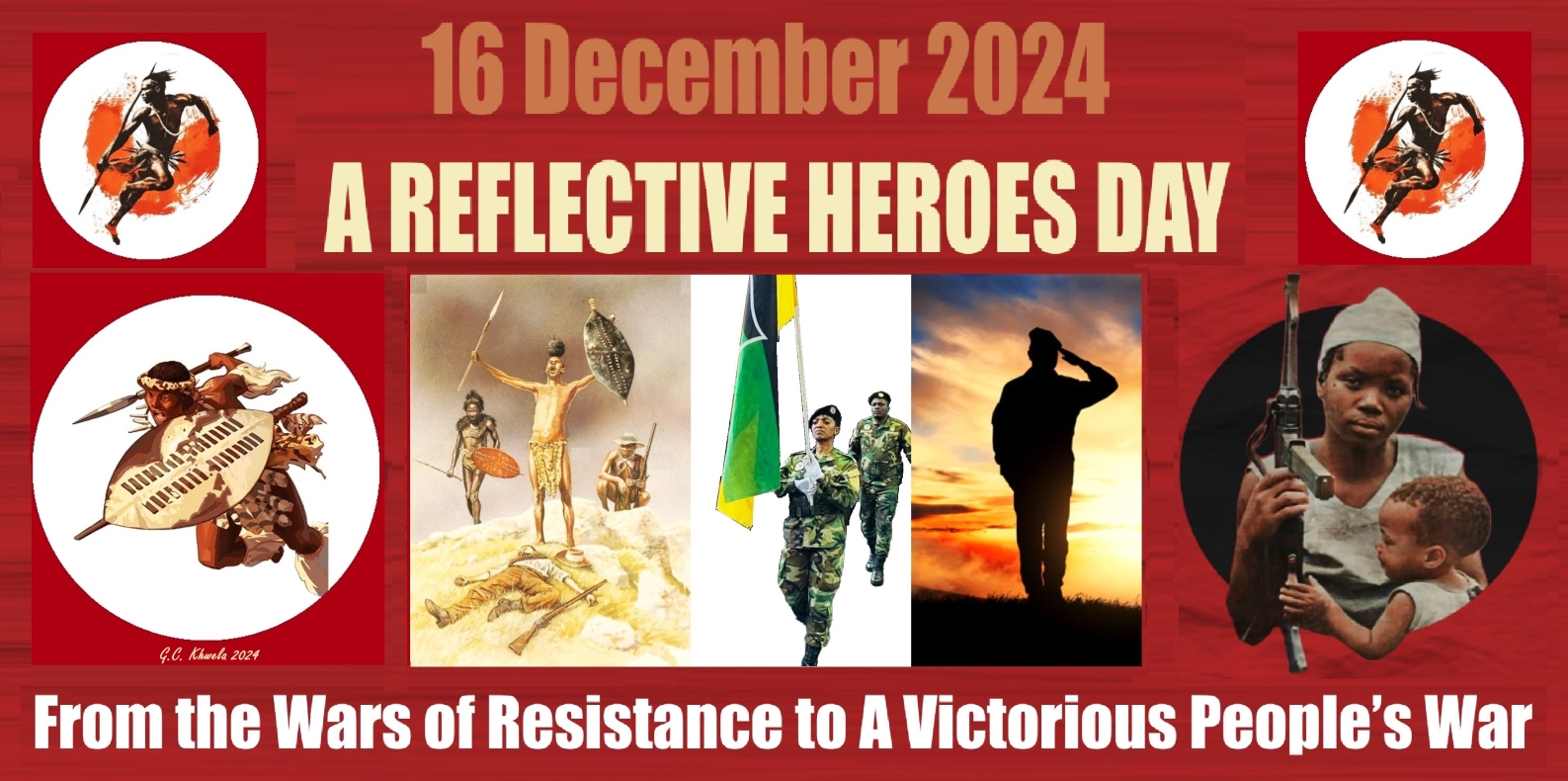
All of the gallant forces that resisted colonial invasion and conquest were heroes and heroines of our people, similar to the guerrilla forces of Umkhonto we Sizwe and other liberation forces, such as the Azanian People’s Liberation Army (APLA), the Azanian National Liberation Army (AZANLA) and the soldiers of the Bantustan armies that ultimately turned their guns against their Puppet leaders. These are all heroes of our people and should be treated as such. Hence, December 16 should be rechristened HEROES DAY!
It should be done to pay homage to all the brave fighters of our land and to accord them the dignity they deserve for bravely fighting for their people and their country. In every country where an anti-colonial or any significant war was fought, their heroes are consistently and significantly recognised.
Why not here in South Africa, where posterity can be proud of its bold heritage? When will our young ones be made aware of who their heroes and heroines are, so that they can stand on their shoulders as proud Patriots? Isn’t it time we reflect on renaming December 16 as HEROES DAY?
MAKE DECEMBER 16 A REFLECTIVE HEROES DAY!
Castro Khwela
Good morning fellow Compatriots!🙏🏾✊🏾👊🏾
Discover more from CASTRO KHWELA
Subscribe to get the latest posts sent to your email.