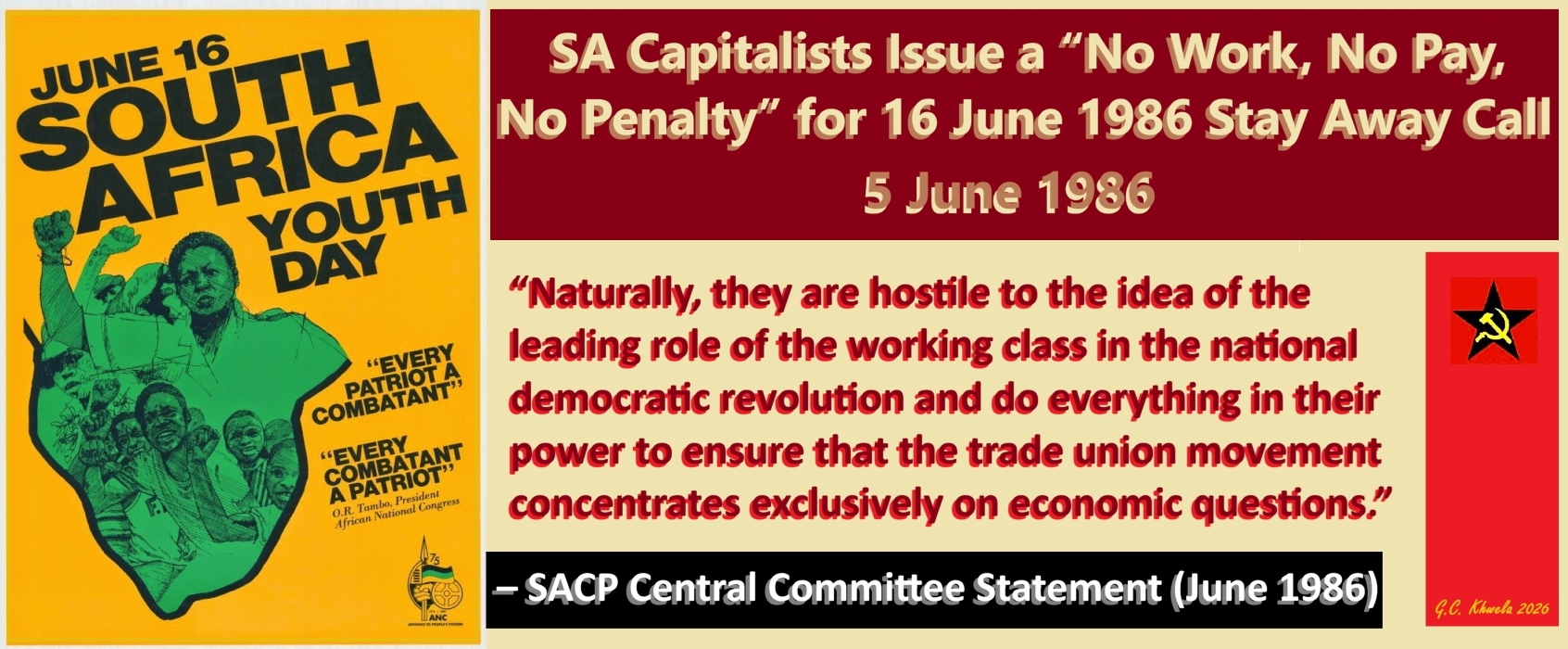
SA Capitalists Issue a “No Work, No Pay, No Penalty” for 16 June 1986 Stay Away Call
On 5 June 1986, the Association of Chambers of Commerce (ASSOCOM) and the Federated Chamber of Industries (FCI) released a statement of “no work, no pay” to workers who stayed away from work on June 16. The statement was released after the Congress of South African Trade Unions (COSATU), the United Democratic Front (UDF) and the National Education Crisis Committee (NECC) met to issue a call for a one-day work stay-away on 16 June 1986, in commemoration of the 10th anniversary of the Soweto Uprisings. ASSOCOM and FCI had almost the same approach to their employees as they both stated that it would be difficult for employers to operate their businesses properly when their workers stayed away from work without prior agreement.
The Association of Chambers of Commerce (ASSOCOM) and the Federated Chamber of Industries (FCI) were not forcibly coerced by the apartheid government to release their statement. Instead, they proactively issued a joint approach guiding employers to implement a “no work, no pay” policy for workers who stayed away on 16 June 1986. They did this voluntarily to protect businesses from losses, arguing that it was impossible to operate properly if employees stayed away without prior agreement. They further stated that it was unviable for businesses to pay workers who did not show up for work on the day.
While the stance was “no work, no pay”, the organisations also broadly encouraged employers to handle the absences without imposing further penalties, aiming to find a balance between political stay-aways and standard labour relations. This approach reflected the growing intersection or contradictions between political activism and industrial relations during the 1980s, particularly following the declaration of the State of Emergency. What was obvious about this stance was their intention to protect their business interests and profits regardless of the political dynamics and upheavals that were occurring in the country.
Trade unions – led predominantly by the newly formed Congress of South African Trade Unions (COSATU) and the National Council of Trade Unions (NACTU) – responded to the “no work, no pay” business policy through a combination of mass defiance, strategic workplace negotiations and political alignment. Rather than backing down, the unions used the corporate stance to further mobilise the workforce and to challenge both capital and the apartheid state. By coordinating with community organisations like the United Democratic Front (UDF) and the National Education Crisis Committee (NECC), unions proved that political solidarity outweighed the financial penalty of losing a day’s wages.
Furthermore, unions used the “no work, no pay” policy as a catalyst to change standard labour contracts. COSATU and its affiliates launched aggressive workplace campaigns demanding that June 16 (Soweto Youth Day) and May 1 (May Day) be officially recognised as paid public holidays in recognition of the working class and the liberation struggle. Union shop stewards negotiated directly with individual factory managements to secure “paid leave” agreements for these specific days, successfully fragmenting the unified corporate stance of central bodies like ASSOCOM and FCI.
Since the employer organisations advised on a policy of “no work, no pay, but no other penalties”, unions strictly held businesses to this boundary. If a business attempted to fire workers, issue formal warnings, or strip attendance and production bonuses, unions retaliated with go-slows, localised wildcat strikes and legal challenges. This effectively forced companies to accept the absenteeism as a legitimate form of political expression without resorting to mass dismissals that would cripple factory output.
The union response marked a permanent shift away from purely economic workplace disputes to what became known as “social movement unionism”. Leaders like COSATU’s Jay Naidoo argued that black workers could not separate their workplace exploitation from their lack of political rights under apartheid. Accepting the “no work, no pay” penalty was framed as a necessary sacrifice for the broader liberation movement, setting the stage for even larger rolling stay-aways later in the 1980s.
The reaction of broader South African society – encompassing the state, local media, independent business owners, and black communities – to the ASSOCOM and FCI “no work, no pay” statement was deeply fractured along racial, political and economic lines. While organised commerce tried to frame their directive as a rational, neutral economic policy, it was immediately swept into the highly polarised political climate of the anti-apartheid struggle. The reaction within society unfolded across several major sectors, including the apartheid state, White corporate and small business, White public opinion and mainstream media, as well as Black civil society and township communities.
The apartheid government, under State President P.W. Botha, viewed the corporate statements as a pragmatic, if soft, baseline. The regime welcomed the “no work, no pay” rule because it aligned with the state’s goal to suppress the growing power of non-racial and black trade unions and to prevent corporate capital from funding what they labelled as “communist-inspired stay-aways”. The state security apparatus, on the other hand, was frustrated by the second half of the corporate directive, which urged employers to impose “no other penalties” (such as dismissals). The intentions of the security apparatus was for businesses to take a harder line – including mass firings and blacklisting – to actively break the backbone of the UDF and COSATU.
Rank-and-file white employers and small business owners reacted with a mix of anxiety and strict adherence to the policy. Many business owners feared that if they paid workers for staying away, it would legitimise political strikes and lead to total loss of management control over the production lines. Conversely, some individual industrial managers quietly broke away from the central ASSOCOM/FCI guidelines. Fearing that implementing “no work, no pay” would cause immediate localised wildcat strikes, sabotage or permanent labour hostility, several firms negotiated private compromises with local shop stewards to avoid a standoff.
The white electorate and the state-aligned media heavily supported the corporate pushback. Major English and Afrikaans newspapers backed the stance, framing “no work, no pay” as a fundamental tenet of free-market capitalism. Media reports warned that the South African economy could not sustain “politically motivated absenteeism”. Meanwhile, the broader white public viewed the upcoming June 16 anniversary with immense dread and saw the corporate refusal to subsidise the strike as a necessary measure to preserve order and security. Nevertheless, increasing anxiety prevailed within the white community in general as the stability of the apartheid state was showing signs of fracturing and lack of control within the black townships conspicuously engulfed the major cities and towns.
Within black townships, the corporate statement was met with complete defiance and deep resentment. Community organisations, student groups within the National Education Crisis Committee (NECC), and local civic associations viewed the policy as proof that white big business was an active partner in apartheid oppression. They argued that companies were penalising black South Africans for mourning the victims of the 1976 Soweto Uprising. Ultimately, the community’s reaction was best measured by their actions on 16 June 1986. Millions of ordinary citizens completely ignored the financial threat of losing a day’s wages. A massive 90% economic shutdown across South Africa’s industrial hubs proved that community solidarity and the liberation struggle completely superseded corporate financial deterrents.
The reaction of the African National Congress (ANC), the South African Congress of Trade Unions (SACTU), and the South African Communist Party (SACP) – collectively functioning as the vanguard of the revolutionary liberation alliance – was one of outright rejection, defiance and strategic escalation. Operating primarily from exile or underground due to bans by the apartheid state, these organisations viewed corporate policies like “no work, no pay” not as neutral business decisions, but as direct collaboration with the apartheid regime to suppress the liberation struggle.
The alliance fundamentally rejected the idea that organised commerce (ASSOCOM and FCI) could remain “neutral” or rely on pure economics during a national crisis. The ANC and SACP argued that the capitalist structure in South Africa was inextricably linked to apartheid oppression. Accordingly, they issued underground propaganda framing the “no work, no pay” stance as an attempt by big business to cushion its own profits while penalising black workers for demanding basic human rights.
As the exiled labour wing closely aligned with the ANC, SACTU used its underground networks to directly counter corporate deterrence. SACTU communicated to workers that the sacrifice of one day’s pay was a necessary, powerful weapon in the broader liberation struggle. SACTU heavily backed the newly formed COSATU inside the country, urging workers to collectivise so that employers could not selectively victimize or fire individuals who stayed away on June 16.
The 16 June 1986 stay-away call occurred just days before the apartheid government declared a stringent, nationwide State of Emergency. The alliance used the corporate resistance to radicalise the workforce further. In its revolutionary broadcasts via Radio Freedom, the ANC called on the working class to move beyond temporary stay-aways and transition into rolling mass actions aimed at “making the apartheid system unworkable and the country ungovernable”.
The alliance effectively used the business community’s stubbornness as diplomatic leverage on the global stage. ANC and SACTU diplomats utilised the “no work, no pay” policies that were threatened to be implemented during the Soweto Day commemorations to lobby international trade unions and governments. They argued that South African corporations were actively punishing workers for protesting apartheid, successfully accelerating the international push for total economic sanctions and disinvestment against South Africa.
The Communist Party framed the corporate reaction as proof that the national democratic revolution could not be separated from the class struggle. They argued that the financial threat of “no work, no pay”, proved that the black working class was the undisputed leading force of the revolution. An interesting statement issued by the Central Committee of the SACP clearly described what was occurring, which said:
“The potential of the workers to discharge their political responsibilities is emphasised by the decisive advance that the working class movement has made with the formation of the Congress of South African Trade Unions (COSATU). This should enable the workers to act nationally, as a united force, dealing not only with economic questions, but also acting to advance the democratic struggle.”
According to the SACP, “The formation of COSATU has also come at the right time. As the economic crisis worsens, the capitalist class will increasingly resort to locking our striking workers, taking advantage of the vast pool of the unemployed and utilising the repressive and punitive possibilities offered by the migrant labour system. The united strength of the workers, organised in COSATU, will have to be brought to bear to defeat the counter-offensive of the employers which has already started.”
“The special place that the ANC occupies in our country as the head of the liberation front”, the SACP added, “continues to be reinforced by the open adherence of millions of our people to this vanguard movement. This development has forced many elements that are otherwise hostile to the national-democratic revolution, including sections of the monopoly bourgeoisie inside and outside our country, to seek contact with the ANC and to promote the idea of a negotiated settlement of the South African problem. It is, however, clear that these forces are seeking a resolution of the struggle in South Africa in favour of the bourgeoisie.”
“They would like to see a bourgeoisie democratic transformation which would leave the capitalist system intact and create the possibility for the rapid emergence of a small and medium African capitalist class which would ally itself with the local monopoly bourgeois and international capital against the masses of the working people of our country.”
Accordingly,” the SACP concluded, “the representatives of this tendency in South African politics are working for a situation whereby this creeping bourgeois democratic transformation would be presided over by an alliance of the big and petty bourgeoisie and their political representatives. Naturally, they are hostile to the idea of the leading role of the working class in the national democratic revolution and do everything in their power to ensure that the trade union movement concentrates exclusively on economic questions.”
Sources:
South African History Online (SAHO).
Michael Parks, “Tutu to Defy South African Ban on Observing Soweto Riots Anniversary”, Los Angeles Times, 6 June 1986.
Shamim Marie, “Divide and Profit: Indian Workers in Natal”, South African Labour Bulletin, Vol. 12, No. 1, November/December 1986.
Robin Hallett, “The Power of the Powerless”, Reality – A Journal of Liberal and Radical Opionion, Vol. 19, No. 4, July 1987.
SACP Central Committee, “The Ideas of Socialism Are Spreading”, The African Communist, No. 105, Second Quarter 1986.
Castro Khwela
Good day fellow Compatriots!🙏🏾✊🏾👊🏾
Discover more from CASTRO KHWELA
Subscribe to get the latest posts sent to your email.