Vlakplaas Murderous Cross-Border Raid into Swaziland
On 4 June 1986, a senior African National Congress (ANC) and Umkhonto we Sizwe (MK) operative, Philip Ngwana Makau Edward Khuto (aka “Pansu or Pantsu Smith”), and two other ANC members, Busi ‘Mzala’ Majola and Sipho Dlamini, who was a key figures in Angola intelligence structures, were killed in a raid on a house in the Dalraich section of Mbabane, Swaziland. Pansu was believed by the apartheid security police to be running an ANC cell involved in the movement of weapons and giving short courses on the use of limpet mines. The attack was a cross-border assassination executed by the apartheid Security Branch and the Vlakplaas unit, since members of the Security Branch’s Soweto Intelligence Unit (SIU) had succeeded in infiltrating Pansu’s cell.
The operation was undertaken following a meeting between General Johan van der Merwe, who was then head of the apartheid Security Branch, and General Ignatius Coetzee, Brigadier Willem Schoon, Colonel Eugene de Kock, head of the Vlakplaas Unit, and Colonel Lodewyk ‘Tiekie’ de Jager of the Soweto Intelligence Unit (SIU). The meeting was to discuss the “September Machinery” of MK, which was considered to be responsible for rural operations, including the landmine attack in Breyten on 21 April 1986. At the meeting, General van der Merwe agreed that the “September Machinery”, which was part of the Transvaal Implementation Machinery, based in Swaziland, had to be eliminated.
In the beginning of April 1986, landmine operations were coordinated by the Transvaal Implementation Machinery of MK, which was a structure to coordinate the activities of the ANC’s political and military, rural and urban, structures for the Transvaal. Paul Dikeledi became the Head of the Machinery, which consisted of Vusimuzi Sindane, Acton Mandla Maseko and Glory Sedibe (aka “September”). Landmine warfare, code-named “Operation Cetshwayo”, was sanctioned by MK Headquarters, in Lusaka, in April 1986 to be coordinated by the Swaziland Regional Politico-Military Committee (RPMC) between the Transvaal and Natal Rural and Urban Implementation Machineries.
“Operation Cetshwayo” was strategically designed to counter the apartheid government’s military presence and border containment strategies in the rural areas of South Africa, primarily focusing on the Eastern Transvaal (now Mpumalanga) and northern border regions. The apartheid regime had implemented the “Promotion of Density of Population in Designated Areas Act”, offering loans to white farmers along international borders to establish a militarised buffer zone. These farms were managed under apartheid South African Defence Force (SADF) directives to conduct reconnaissance, track guerrilla entry, and block the infiltration of MK cadres and weaponry. Operation Cetshwayo was MK’s direct tactical response to dismantle this buffer system.
Because border farmers were formally incorporated into state security structures and actively aided the military, MK regarded them, their farms, and the surrounding patrol roads as legitimate military targets. The operation aimed to sever lines of communication, mine rural roads used by SADF patrols, and stretch the resources of the state’s security apparatus. MK operatives conducted surveillance on rural roads to track SADF movements before burying landmines. High-profile blasts occurred on transit routes, such as the Diepgezet/Barberton Mine road. The strategy was aligned with decisions made at the ANC’s landmark Kabwe Conference in June 1985.
In the morning of 4 June 1986, an apartheid Security Branch team consisting of Vlakplaas operatives, approached an underground safe house in Fountains, Dalraich section of Mbabane, a few kilometres from KwaLuseni Hotel. The team, which was conveyed in a five-vehicle convoy, consisted of Colonels Eugene de Kock, Willem ‘Timol’ Coetzee, Anton Pretorius, Christo Deetlefs and Lodewyk de Jager, as well as Captain Paul van Dyk and Sergeant Douw Willemse, who were directed to the house by Agent “SWT180”. The Agent was later confirmed to be ANC operative, Nompumelelo Zakade.
At the house, the team took up positions while Zakade knocked on the front door. A few minutes after the knock, someone answered within the house to confirm who it was. When Zakade mentioned her name, the door was opened, while Eugene de Kock and ‘Tiekie’ de Jager stormed in, followed by Paul van Dyk. The person who had answered the door was Sipho Dlamini, who was immediately shot dead by De Kock. Since the house was dark, the operatives used torches that were attached to their firearms. One of the bedroom doors became open, and a young woman tried to run past the operatives in the lounge. The woman, who was later confirmed to be Busi Majola (aka “Mzala”), was also shot dead by De Jager.
Another person who was shot dead during the raid was Philip Nwanematsu, also referred to as Philip Ngwana Makau Edward Khuto (aka “Pansu or Pantsu Smith”), whose identity was confirmed by Nompumelelo Zakade, and photos of all the deceased were taken by Anton Pretorius. After the raid, the leader, Eugene de Kock, drove the Team through the night to report directly to police commissioner, General Johan Coetzee. At a 05h30 meeting at Coetzee’s home, at which Brigadier Willem Schoon and Colonel Schalk Jan Visser (head of the Eastern Transvaal Security Branch) and Colonel Tiekie de Jager of the SIU were also present, a report was given to Coetzee.
During the Truth and Reconciliation Commission (TRC) hearings, it was disclosed that the operation was planned and carried out by apartheid-era security forces, including notorious commanders like Eugene de Kock, who later applied for and were granted amnesty for the killings. The then head of the security police, General van der Merwe, also applied for amnesty for this operation, although he gave no details of his precise role, except for approving it. One of the witnesses during the hearings, Chris Hlongwane, gave the Commission a statement on his role as an informer in this operation, for which he was paid R7,000.
It is unclear what role Chris Hlongwane played in the operation, besides being an informant of the SIU. However, after her arrest by the ANC’s National Security Department (NAT), Nompumelelo Zakade confirmed that she was responsible for pointing the raiding apartheid security team to the house in Dalraich, Mbabane, for which she was paid R8,500. Zakade was recruited by an apartheid Security Branch operative, Allan Ndlovu in Swaziland, in 1985 and handed over to Captain Ronnie Nel, the Head of the Elimination Squad for Swaziland, based in Compol Building, in Pretoria. In March 1986, Zakade was then approached by a Van Vuuren, whose actual name was Lange, who utilised her in the operations against several ANC and Umkhonto we Sizwe cadres in Swaziland.
The targeted killing of Philip Ngwana Makau Edward Khuto (aka “Pansu Smith”), Busi ‘Mzala’ Majola, and Sipho Dlamini in June 1986 was approved at the highest levels of the aparthied Security Branch due to a combination of intense political pressure, actionable intelligence, and strategic military timing. According to the Truth and Reconciliation Commission (TRC) amnesty testimonies and official findings, the operation was justified and cleared by top command since the Security Branch believed Pansu Smith was running a highly effective cell focused on the cross-border smuggling of heavy weaponry into South Africa.
Intelligence indicated the cell was actively conducting short courses teaching operatives how to deploy and detonate limpet mines. The Soweto Intelligence Unit (SIU) had successfully embedded informants within the cell, particularly an agent named Chris Hlongwane. Top apartheid Security Branch commanders approved the raid to strike while their intelligence was completely fresh and precise. The apartheid regime defended the cross-border raid as a pre-emptive strike. Operational clearance was fast-tracked to neutralise the cell just 12 days before the 10th anniversary of the June 16 uprising and the escalation of the MK’s armed struggle.
Apartheid security command believed the unit was preparing to launch high-profile commemorative bombings within South Africa in mid-June 1986. During that time the apartheid state was facing escalating domestic unrest and a surge in landmine and limpet-mine incidents. In their amnesty applications, senior officials testified that politicians and the white public heavily blamed the police for failing to stop civilian casualties. This created massive internal pressure within the State Security Council to greenlight extra-judicial, cross-border neutralisation operations.
Following the June 1986 assassinations, the ANC and its armed wing, Umkhonto we Sizwe (MK), responded through a mixture of public condemnation, security restructuring, and targeted military retaliation. The ANC immediately issued statements pointing to the cross-border operation as proof of the apartheid regime’s “lethal global campaign” and illegal use of external death squads.
They exposed the raid to international bodies to highlight apartheid South Africa’s violation of Swazi sovereignty. The ANC elevated the three slain operatives to the status of liberation martyrs. Because Majola and Dlamini were highly visible, popular former students at the University of Swaziland and local hospital employees, the ANC used their deaths to galvanise political consciousness and support within the local Swazi community.
Because the Vlakplaas and Soweto Intelligence units had executed the raid with absolute pinpoint accuracy, the ANC leadership realised that their Swaziland structures were deeply compromised. The command launched internal security sweeps within the Transvaal Machinery to identify informants. The ANC eventually discovered that the cell had been completely betrayed by embedded police agents, such as Chris Hlongwane, leading to a tightening of cross-border operational protocols.
Since the killing of the “September Machinery” operatives occurred right on the eve of June 16, the 10th anniversary of the Soweto Uprising, MK responded by escalating its armed campaign within South Africa in direct retaliation for the Swaziland assassinations. MK cadres intensified their sabotage operations in the Eastern Transvaal (now Mpumalanga) and the Witwatersrand. According to the TRC submissions, the period directly following these June killings saw a massive surge in landmine deployments along the border districts adjacent to Swaziland and over 30 targeted limpet mine explosions inside the country.
MK cadres aggressively sought out and executed suspected police informants and state structures within the townships to avenge the loss of senior logistics commanders like Pansu Smith. The ANC heavily criticised the Swazi government and local police for their complicity and the Movement’s political leadership even pressured Swazi authorities over the fact that South African hit squads could operate with near-impunity in suburbs like Dalriach. This forced the ANC to adapt how it concealed safe houses, shifting away from known university and medical networks in Mbabane.
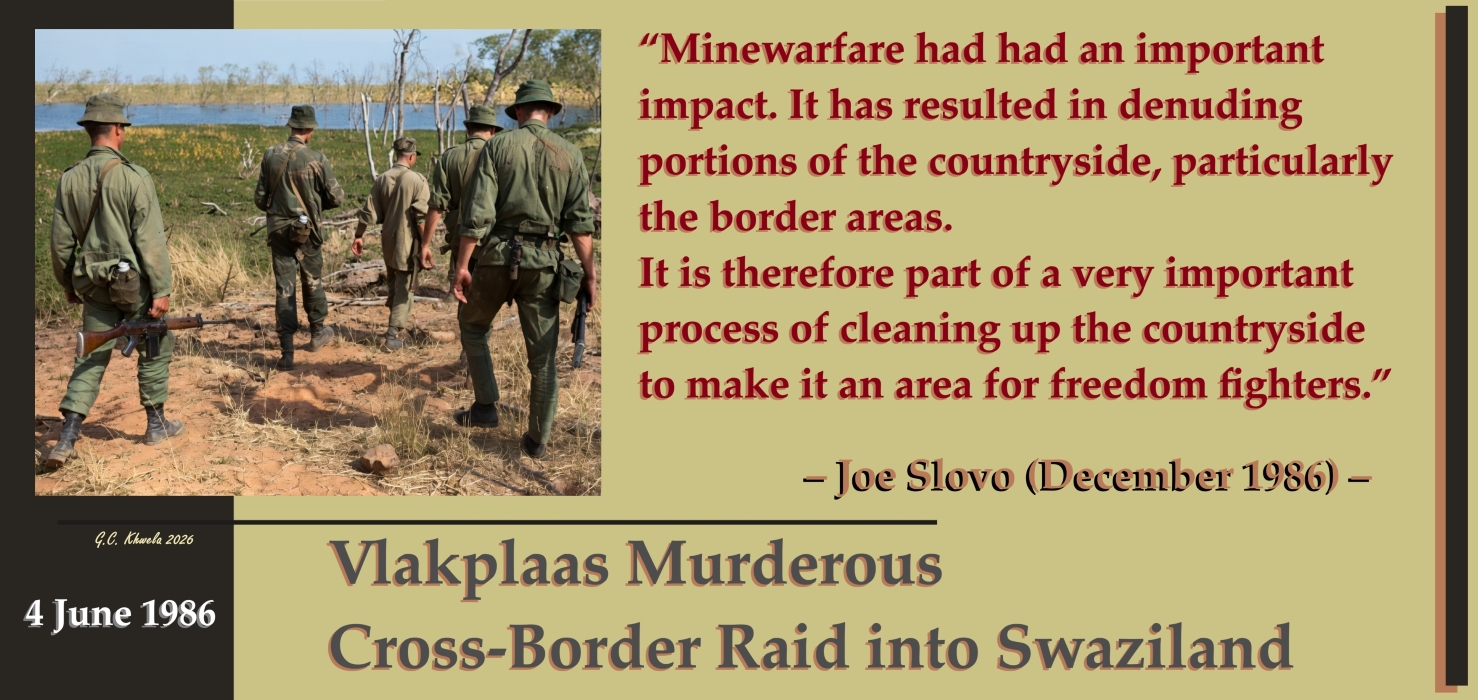
During that time, according to MK Chief of Staff, Joe Slovo, “Minewarfare had had an important impact. It has resulted in denuding portions of the countryside, particularly the border areas. It is therefore part of a very important process of cleaning up the countryside to make it an area for freedom fighters. … If there is a legitimate target, surrounded by white houses, we can no longer be restricted in engaging the enemy just because there happens to be civilians in the vicinity. So in that sense too we have altered our approach.”
High-ranking commanders oversaw the regional execution of the “Operation Cetshwayo” campaign. However, despite instructions to strictly target military patrols, the indiscriminate nature of landmines resulted in severe civilian casualties. Multiple civilian vehicles detonated these devices, resulting in the deaths and injuries of innocent rural labourers and families. Accordingly, due to the high number of unintended civilian casualties, the ANC faced internal ethical pressure and international backlash, ultimately forcing leadership to abandon the rural landmine campaign in 1989.
Sources:
South African History Archives (SAHA).
South African History Online (SAHO).
Joe Slovo, “1976 to the Present”, Dawn – Journal of Umkhonto we Sizwe, Souvenir Issue, December 1986.
African National Congress, “Further Submissions and Responses by the African National Congress to Questions Raised by the Commission for Truth and Reconciliation”, 12 May 1997.
Truth and Reconciliation Commission, “Truth and Reconciliation Commission of South Africa Report, Vol. 2”, Truth and Reconciliation Commission, 29 October 1998.
Sapa, “Landmine Victims Forgive ANC Bombers”, South African Press Association, Independent Online (IOL), 4 May 2000.
Truth and Reconciliation Commission, “Truth and Reconciliation Commission of South Africa Report, Vol. 6”, Truth and Reconciliation Commission, 21 March 2003.
Thula Simpson, “Umkhonto we Sizwe: The ANC’s Armed Struggle”, Penguin, 2016.
Castro Khwela
Good day fellow Compatriots!🙏🏾✊🏾👊🏾
Discover more from CASTRO KHWELA
Subscribe to get the latest posts sent to your email.