Mother of the Struggle: Albertina Sisulu Passes On in Johannesburg
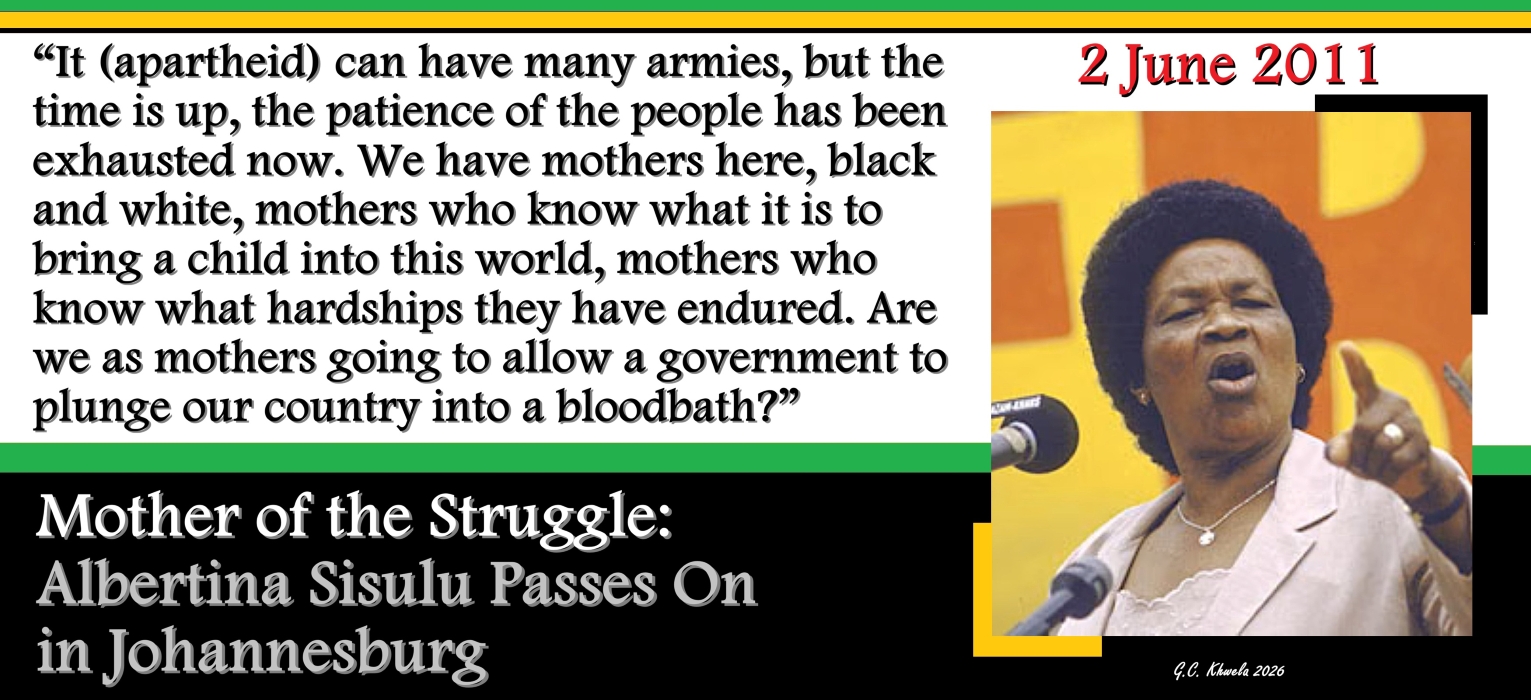
On 2 June 2011, mother and stalwart of the liberation struggle, Albertina Sisulu, fondly known as “Mama Sisulu”, the wife of the revolutionary giant, Walter Sisulu, passed on at her Linden home, Johannesburg, at the tender age of 92. Often referred to as the “Mother of the Nation”, she was a nurse and one of the most important leaders of the anti-colonial and anti-imperialist struggle in South Africa. Mama Sisulu was renowned for her fearless opposition to the apartheid regime, her pivotal role in women’s empowerment, and her lifelong advocacy for education and human rights. She was buried next to her husband, Walter at Newclare Cemetery, Johannesburg, on 11 June 2011.
Born Nontsikelo Thethiwe in the Tsomo district of the Transkei on 21 October 1918, she was the second of five children of Bonilizwe and Monikazi Thethiwe. Albertina Sisulu’s mother survived the Spanish Flu, but was constantly ill and very weak because of this. It fell upon Nontsikelelo, as the eldest girl, to take on a motherly role for her younger siblings. She had to stay out of school for long periods of time, which resulted in her being two years older than the rest of her class in her last year of primary school. She adopted the name Albertina when she started her schooling at a Presbyterian mission school.
After being orphaned as a teenager, she was obliged to help provide for her younger brothers and sisters. Abandoning her ambition to train as a teacher, she graduated from Mariazell College in 1939 and chose a career in nursing. She then left the Transkei to train as a nurse at Johannesburg’s Non-European Hospital in 1940, as nurses were paid during their training at that time. Albertina started work in Johannesburg as a midwife in 1946, often walking to visit patients in townships.
She first met Walter Sisulu in 1941 while working at Johannesburg General Hospital; at that time he was a young political activist. They married in 1944. The Sisulus married in 1944 at a ceremony in which Nelson Mandela was the best man. Also present were Anton Lembede and Evelyn Mase. At their wedding reception, Anton Lembede (then President of the ANC Youth League) famously gave a speech warning Albertina that she was “marrying a man who was already married to the nation”. This proved prophetic, as political activism came to define their entire lives together.
Due to Walter’ s revolutionary commitments and subsequent life sentence at the Rivonia Trial in 1964, the couple spent scarcely nine years together in the first two decades of their marriage. They endured a 26-year separation while Walter was jailed on Robben Island. Their bond survived through carefully guarded, restricted letters of deep affection and unwavering commitment to the shared goal of liberation. Unlike many traditional couples of the era, their dynamic was built on intense mutual respect, friendship, and open communication.
When Walter proposed in 1941, Albertina tested him by stating she could not marry because she already had children (referring to her younger siblings whom she supported after her parents died). Rather than being deterred, Walter was deeply impressed by her integrity and gladly promised to share the responsibility. Together, they raised five biological children (including Max, Mlungisi, Zwelakhe, and Lindiwe) and adopted four others. While Walter was imprisoned, Albertina ran their household in Soweto, worked as a nurse to support the family, and faced her own solitary confinement and banning orders. Despite the pressure, their home remained a haven for local activists and children alike.
Albertina did not display an interest in politics at first, only attending political meetings with Walter in a supporting capacity, but she eventually got involved in politics when she joined the African National Congress (ANC) Women’s League in 1948, and took part in the launch of the Freedom Charter the in 1955. Albertina Sisulu was the only woman present at the birth of the ANC Youth League in 1944. She became a member of the executive of the Federation of South African Women (FEDSAW) in 1954.
On 9 August 1956, Albertina joined Lilian Ngoyi, Helen Joseph and Sophia Williams-De Bruyn in a march of 20,000 women to the Union Buildings of Pretoria in protest against the apartheid government’s requirement that women carry passbooks as part of the pass laws. And she actively campaigned against the 1953 Bantu Education Act, working with other women to close schools and set up alternative, underground educational classes for African children.
She was arrested after her husband skipped jail to go underground in 1963, becoming the first woman to be arrested under the General Laws Amendment Act of 1962 enacted in May. The act gave the police the power to hold suspects in detention for 90 days without charging them. She was placed in solitary confinement for almost two months until 6 August. During that time, she was subsequently in and out of jail for her political activities, but she continued to resist against apartheid, despite being banned for most of the 1960s.
When her husband, ANC leader and Umkhonto we Sizwe (MK) Commander and Commissar, Walter Sisulu, was sentenced to life imprisonment alongside Nelson Mandela and the other Rivonia Trialists, Mama Sisulu became the sole breadwinner. She supported their children, cared for the children of other imprisoned or exiled activists, and continued her political work despite enduring decades of police harassment, detention, and near-continuous banning orders.
Mama Albertina Sisulu played a vital, foundational role in maintaining, rebuilding, and steering the underground machinery of the banned ANC after its core leadership was imprisoned or exiled in the early 1960s. Operating under severe domestic restrictions, house arrest, and constant surveillance, she served as a resilient bridge between generations of activists, jailed leaders, and the external mission.
In June 1963, upon her release, after being arrested under the General Laws Amendment Act, and despite being slapped with a gruelling five-year banning order in 1964, she worked quietly with remaining stalwarts like John Nkadimeng and later Joe Gqabi. Under the radar, they forged the first post-Rivonia internal networks. Her early underground focus centred on facilitating the safe passage and escape logistics of ANC members fleeing South Africa for educational or military training abroad.
During the 1970s, as the Black Consciousness Movement (BCM) galvanised the youth, Mama Sisulu acted as an underground ideological anchor, ensuring the ANC’s non-racial, liberation ethos survived. Mama Albertina Sisulu’s relationship with the BCM youth in the 1970s was a complex mix of maternal support, political ideological debate, and quiet guidance. While she deeply respected and nurtured their revolutionary energy, she simultaneously pushed back against their exclusionary views on race, steering them toward the ANC framework of non-racialism.
She was instrumental in establishing “Thusang Basadi” (“Hands-On Women”), a Soweto-based underground ANC cell designed to politically educate and recruit women into the struggle. She also used her home to secretly de-brief and politically educate young activists and worked to systematically transition youth—including her own children like Lindiwe and Zwelakhe—from Black Consciousness ideas into the broader underground framework of the ANC. Operating from her home in Orlando West, Soweto, she devised covert channels to exchange communications between political prisoners on Robben Island and the ANC’s external mission led by ANC President Oliver Tambo.
In the 1980s, she emerged as a crucial community leader in Soweto and a prominent figure in the struggles against apartheid instituted black community councils. During the 1980s, the focus shifted from survival to mass mobilisation, culminating in the launch of internal fronts that mirrored ANC objectives. Though still restricted, she worked behind the scenes on national steering committees to launch the UDF in 1983. She was elected its co-president while still a target of the state, bridging the gap between covert operations and overt mass resistance.
She spearheaded underground and public campaigns to revive the Federation of South African Women (FEDSAW) and guided community-level resistance, such as the Soweto rent boycotts. Her pivotal underground coordinating role meant she was continually arrested, placed in solitary confinement (in 1981 and 1985), and tried for high treason in 1984 as the state attempted to dismantle the UDF network.
Following the fall of apartheid, she served as a Member of Parliament in South Africa’s first democratic government in 1994, dedicating her later years to improving public healthcare and the rights of the elderly. Former ANC President Jacob Zuma paid tribute to Mama Albertina Sisulu in the wake of her death saying, “Mama Sisulu has, over the decades, been a pillar of strength not only for the Sisulu family but also the entire liberation movement, as she reared, counselled, nursed and educated most of the leaders and founders of the democratic South Africa”.
“Women are the people who are going to relieve us from all this oppression and depression… It is the women who are on the street committees educating the people to stand up and protect each other.” – Albertina Sisulu.
Sources:
Wikipedia.
South African History Online (SAHO).
Oscar L. Beard, “Walter Sisulu – Albertina Sisulu: Sisulus Received Warmly, Point the Way”, First World Anti-Apartheid Newsletter”, Vol. 2, No. 3, Fall Issue 1991.
Elinor Sisulu, “Walter and Albertina Sisulu – In Our Lifetime”, David Phillip, 2002.
Kameron Hurley, “The Voice of Women: The ANC and the Rhetoric of Women’s Resistance, 1976-1989”, MA: University of Natal, July 2003.
Gregory Houston, “Chapter 15: The Post-Rivonia ANC and SACP Underground”, The Road to Democracy in South Africa, Vol. 1 (1960–1970), South African Democracy Education Trust, Zebra, January 2004.
Gregory Houston and Bernard Magubane, “Chapter 8: The ANC Political Underground in the 1970s”, The Road to Democracy In South Africa, Vol. 2 (1970-1980), South African Democracy Education Trust, UNISA Press, March 2006.
Raymond Suttner, “The ANC Underground in South Africa, 1950-1976”, First Forum Press, 2009.
Department of Basic Education, “A Century of Struggle: Be the legacy!”, Department of Basic Education, 2018.
Thandi Modise, “Celebrating the Centenary of a Gentle, Humble and Selfless Giant – Mama Albertina Sisulu”, Insession – Official Newsletter of the Parliament of the Republic of South Africa, Issue 9, 2018.
Western Cape Provincial Parliament, “Albertina Sisulu, 1918 – 2011 (Fact Sheet 19)”, Western Cape Provincial Parliament, 29 June 2018.
Paul, J.P. Fouché, Refiloe Molutsi and Pravani Naidoo, “Albertina Sisulu: A Psychobiographical Sketch from an Integrated African Psychology Perspective”, Faculty of the Humanities, University of the Free State, 6 October 2023.
Resources, “Albertina Sisulu: Women in the Anti-Apartheid Movement”, The Anti-Apartheid Legacy: Centre of Memory and Learning (CML) and the University of East Anglia, October 2023.
Castro Khwela
Good morning fellow Compatriots!🙏🏾✊🏾👊🏾
Discover more from CASTRO KHWELA
Subscribe to get the latest posts sent to your email.