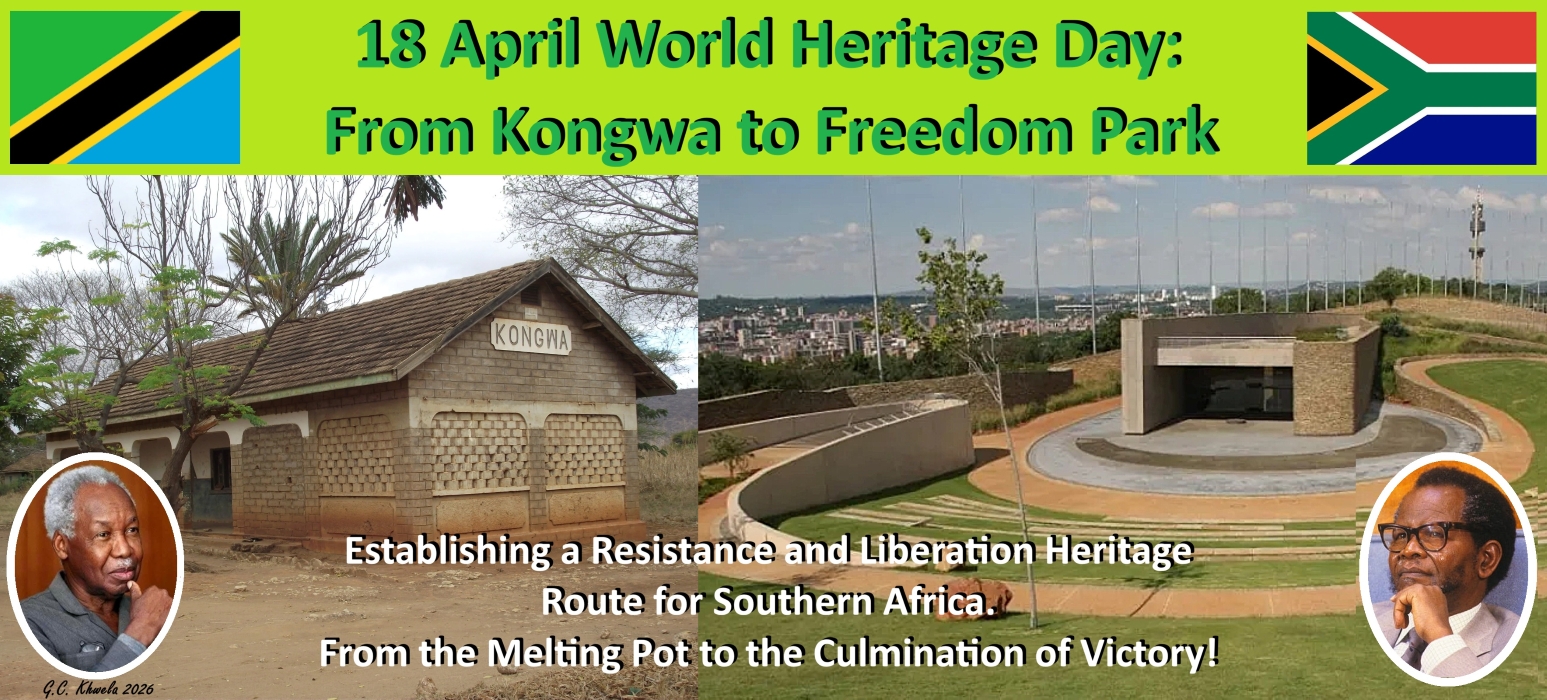
18 April World Heritage Day: From Kongwa to Freedom Park
On 18 April, World Heritage Day, also known as the International Day for Monuments and Sites, is celebrated annually to promote awareness of cultural heritage, diversity, and the importance of preserving historical sites and monuments. Established in 1983 by The International Council on Monuments and Sites (ICOMOS) and adopted by the United Nations Educational, Scientific and Cultural Organization (UNESCO), the day highlights the vulnerability of heritage sites and encourages conservation efforts. One of these sites that are being pursued currently, is to develop a route from Kongwa to Freedom Park, which must also be linked with other liberation movements, making it a regional programme.
Significant Aspects of World Heritage Day include the encouragement of local communities and individuals to understand the importance of cultural heritage and to protect historical sites from threats. The day often features guided tours, exhibitions, lectures, and free admission to museums and heritage sites. Furthermore, the day frequently focuses on specific themes, such as sustainable development, climate-resilient pathways for heritage, or protecting heritage under threat from conflict. It is a global observance aimed at celebrating both natural and cultural heritage, including UNESCO World Heritage sites like the Resistance and Liberation Heritage Route, which is a national South African project documenting, preserving, and commemorating sites linked to the struggle against colonialism and apartheid, leading to democracy.
Many organizations offer virtual tours and digital exhibitions, allowing for global participation in exploring such heritage sites, and this is what is envisaged for the route from Kongwa to Freedom Park, as efforts are being undertaken to include it as a major part of the Resistance and Liberation Heritage Route. As a UNESCO-supported initiative, the Resistance and Liberation Heritage Route highlights key locations, such as Robben Island, Liliesleaf Farm, and Constitution Hill, to educate on the path to freedom. What is intended with the from Kongwa to Freedom Park route, is to include other regional sites, beginning from Kongwa, covering the entire southern African region until it ends at Freedom Park.
The Resistance and Liberation Heritage Route acts as a national memory project, honouring individuals who sacrificed their lives and protecting heritage sites for future generations. It serves to fill gaps in the narration of South Africa’s painful history and promotes the values of the Constitution. The route features numerous locations, including the Union Buildings, Sharpeville Massacre site, Freedom Park (Pretoria), and the Mandela Capture Site. In July 2024, 14 components of the Liberation Heritage Route were inscribed as South Africa’s 12th World Heritage Site, highlighting them as a “serial property” of global significance. Specific routes exist, such as the Mpumalanga Resistance and Liberation Heritage Route, focusing on local freedom fighters and historical locations within that region.
Sites that were identified to be part of the Resistance and Liberation Heritage Route include the Gallows at Kgosi Mampuru Prison, Freedom Park, and the Union Buildings in Tshwane Region; the Nkangala district’s Delmas Treason Trial Court and Lynnville Cenotaph in Mpumalanga; the Inanda Heritage Route, Isandlwana, and the Mandela Capture Site in KwaZulu-Natal. The RLHR is linked to a broader pan-African project titled “Roads to Independence in Africa: The African Liberation Heritage”. The project is more than just a map, but a multi-layered initiative focused on preservation, education, and economic development in rural areas through tourism. It is part of a larger continental programme endorsed by the African Union and UNESCO to recognise the universal value of Africa’s liberation history.
In July 2024, 14 components of the route, grouped under the “Human Rights, Liberation and Reconciliation: Nelson Mandela Legacy Sites”, were inscribed as UNESCO World Heritage Sites, which in Gauteng consist of the Union Buildings in Pretoria, the Sharpeville Memorial Precinct, Liliesleaf Farm, Constitution Hill and Walter Sisulu Square. In the Eastern Cape, such sites include The Great Place at Mqhekezweni and the University of Fort Hare. In KwaZulu-Natal the Ohlange Institute and in the Free State the Waaihoek Wesleyan Church in Bloemfontein.
While the national project is overseen by the Department of Sport, Arts and Culture, several provinces have developed specific legs, such as in Mpumalanga, which features the Ehlanzeni District and Nkangala District routes, including sites like the Delmas Treason Trial Court, the Lynnville Cenotaph and Mapoch Caves. In Tshwane (Pretoria), there is a dedicated sub-route within the capital that focuses on local struggle landmarks. A central pillar of the Route is the Exile Repatriation Project, which facilitates the return of the remains of liberation icons who died in exile. Recent efforts have focused on identifying and repatriating heroes from Zambia and Zimbabwe to provide them with a final resting place in South Africa.
Currently efforts are being undertaken towards developing a vision for a Kongwa and the Route to Freedom Park being declared as a World Heritage Site, as part of the Resistance and Liberation Heritage Route. The reason is that Kongwa became the main accommodation of the various armed forces of the national liberation movements in southern Africa. Joint efforts were made by these movements in the fight against the Unholy Alliance (Portuguese Colonialism in Mozambique, Guinea Bissau-Cape Verde, and Angola, and Racist Regimes in Rhodesia, South-West Africa and South Africa) until the liberation of South Africa and establishment of Freedom Park.
These movements included: the African National Congress’s (ANC) Umkhonto we Sizwe (MK); the South West African People’s Organisation’s (SWAPO) People’s Liberation Army of Namibia (PLAN); the Patriotic Front of Zimbabwe, which includes the Zimbabwe African People’s Union’s (ZAPU) Zimbabwe People’s Revolutionary Army (ZIPRA) and the Zimbabwe African National Union’s (ZANU) Zimbabwe African National Liberation Army (ZANLA), which was not necessarily part of the Kongwa Camp but in Mgagao Camp; the Popular Movement for the Liberation of Angola’s (MPLA) People’s Armed Forces for the Liberation of Angola (FAPLA); and the Liberation Front of Mozambique’s (FRELIMO) People’s Forces for the Liberation of Mozambique (FPLM).
From 1964, when it was first granted by the Tanzanian government to the Liberation Committee of the Organisation of African Unity (OAU) recognised liberation movements, Kongwa camp has been a key site in southern Africa’s exile history. First SWAPO and FRELIMO, and later the ANC, MPLA and ZAPU, inhabited neighbouring sites near the town of Kongwa in Dodoma, central Tanzania, where they trained their respective members in guerrilla tactics and prepared to infiltrate their countries of origin. Despite the importance of Kongwa for any history of southern Africa’s liberation struggles, few secondary sources draw attention to Kongwa as a lived space, and none consider it beyond the historiography of a particular national movement.
From Kongwa in Dodoma, to Morogoro and Dar es Salaam, the liberation movement and their respective armed forces moved into their specific countries, sometimes jointly as in the case of the ANC, FRELIMO and the Patriotic Front of Zimbabwe, they established various bases along the way and were engaged in several skirmishes, battles, campaigns and raids with the enemy forces. In several cases of moving to their respective countries, they went through several countries and were assisted by the peoples and the governments of these countries, particularly Zambia, Republic of the Congo, Democratic Republic of Congo, Botswana, Eswatini and Lesotho.
Furthermore, inclusion of progressive countries, movements and organisations in Europe, the Americas, Asia and the African continent – under the auspices of the OAU Liberation Committee – that supported the efforts of the Southern African Liberation Movements in fighting colonialism and racist regimes in the region. Regional, continental and international solidarity among former liberation movements remains vital for sharing experiences, preserving common histories and advancing progressive global values. Ultimately, a focal point of national and regional remembrance, a regional monument, which includes a Tomb of the Unknown Soldier, be designed and erected in Freedom Park to honour fallen heroes and heroines of the liberation struggle in the Southern African region.
Establishing a Resistance and Liberation Heritage Route for Southern Africa.
From the Melting Pot to the Culmination of Victory!
Sources:
Wikipedia.
Olga Bialostocka, “Liberation Heritage Route: Reminiscent of the Painful Past or a Road to the Future?”, Africa Institute of South Africa, AISA POLICY Brief Number 100 – November 2013.
NHC, “Resistance & Liberation Heritage Route”, National Heritage Council South Africa, https://www.nhc.org.za/liberation-heritage/#
GDRC, “Urban Heritage and Conservation”, The Global Development Research Center, https://www.gdrc.org/heritage/world-heritage-day.html#
UNESCO, “International Day for Monuments and Sites 2021 – Complex Pasts: Diverse Futures”, UNESCO: World Heritage Foundation, 16 April 2021.
Castro Khwela
Good day fellow Compatriots!
Discover more from CASTRO KHWELA
Subscribe to get the latest posts sent to your email.