15 April World Art Day: Evoking the Medu Arts Ensemble
April 15 is celebrated annually as World Art Day, which was a global initiative dedicated to promoting the understanding, development, diffusion and enjoyment of art, as well as strengthening the connection between artistic creations and society. This day, which initiated by the International Association of Art (IAA) in 2012, was proclaimed in 2019 by the United Nations Educational, Scientific and Cultural Organization (UNESCO), highlighting the importance of art in fostering creativity, cultural diversity, and freedom of expression.
The day, which celebrates art and the artists, honours artistic contributions, encouraging, supporting, and protecting artists and artistic freedom, was chosen to coincide with the birthday of Leonardo da Vinci, on 15 April 1452, as a symbol of freedom of expression, peace and brotherhood. Global Activities often involve celebrations that include feature workshops, debates, conferences and exhibitions to encourage awareness of diverse art forms and their role in society. The day reinforces the role of arts in education, sustainable development, and social cohesion, promoting art as a means for a more peaceful world, as well as a valuable tool to addressing injustice, oppression and exploitation.
Addressing such injustices, oppression and exploitation, were activists and revolutionary artists such as the Medu Arts Ensemble. On this day we should honour the revolutionary Medu Arts Ensemble, which was at the forefront of fighting apartheid oppression and exposing its inhuman atrocities. A group of artists, who preferred to be referred to as “cultural workers” from the townships of South Africa, fled into exile in Gaborone, Botswana, in 1977. They included Molefe Pheto, from Mhloti Theatre, and Thami Mnyele, who followed in 1978.
In Gaborone they established the cultural organisation, as the Medu Art Ensemble (“Medu” is a SePedi word meaning “Roots”), which ran units specialising in music, theatre, graphics and visual arts, photography, and “research and production” (which meant creative writing). During its eight years of its existence, Medu consisted of around 15 to as many as 50 members, who were largely South Africa exiles. They preferred to call themselves “cultural workers” rather than “artists”, implying that as art creators they did not see themselves as elite and isolated individuals, touched by creative madness or genius, but simply people doing their work, whether painting, music or poetry.
The visual arts unit of Medu consisted of Thami Mnyele; Miles Pelo, who was exiled 1981, and left Botswana in 1982 for Cuba, Tanzania and England; Heinz Klug, who was in Botswana from 1979 to 1985; Judy Seidman, who was born in America, and joined Medu in 1980 to 1985; Gordon Metz, who was in Medu from 1979 to 1985; Albio and Theresa Gonzales, who were a Swedish-Spanish couple that had been in Gaborone from 1979 to 1985; Philip Segola, a Botswana citizen, who became an occasional Medu member; and Lentswe Mokgatle, who was in Medu from 1982 to 1985. Another Zimbabwe-born artist George Nene was not formally a member of the group, but was in Gaborone Central Prison during this period, where he underwent art classes run by Medu for prisoners.
Other revolutionary cultural activists in Medu included: Mongane Wally Serote, Mandla Langa, Pheto Serote, Bachana Mokwena, Keorapetse Khotsitsile, Baleka Mbete, Marius Schoon, Patrick Fitzgerald and Thele Moema in literature and drama; Mike Kahn and Tim Williams in photography; and Jonas Gwangwa, Dennis Mpale, Steve Dyer, Hugh Masekela, Livy Phahle and Tony Cedras in music, as well as journalist Gwen Ansell. Other members included Muff Anderson, Mike Hamlyn and Uriel Abrahamse in miscellaneous roles.
These cultural workers within Medu saw their aesthetic and cultural approach as rooted in the strands of South African revolutionary and Africanist culture, building upon the work of cultural organisations such as Staffrider, a revolutionary artistic magazine which was barely a year old in 1978, and had recently formed community arts structures. Thami Mnyele was alleged to have frequently referred to Medu in jest as “Staffrider in exile”. This approach to the arts underpinned the forms as well as the content of Medu’s cultural production. Images and symbols grew through collective discussion and participation to which individual artists could bring their own vision and inspiration.
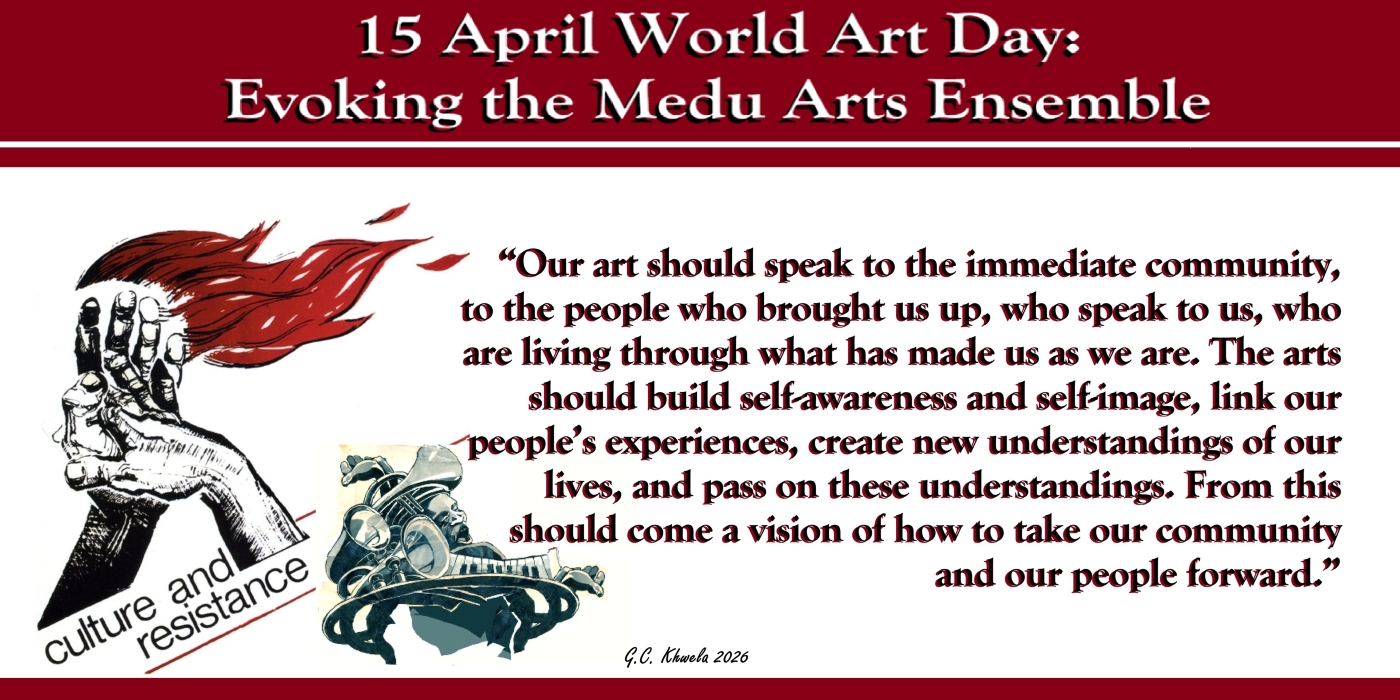
Their motto was: “Our art should speak to the immediate community, to the people who brought us up, who speak to us, who are living through what has made us as we are. The arts should build self-awareness and self-image, link our people’s experiences, create new understandings of our lives, and pass on these understandings. From this should come a vision of how to take our community and our people forward.”
The discussions on the artworks regularly included all Medu members, even those who had no prior visual arts background, to contribute through the messaging of posters and graphics and each artist was expected to actively develop skills and techniques for expression and production. Moreover, everyone had to work with others within the collective to find ways to express themselves. Ideas and principles were also shared with groups inside the country, including the discourse around Staffrider magazine, to the newly formed Cape Arts Project as well as the Junction Avenue in Johannesburg. This was enabled by the nearness of Botswana’s capital, Gaborone, to South Africa, which is a mere 365 kilometres drive to Johannesburg.
The main focus of Medu’s artworks was with poster-making, which became a well-conceived and nurtured project that was intended to fill a function to build a broader sense of community and of direction. The approach was that few people in South Africa’s townships would appreciate, understand or interact with “fine art” that was largely displayed in mainly White art galleries or well-off private homes. However, many people would take to heart images, symbols and slogans that they saw, that spoke to events around them.
Thus, the art form they pursued was focussed on printed posters, slipped into the country, stuck up on walls at night, or in offices. These would be seen and valued by people walking past, even if they were ripped down later by the security police. Such art became the messaging that Medu channelled into the country through artistic endeavour. Photography also provided a bottomless well for images of struggle in Southern Africa. Photos were transformed into new graphics, which were often aggregated within collages, or inspiring drawn images. Several posters were made up of photo-collages, changing meaning through new interrelations of images, challenging the actuality of each image.
Medu visual artists often experimented with new production processes, as they regularly drew upon all members to discuss the messages of the posters and graphic arts. Images and symbols, designs and slogans, grew through collective discussion and participation. Individual artists had to bring their own vision and inspiration, and these would be tested against a group. Every artist had to actively develop their own skills and techniques for expression and production, and they would also be expected to work with, and to train others, to find effective means of expression. Creativity became a collective endeavour, which became a shared enterprise between the individual artist and the collective within which they worked.
Ultimately, artists within the Medu Ensemble began searching for methods of producing graphics that used materials and skills that were readily available in the townships and villages. One of these, was silk-screening, which was a cheap and readily available technology. Moreover, Medu activists began exploring ways to adopt newer silkscreen (such as photo stencil) technologies to township conditions, where people might not have running water or electricity.
By 1984 the graphics unit proposed producing and distributing the “silkscreen workshop in a suitcase”. This would be a portable box (50 cm x 75cm x15cm) with a silkscreen press that could print A2 posters, ink, squeegee and stencil material. This would enable township organisations to make posters even under ill-equipped or illegal conditions. With the assistance of Dutch donors, a few pilot suitcases were built; but following Medu’s destruction in 1985, they were not put into extensive use.
These innovative methods became the inspiration for the Culture and Resistance Festival that Medu hosted in Gaborone, in 1982, where it was famously articulated that “culture is a weapon of struggle”. Culture was not viewed as a merely decorative or passive endeavour, but as a proactive tool to activate, mobilise and unify people in the fight against the racist regime. Arts and culture became a weapon against apartheid and colonialism. In the context of South Africa, it meant artists in exile and activists inside the country were creating work to expose the brutality of apartheid, promote national unity, and build a “People’s Culture”.
Following the 1982 Culture and Resistance Festival, Medu Arts Ensemble’s position in Botswana became increasingly perilous, as apartheid South African Defence Force (SADF) raids into Mozambique, Lesotho and Swaziland became frequent, and attacks on individuals in Botswana increased dramatically after 1982. While the Botswana government was sympathetic to the struggle in South Africa, it pressured people to play down links with the liberation movement.
On 14 June 1985, two days before the African National Congress’ (ANC) Kabwe Conference in Zambia, the apartheid SADF raided Gaborone, killing twelve people, including Medu artist Thami Mnyele and its treasurer, Mike Hamlyn. Several houses of Medu Ensemble members were destroyed, and a number of people were killed in them. Overnight Medu ceased to exist, as many members left the country, while others remained in Botswana as underground operatives, not as artists in residence.
Nevertheless, the theme that Medu championed of the “Cultural Worker”, rather than the “Artist”, emphasised the concept of the “cultural worker” as an artist who used their craft to engage with political reality and social development, rather than a detached or “mystical” artist. The theme served as a way for marginalised groups to preserve their history, values, and traditions when faced with cultural imperialism or erasure, and involved both overt, defiant art (like protest posters) and subtle, “hidden” forms of revolutionary messaging, such as coded lyrics, satire, or graphics that were designed to undermine authority without being immediately detected.
“Artists will have to face up to and challenge the prevailing power structure, by raising the levels of consciousness, by expanding the boundaries of visual and conceptual experiences. This is one function of the creative imagination amongst others; and in this lies a unique power, the power to pose alternatives and to induce people to think; the power to combat the specific form that cultural apartheid takes within the sphere of artistic production.” – Dikobe wa Mogale Ben Martins, 1982.
Sources:
Wikipedia.
South African History Online (SAHO).
Dikobe wa Mogale Ben Martins “The Necessity of Art for National Liberation”, Paper Presented at the Culture and Resistance Festival, Gaborone, 5 – 9 July 1982.
Mary Corrigall, “Art Lost in a Time of Struggle by Mary Corrigall”, Sunday Independent, 31 March 2011.
Luke Fidler, “Artists for Revolutionary Change: A Review of Medu Art Ensemble at the Art Institute of Chicago”, Newcity Art, 25 July 2019.
Castro Khwela
Good morning fellow Compatriots!
Discover more from CASTRO KHWELA
Subscribe to get the latest posts sent to your email.