
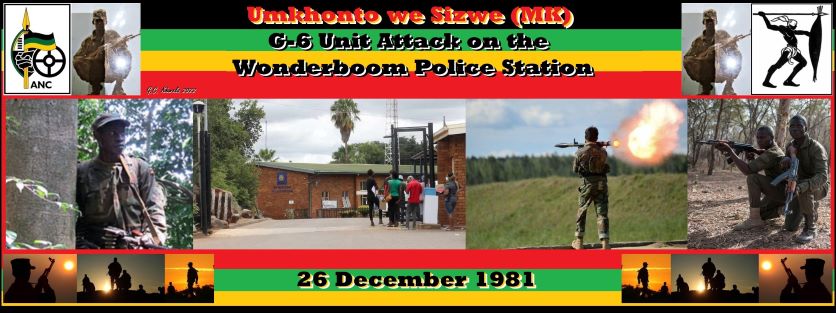
In the evening of 26 December 1981, which was a holiday referred to as “Boxing Day” in South Africa, members of Umkhonto we Sizwe (MK) Transvaal Urban Machinery’s G-6 Unit, Jerry Semano Mosololi, Sydney Molefe and Nicholas Hlongwane left their base, which was an underground dwelling on the island in the Apies River, to a motor rest place near the Hammanskraal taxi rank.
At around 21:00, Simon Thelle Mogoerane and “Bruce” arrived in a Ford Valiant, and the three boarded the vehicle with five AK-47 assault rifles and an RPG-7 rocket launcher. The vehicle then drove to the Wonderboom Police Station, where it stopped in the parking lot in front.
Outside the police station, two policemen were seated on a bench and before they knew what was happening, Molefe and Mogoerane opened fire on them with their AK-47 rifles, with one of the policemen, Constable D.M. Nkosi, being killed.
Meanwhile, Hlongwane and Mosololi proceeded to the charge office, where Hlongwane threw a hand grenade, as Bruce was opening fire towards the station with an RPG-7 rocket launcher. During the firing, Mogoerane ran to the vehicle entrance section at the rear of the police station precinct to attend to the incoming vehicles.
Following a brief lull in the firing, Molefe entered the charge office to check if there were any more policemen inside. After establishing that the station was quiet, Molefe ordered his comrades to retreat. They then ran to the Ford Valiant, which took them to a junction of a gravel and tar road, near to Hammanskraal, where Mosololi, Molefe and Mogoerane disembarked, while Hlongwane and Bruce advanced further in order to burn the vehicle.
Later on it was confirmed that besides Constable Nkosi being killed, four policemen, including two white officers, were injured during the attack. The strategic emphasis which shaped the struggle from 1979 onwards was the necessity for an organised underground political presence to complement armed activities.
It was considered essential that ANC operatives should link up with different forms of popular struggles in township and villages whose protest campaigns were redefining anti-apartheid politics. The “armed propaganda” of MK attacks was intended to serve as a secondary means to deepen mass mobilisation.
The momentous 1978 Politico-Military Strategy Commission report under African National Congress (ANC) President OR Tambo, known as “The Green Book: Theses on our Strategic Line”, also stressed the primacy of political mobilisation:
“The armed struggle must be based on, and grow out of, mass political support and it must eventually involve all our people. All military activities must at every stage be guided by and determined by the need to generate political mobilisation, organisation and resistance, with the aim of progressively weakening the enemy’s grip on the reins of political, economic, social and military power, by a combination of political and military action.”
Armed activity at that stage, the report stated, served “to keep the perspective of people’s revolutionary violence as the ultimate weapon for the seizure of power”, and “to concentrate on armed propaganda actions whose immediate purpose is to support and stimulate political activity and organisation rather than to hit at the enemy”.
In line with this approach, MK operations by units of the Transvaal Urban Machinery took place, mainly aimed at police stations in the Pretoria-Witwatersrand-Vereeniging (PWV) area. At this time the ANC’s dilemma was that in order to be successful militarily, it had to establish a political base inside the country: yet a political base could not grow without military actions serving to reinforce people’s confidence and motivate them to become involved in political and other forms of resistance.
There was a need to capture the imagination of the oppressed through demonstrating that the enemy was not invincible, and to gain international recognition of the armed struggle.
Castro Khwela
Good day fellow Compatriots!
Discover more from CASTRO KHWELA
Subscribe to get the latest posts sent to your email.

I have been reading your previous Information shared on the work of our guerrilla it has been good and thanks for sharing our wonderful history of our gallant fighters.
Bruce, Molefe and Mogoerane are inspiring me every time I read about them. This platform is more informative to an extent that our History is a must in schools.