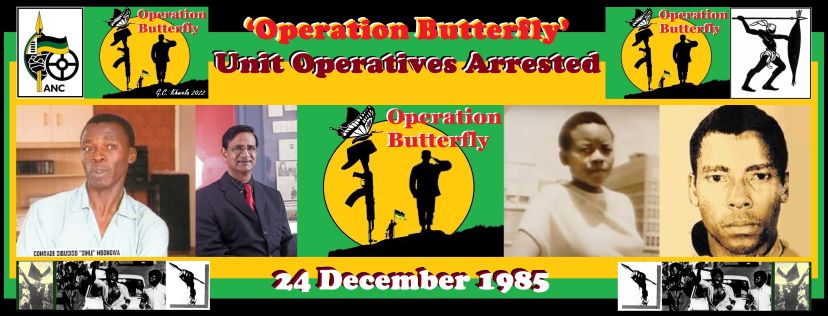
In the morning of 24 December 1985, the apartheid Security Branch reported that it had arrested top ranking African National Congress (ANC) and Umkhonto we Sizwe (MK) operatives in Durban on 23 December 1985. The report followed an operation undertaken around 22:30 the previous night, whereby a large group of security and railway policemen surrounded house number 2, Narbada Road, Merewent, in Durban.
When knocking on the door, Sandy Afrika opened, and the apartheid policemen forcefully went in to search the house after they had introduced themselves. At the kitchen, they found Richard Naidoo, who was the driver during the attack on Amichand Rajbansi’s house, and “Kwazi Sithole” in the lounge.
Afterwards the policemen went to a bedroom upstairs, where Sandy’s husband, Vejay Ramlakan, was conversing with Sihle Mbongwa (aka “Sibusiso Ndlazi”), who introduced himself as “George Fakude”, and another woman, who was introduced as Phila Ndwandwe. All the occupants of the house were arrested.
The arrests followed a massive limpet mine blast in Amanzimtoti that morning by Andrew Sibusiso Zondo and Jacob Mofokeng, which resulted in five white people being killed, and approximately 47 people injured, most of them being white. The blast was part of a retaliatory attack by MK following the Lesotho Raid of 20 December 1985 by the Vlakplaas unit of six men, resulting in the death of nine people, including one Lesotho national.
The previous night, prior to the Amanzimtoti bombing, Lulamile Xate (aka “Tallman”) met with Andrew Sibusiso Zondo at Mapiki Dlomo’s house in Lamontville, where he instructed him to avenge the killings in Lesotho. Xate also met with Audway Msomi, the same evening, giving him the same instruction. The following day, Msomi with Thuso Tshika exploded an empty Volkswagen Kombi parked on the corner of Pine and Albert Street in Durban.
All these operatives were part of the Natal Machinery’s “Operation Butterfly”, which was a programme to develop an integrated political- military underground command structure in the greater Durban area. Telephone engagements between members of the MK ‘Operation Butterfly’ Unit were consistently monitored by the apartheid Security Branch, especially conversations between Sihle Mbongwa (aka “Sibusiso Ndlanzi” or “George Fakude”) and Raymond Lalla (aka “Comrade Brazo”). These were monitored through a wiretap on Vejay Ramlakan’s phone.
The new Command was installed under Mbongwa and Kevin Qobosheane to be in charge of various units amongst whom Sibongiseni Dlomo and Xate were commanding. Operations were also commanded from Swaziland under Raymond Lalla, which was an extensive project spanning the entire province of Natal.
The political cadre was headed by Terence Tryon, who had to be initially accommodated at a hotel, where Ramlakan maintained telephone contact with him. From that moment the Butterfly contingent, which totalled about nine personnel, entered South Africa from Swaziland in early December.
However, there were, from the beginning of the project, a series of basic security breakdowns. The Butterfly contingent’s first port of call was Ramlakan’s own house. Ramlakan also used telephone communications with Yacoob Abba Omar, instead of the less direct methods used in the past.
Tryon himself, together with some of his military counterparts, indicated deep unhappiness about the security procedures of the entire project, yet they continued to hold meetings at Ramlakan’s house, which was under constant surveillance by the apartheid Security Branch.
Barely a month later, the end came in the early hours of Christmas Eve. The apartheid police raided several homes and university residences in the Durban area, obviously employing good intelligence. They arrested all the exiles infiltrated for Operation Butterfly, except for Tryon, who had wisely preferred to rely on his own contacts in Durban, and who returned to exile following the arrests.
Ramlakan’s unit was completely decimated, though a few other linked structures survived, and Yacoob Abba Omar left for exile shortly afterwards. Operatives believed they had walked into a trap set by apartheid security forces and Ramlakan insisted there must have been a security leak in Swaziland. Years later, “Ralph” or “Fear”, who had helped draw up the Butterfly arrangement, apparently admitted to being a long-term apartheid security agent.
As a test project for integrating political and military structures inside the country, “Operation Butterfly” should have been commanded from the Office of the ANC President, Oliver Tambo, or by a special task team established under the auspices of the Politico-Military Strategy Commission (PMSC), rather than be left to the hands of a Regional (Natal) Machinery.
This would have ensured that the security aspects of the operation (OPSEC) were strictly adhered to, as it was to provide lessons on integrating exile guerrillas and internally trained combat units, as well as link these military efforts with mass political struggles.
Castro Khwela
Good day fellow Compatriots!
Discover more from CASTRO KHWELA
Subscribe to get the latest posts sent to your email.