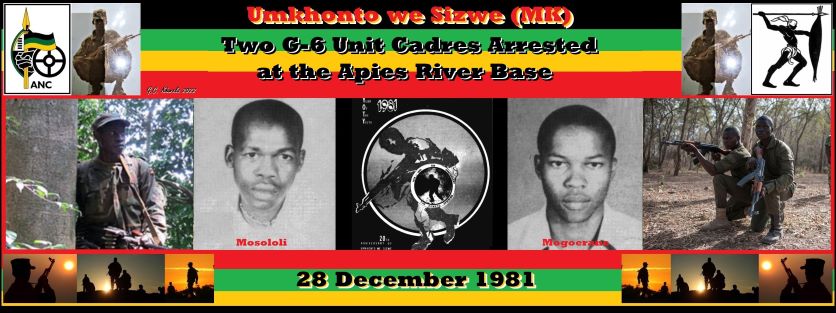
On 28 December 1981, at around 11:00 in the morning, Umkhonto we Sizwe (MK) operatives, Jerry Joseph Mosololi and “Bruce”, were inside their G-6 Unit’s underground dwelling in the Apies River, near Hammanskraal, while Syndey Molefe was sitting outside under a tree shade. About 400 metres away, Nicholas Hlongwane was washing his clothes in the river, while Thelle Simon Mogoerane had gone to buy some food at the nearby shops.
Meanwhile Molefe noticed a man standing in front of the base and another one standing a few metres away. When he approached the man, he began to run away, and Molefe immediately went into the underground dwelling to inform his comrades, Mosololi and Bruce, that the base had been spotted and they had to remove the weapons and hide them.
Mosololi then responded that while they were moving the weapons, he was going to warn “Commander Mteleki Nsizwa” (real name Nicholas Hlongwane), since he was busy doing his washing. A few minutes later, when Mosololi and Hlongwane returned, Molefe and Bruce had already removed the weapons, with only the kitbags remaining. Mosololi and Hlongwane then hid the kitbags somewhere inside the bushes.
After they had managed to shift everything from the dwelling, Mosololi went inside alone to confirm if everything was removed. While he was still inside, he heard a shot go off outside, which was accompanied by sounds of hasty footsteps like somebody was running. Seconds later, he heard someone shouting that he wanted to go into the dwelling, and he responded that he was coming out and they should not shoot.
Getting out of the hole, he encountered a large contingent of apartheid policemen waiting, who pounced on him and began searching him. They then took his money and his reference book, and then handcuffed him. One of the apartheid policemen, who was later confirmed to be Constable van Wyk, asked Mosololi what was he doing there. Failing to respond, Van Wyk then punched Mosololi in the mouth, while asking him where the weapons were. Following being assaulted several times, Mosololi ultimately yielded that the weapons were taken by those who were staying with him in the dwelling, and who had fled the scene.
While Mosololi was being tortured, Mogoerane returned to the base from the shops, carrying some food that he had purchased. When he approached the base, the apartheid policemen pounced and arrested him. Nevertheless, Hlongwane, Molefe and Bruce managed to escape without being arrested.
According to police reports, Mogoerane and Mosololi were arrested at the underground dugout base on the island in the Apies River in Hammanskraal in the late afternoon of 28 December 1981. The location of the base had been discovered when an old man called Samson saw people on the island and went to investigate.
The guerrillas then decided to leave the base and just as they were removing their possessions the police raided them. Mosololi, who was inside the base passing on their possessions to Hlongwane, was unable to escape, but Hlongwane managed to run away.
On 9 June 1983, Mosololi, Mogoerane and Marcus Thabo Motaung were executed for their part in a hit on Wonderboompoort police station. The three MK soldiers were brought to court on charges relating to attacks on racist police stations at Orlando, Moroka and Wonderboompoort. In these attacks, four apartheid policemen were killed and a number of others injured.
When the trial first opened on 23 April 1982 in the Pretoria Magistrates Court, only Mogoerane (23 years old) and Mosololi (25 years old) appeared in court. Both were dragged barefoot into the courtroom wearing leg irons. They refused to plead to the main charge of treason or the alternative charges of participating in “terrorist activities”, murder and robbery with aggravating circumstances.
When they appeared for a third time, in the Pretoria Supreme Court on 1 June 1982, they were accompanied by a third accused, Marcus Thabo Motaung, who was 27 years old then.
The accused guerrillas then became known as the Moroka Three before their execution on 9 June 1983. A massive campaign was launched globally, particularly by the Anti-Apartheid Movement in Europe and the United States, to save their lives. The Umkhonto we Sizwe (MK) Journal, “Dawn”, Issue No. 1, 1988, paid tribute to these gallant fighters by emphasising that:
“At this point in our struggle, it is necessary to remind ourselves what we, as members of MK, truly are, by drawing inspiration from their spirit and reaffirming our vow. In remembering them we cannot forget their outstanding contribution in the struggle for the seizure of power … For us their deeds shall remain a deep source of inspiration until their ideals they cherished have been brought to fruition.”
Castro Khwela
Good day fellow Compatriots!
Discover more from CASTRO KHWELA
Subscribe to get the latest posts sent to your email.