
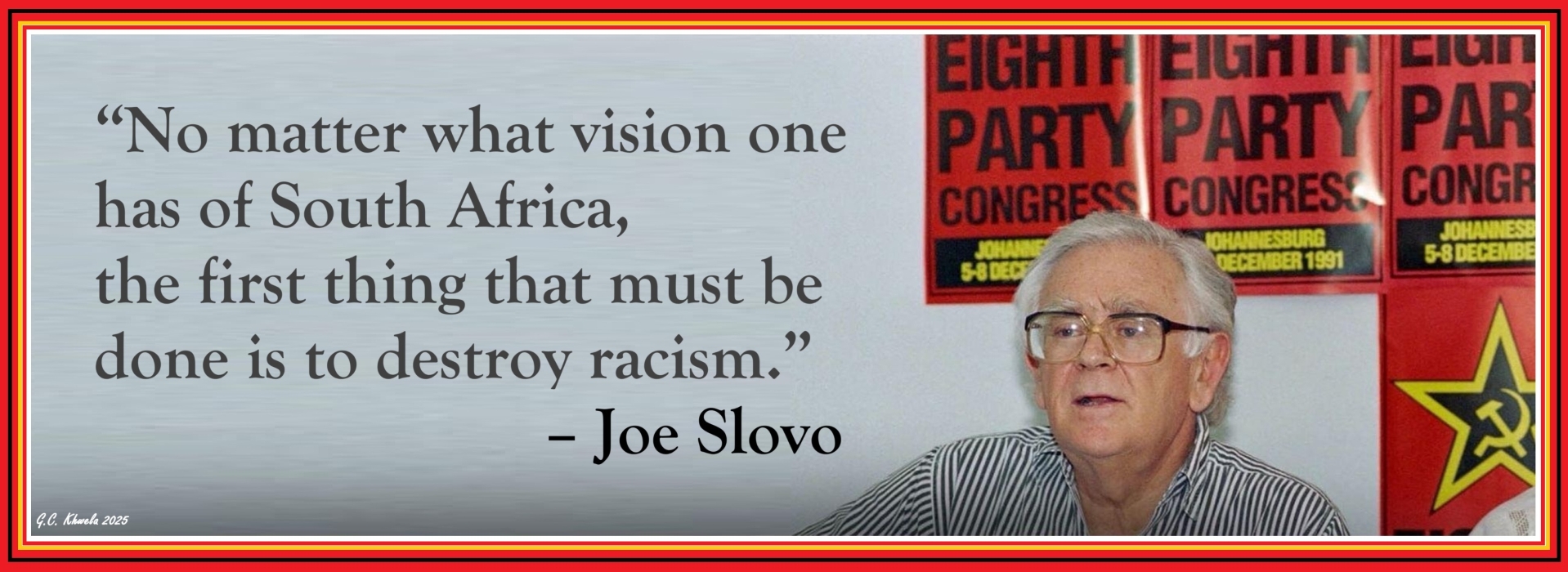
“No matter what vision one has of South Africa, the first thing that must be done is to destroy racism.”
– Joe Slovo
This implies that regardless of what someone personally hopes for or imagines about the country, “whether it be a focus on economic prosperity, social equality, cultural richness, or political stability, the underlying understanding is that South Africa must confront and overcome its legacy of apartheid to achieve a truly unified and just future; it acknowledges the diverse perspectives on the country’s ideal path forward while emphasising the critical need to address racial inequality as a foundational step”. – Joe Slovo
In 2025, South Africa has completed a thirty-year cycle of being a post-apartheid state, and yet a large number of the formerly oppressed majority have little to show that they live in a post-oppressive system that is supposed to be providing opportunities for sustainable development and progress. The relations of production still remain the same and the major sectors of the economy are still in the hands of those who owned them during the colonial and apartheid periods.
Only a handful of the black majority in general and Africans in particular are exposed to the corridors of economic power, and in most instances are those who are either politically connected or those who inherited their wealth due to the Bantustan and the Tri-cameral systems. The rest are still struggling to make ends meet through getting employment, especially in the public sector, as the private sector still remains in the hands of those who used to determine entry into it, particularly the white owners of mining, industrial and financial capital.
The leading party, which is the oldest national liberation movement in the African continent, the African National Congress (ANC), is struggling to take the country forward from a populace that is merely able to vote them into power, but unable to transform the economy into a democratically-owned and driven sector beyond the apartheid or colonial relations. One is therefore justified to refer to South Africa’s political economy as being largely on a neo-colonial and even as a neo-apartheid basis, with a superstructure that is responding to the crises of the gaps that a formerly colonial and apartheid state did not cater for.
Largely, the colonial and apartheid political economy did not extend itself to address issues such as poverty, water, energy (electricity), sanitation and health, housing, education as well as environmental concerns, but most importantly the challenges of unemployment and inequality within the black community in general, and Africans in particular. The ANC inherited an apartheid debt that is consistently mounting, and its servicing costs are unjustifiably eating into the coffers that could have been utilised towards effecting service delivery, particularly in areas where development is still imperceptible.
Responses by the current superstructure (under a so-called government of national unity, which is led by the ANC) to crises of a neo-colonial and a neo-apartheid state are a tall mountain to climb, especially if led and driven from the centre, as other sectors are not responding enthusiastically or are rather selective in their responses. Actually, it should have been expected and be obligatory on all sectors to energetically respond alongside the state, at the centre, towards redressing imbalances of the past to ensure a level-playing field for a conspicuously uneven economy to compete globally.
However, the other sectors, particularly the private and civil sectors, do not share the same vision as the national liberation movement, since they are deliberately withholding their contribution, and the rest are not exposed to or understand the theories and practicalities of socio-economic development. Most of them are still grounded in the crude capitalistic approach towards production, redistribution and consumption, which emphasises individualistic rather than collective efforts towards economic advancement and global competitiveness. The latter has nothing to do with socialistic ambitions, as most champions of the former often argue, but has everything to do with giving capitalism an impetus it has never experienced before within a unique South African context towards mutual benefit.
This is where the social compact, which was touted in various States of the Nation addresses, have failed to materialise: a social compact that ensures that the country’s economy is given a lift to revive the productive forces, particularly the industrial (including manufacturing, mining, agricultural and oceanographic) and financial capacity within which the mostly literate, but currently redundant, youth could be reorientated and utilised. For the past thirty years the ANC has been begging the private and civil sector to come to the party, without success, and unfortunately also foreign direct investment is reluctant to inject into a morbid environment that shows slow growth and alarmingly high levels of unemployment.
It is high time that the people of South Africa and their governments realise that the phase of going cap-in-hand to the private sector, in particular, to join the transformation journey is over, but must now create an environment whereby this sector will wake up to the reality that if it does not become part, it will be left behind, as the rest of society transcends to another mode of socio-economic advancement.
It wouldn’t be a smooth and easy journey, but it is within the grasp of the national liberation movement in conjunction with other socio-political and economic forces that are willing to take the voyage to a truly non-racial national democratic society. The argument here is that there is a huge potential for the economy to grow and expand effectively, given the right leadership, space, latitude, tools and resources to do so. And this will be the beginning of an accurate designation of a national democratic revolution.
Castro Khwela
Good morning fellow Compatriots!🙏🏾✊🏾👊🏾
Discover more from CASTRO KHWELA
Subscribe to get the latest posts sent to your email.



i wish we could debate alternatives to reliance on private sector investment or ways of compelling the white monopoly capital to join the transformation journey before NDR loses out on the commitment of the principal motive force