Apartheid South Africa Signs the Nuclear Non-Proliferation Treaty (NPT)
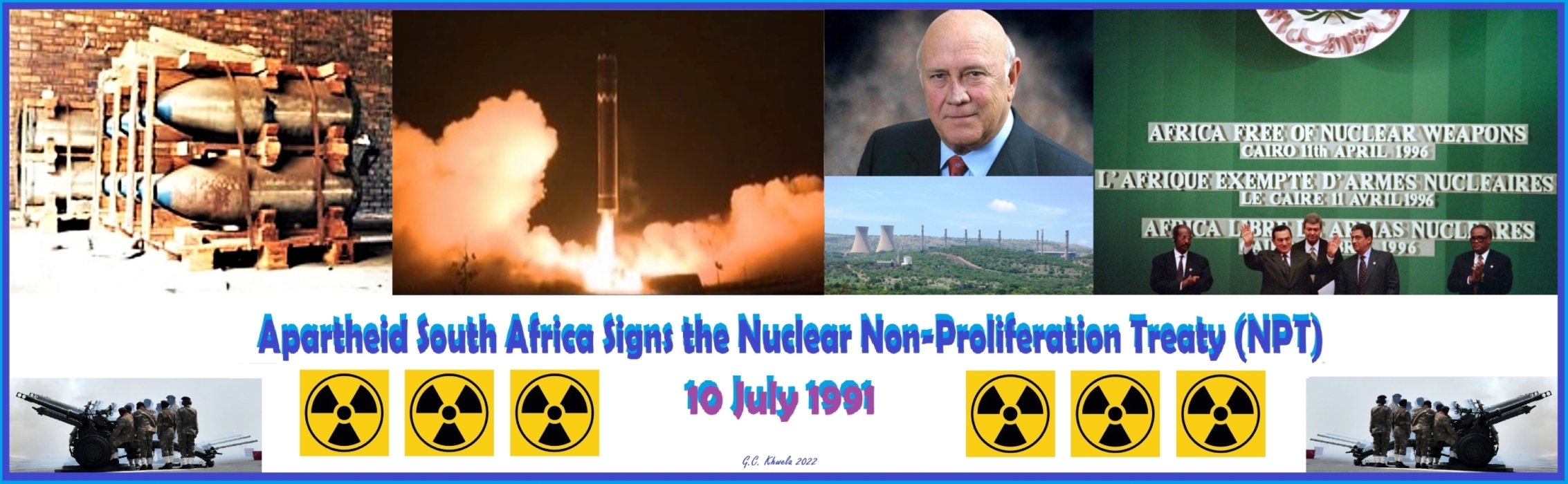
Exactly 35 years ago, on 10 July 1991, apartheid South Africa, which was by then a nuclear-armed state, signed the Nuclear Non-Proliferation Treaty (NPT). When they signed the treaty, President F.W. de Klerk deliberately hid the truth that South Africa had secretly manufactured six nuclear bombs during the 1970s and 1980s. It should be remembered that the end of the Cold War had dramatically altered the political and strategic landscape of Southern Africa. Cuban troops were already withdrawing from Angola when F.W. de Klerk replaced P.W. Botha as president on 15 August 1989.
The Berlin Wall fell in November that year and de Klerk soon embarked on a different course that led to the unbanning of the African National Congress (ANC) and other movements including the South African Communist Party (SACP), as well as the release of Nelson Mandela in early 1990. With “the Soviet and Cuban threat” gone, South Africa could no longer appeal for Western support by invoking anti-communist arguments, nor could it rationalise repression of the democratic opposition by cloaking apartheid in Cold War rhetoric. The political landscape in Pretoria was changing, but the formidable nuclear arsenal that apartheid South Africa had constructed with Israel’s help remained a major concern for the United States government in the early 1990s.
Despite the ANC’s commitment to the principles of non-proliferation, certain United States and British officials, as well as some Israelis, feared that sensitive nuclear technology might fall into the hands of ANC allies, such as Fidel Castro of Cuba and Muammar Gaddafi of Libya, who were hostile to the West. The apartheid government framed this move as a transparent step to end international isolation, drop apartheid-era policies and open its civilian nuclear facilities to the International Atomic Energy Agency (IAEA).
South Africa knew that it would never be welcomed back into the international community with a covert nuclear weapons programme. Accordingly in 1990, under pressure from Washington and London, De Klerk ordered the dismantlement of all existing nuclear warheads and the destruction of all proliferation-sensitive records associated with the programme. By signing the Nuclear Non-Proliferation Treaty (NPT), Pretoria could in one stroke shed its pariah status and gain a seat at the table in major international organisations dealing with nuclear energy and proliferation, such as the Nuclear Suppliers Group (NSG) and the International Atomic Energy Agency (IAEA).
Despite these “internationally acclaimed” moves, the apartheid South African government fought tenaciously to retain the country’s missile technology capability for launching satellites until Washington imposed sanctions against Armscor (South Africa’s Armaments Manufacturing, Exporting and Procurement Corporation), in terms of the Missile Technology Control Regime (MTCR). In 1991, the South African Ambassador to the United States made a last-ditch effort to defend his country’s missile programme as a space launch platform vital to the nation’s economy.
Washington doubted the commercial viability of such a programme and feared that there was too great an incentive to use the same technology to build and export missiles, especially under a future black majority government. Under heavy pressure from the United States, South Africa’s satellite launch capability was eventually put to an end.
With hindsight, Princeton Lyman, the US Ambassador to Pretoria at the time, admitted that South Africa may have been able to compete in the satellite launch industry, but the prospects of proliferation under a black majority government was his overriding concern. In 1994, Washington paid the Pretoria regime approximately $500 000 toward the destruction of the equipment and signed an agreement marking the end of the programme and paving the way for South Africa’s accession to the Missile Technology Control Regime (MTCR).
It was an insignificant sum in the eyes of those who had built and tested the missiles, whose development had actually costed enormous amounts for the racist regime. They remained bitter about the pressure the United States exerted on the apartheid government to end the missile programme, as they claimed that “South Africa sacrificed (on the altar of morality and acceptability to the international community) its leading edge of defence technology, and its leading position as one of the world’s important exporters of weapon systems”, including fifteen thousand job opportunities.
After having spent millions of Rands developing the technologies necessary to enable the production of nuclear weapons, the apartheid regime then completely dissolved and disassembled the entire programme in the twilight of the negotiations between the apartheid state and the national liberation movements. De Klerk’s reforms also required a re-assessment of the nuclear weapons programme, as he stated that from the mid-1980s he had moral qualms about the nuclear weapons programme and believed nuclear weapons to be a burden, as they had lost their deterrence purpose following the end of hostilities in Angola.
When questioned about the timing of the announcement, De Klerk said the apartheid government feared that revealing the existence of its nuclear arsenal earlier could have led to confrontational IAEA (International Atomic Energy Agency) inspections similar to those occurring in Iraq. De Klerk’s announcement before Parliament followed growing international and domestic pressure to reveal the programme, which had been widely suspected in any case, especially by the main adversary to the regime, the African National Congress (ANC). De Klerk acknowledged this pressure in his speech, citing allegations in the media and by some countries that South Africa had not fully revealed its stock of HEU (highly enriched uranium).
Apartheid South Africa’s ambitions to develop nuclear weapons began in 1948 after giving commission to the South African Atomic Energy Corporation (SAAEC), the forerunner corporation to oversee the country’s uranium mining and industrial trade. In 1957, South Africa reached an understanding with the United States (US) after signing a 50-year collaboration under the US-sanctioned programme, Atoms for Peace. The treaty concluded the acquisition of a single nuclear research reactor in 1965, the SAFARI-1, and an accompanying supply of highly enriched uranium (HEU) fuel, located in Pelindaba.
In 1967, South Africa decided to pursue plutonium capability and constructed its own reactor, SAFARI-2 reactor, also at Pelindaba. However, in 1969, the project was abandoned by the apartheid government as it began to focus on the success of its uranium enrichment programme, since the country was able to mine uranium ore domestically. The motivation was on utilising aerodynamic nozzle enrichment techniques to produce weapons-grade material.
In 1969, a pair of senior South African scientists met with Sultan Bashiruddin Mahmood, a nuclear engineer from Pakistan, to conduct studies, research and independent experiments on uranium enrichment. In the 1970s South Africa also capitalised on sufficient experience gained with the US government’s Peaceful Nuclear Explosions (PNE) programme and in 1971, transformed it into a weapons programme.
The apartheid government also collaborated with West Germany, France and Israel in the development of nuclear weapons during the 1970s, and it was enabled to develop a small finite deterrence arsenal of gun-type fission weapons in the 1980s. South Africa only produced an operational weapon after ARMSCOR took over production, and in 1982 it built the first operational weapon. The Atomic Energy Board (AEB) selected test sites in the Kalahari Desert at the Vastrap weapons range north of Upington. These were detected by Soviet intelligence, which in August 1977 alerted the US, and the existence of the test site was confirmed.
The warheads were originally configured to be delivered from one of several aircraft types then in service with the Air Force (SAAF). Concerns about the vulnerability of the ageing aircraft to the Cuban anti-aircraft defence network in Angola subsequently led to the investigation of missile-based delivery systems, based on the RSA-3/4 launchers that had already been built for the space programme.
It was not until 24 March 1993, after all Pretoria’s nuclear bombs had been dismantled, that apartheid President F.W. de Klerk went public and announced to Parliament that South Africa had in fact possessed nuclear weapons. However, many question remained about the truthfulness of South Africa’s nuclear declarations, though they centred more on the issue of cooperation with Israel than concerns about possibilities of a hidden nuclear stockpile. During his speech in Parliament in March 1993, De Klerk declared that “At no time did South Africa acquire nuclear weapons technology or materials from another country, nor has it provided any to any other country, or co-operated with another country in this regard”.
Dubiously, De Klerk explained that the tritium they procured from Israel was an acquisition for commercial use, and that it was never used, which was an unconvincing excuse, given that the apartheid regime was planning and researching thermonuclear weapons at the time. Moreover, there was no explanation regarding the uranium that was supplied to Israel in the 1960s to the 1970s, including the decision to lift the safeguards on the uranium stockpile.
De Klerk carefully chose his words by artfully sidestepping the truth in his 1993 address to Parliament in order to prevent the full exposure of Israeli-South African nuclear cooperation for close to thirty years. Furthermore, De Klerk ensured that by shutting down the nuclear programme, its secrets will go down without being completely unveiled. “They feared that sensitive nuclear technology might fall into the hands of ANC allies … and … the prospects of proliferation under a black majority government. Really?
Sources:
Wikipedia.
South African History Online (SAHO).
South African History Archives (SAHA).
Zondi Masiza, “A Chronology of South Africa’s Nuclear Program”, The Nonproliferation Review, Fall 1993.
David Albright, “South Africa’s Secret Nuclear Weapons”, ISIS REPORT, May 1994.
Adolf von Baeckmann, Garry Dillon and Demetrius Perricos, “Nuclear verification in South Africa”, IAEA BULLETIN, No. 1, 1995.
Frank V. Pabian, “South Africa’s Nuclear Weapon Program: Lessons for U.S. Nonproliferation Policy”, The Nonproliferation Review, Fall 1995.
David Albright, “South Africa’s Nuclear Weapons Program”, Institute for Science and International Security, 14 March 2001.
Maria Babbage, “White Elephants: Why South Africa Gave Up the Bomb and the Implications for Nuclear Nonproliferation Policy”, Journal of Public and International Affairs, Vol. 15, Spring 2004.
Brian Kaper, “Understanding the South African nuclear experience and its applicability to Iran”, Journal of Public and International Affairs. Vol. 19, 2008.
Chris McGreal, “Revealed: How Israel Offered to Sell South Africa Nuclear Weapons”, The Guardian, 24 May 2010.
Sasha Polakow-Suransky, “The Unspoken Alliance: Israel’s Secret Relationship with Apartheid South Africa”, Jacana, 2010.
Lucky Asuelime and Suzanne Francis, “Drivers of Nuclear Proliferation: South Africa’s Incentives and Constraints”, Journal for Contemporary History, Vol. 39, No. 1, 2014.
David Albright and Andrea Stricker, “Revisiting South Africa’s Nuclear Weapons Program: Its History, Dismantlement, and Lessons for Today”, Institute for Science and International Security, 2016.
Atomic Heritage Foundation, “South African Nuclear Program”, Atomic Heritage Foundation, 15 August 2018.
Robert E. Kelley, “A Technical Retrospective of the Former South African Nuclear Weapon Programme”, Stockholm International Peace Research Institute (SIPRI), October 2020.
Robin Möser, “SA the Only Country to Have Dismantled Its Nuclear Weapons Capability”, Mail & Guardian, 25 June 2021.
Jo-Ansie van Wyk and Anna-Mart van Wyk, “The ANC and Apartheid South Africa’s Nuclear Weapons Program”, The Thinker, Vol. 100 No. 3, 2024.
Castro Khwela
Good evening fellow Compatriots!🙏🏾✊🏾👊🏾
Discover more from CASTRO KHWELA
Subscribe to get the latest posts sent to your email.