Morogoro Consultative Conference Strategy and Tactics
The African Masses – the Main Force for Liberation
It has to be acknowledged, and it cannot be denied that the major accomplishment of the African National Congress’ (ANC) Morogoro Conference in its adoption of the Strategy and Tactics document “was the broadening of the conception of African nationalism. Quite correctly, the conference reaffirmed that ‘the main content of the present stage of the South African revolution is the national liberation of the largest and most oppressed group – the African people’, but stressed that the qualities of African nationalism did not stand in conflict with the principles of internationalism. On the contrary, African nationalism could now confidently draw into its ranks all section of the population dedicated to the overthrow of white domination and prepared to abide by the programme and principles of the ANC” (African Communist, No. 77, Second Quarter, 1979).
According to the Conference’s Strategy and Tactics Document, “This strategic aim must govern every aspect of the conduct of our struggle whether it be the formulation of policy or the creation of structures. Among other things, it demands in the first place the maximum mobilisation of the African people as a disposed and racially oppressed nation. This is the mainspring and it must not be weakened. It involves a stimulation and a deepening of national confidence, national pride and national assertiveness. Properly channelled and properly led, these qualities do not stand in conflict with the principles of internationalism. Indeed, they become the basis for more lasting and more meaningful co-operation; a co-operation which is self-imposed, equal and one which is neither based on dependence nor gives the appearance of being so.”
“The national character of the struggle must therefore dominate our approach. But it is a national struggle which is taking place in a different era and in a different context from those which characterised the early struggles against colonialism. It is happening in a new kind of world – a world which is no longer monopolised by the imperialist world system; a world in which the existence of the powerful socialist system and a significant sector of newly liberated areas has altered the balance of forces; a world in which the horizons liberated from foreign oppression extend beyond mere formal political control and encompass the element which makes such control meaningful – economic emancipation.”
“It is also happening in a new kind of South Africa: a South Africa in which there is a large and well-developed working class whose class consciousness and in which the independent expressions of the working people – their political organs and trade union – are very much part of the liberation front. Thus, our nationalism must not be confused with chauvinism or narrow nationalism of a previous epoch. It must not be confused with the classical drive by an elitist group among the oppressed people to gain ascendancy so that they can replace the oppressor in the exploitation of the mass.”
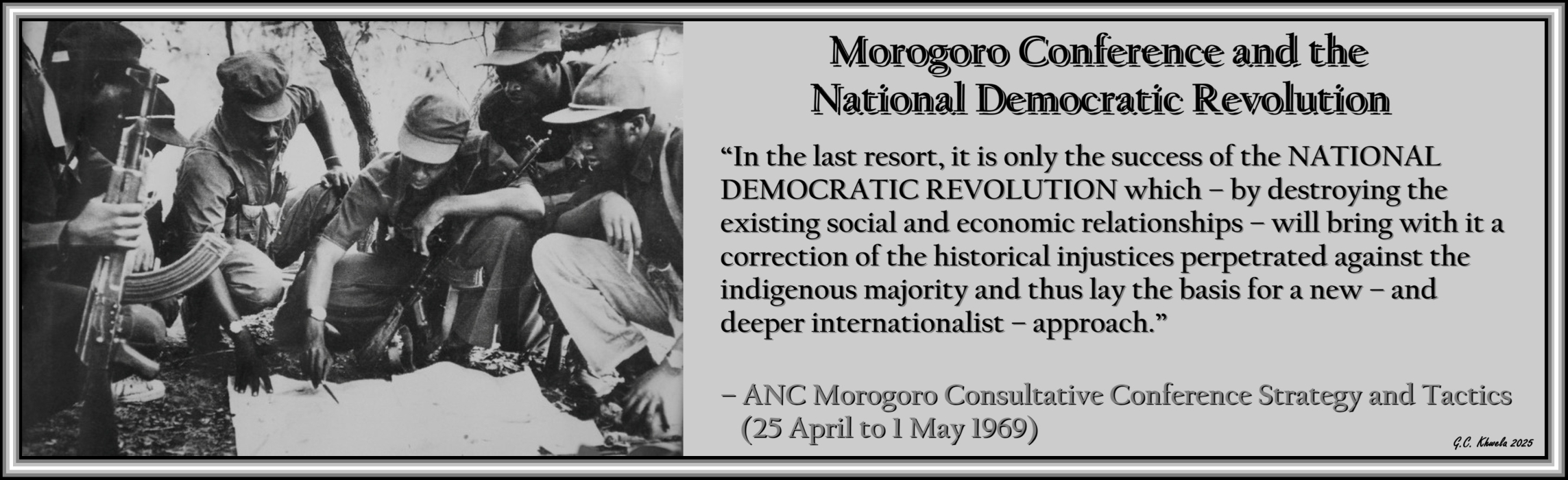
“But none of this detracts from the basically national context of our liberation drive. In the last resort, it is only the success of the national democratic revolution which – by destroying the existing social and economic relationships – will bring with it a correction of the historical injustices perpetrated against the indigenous majority and thus lay the basis for a new – and deeper internationalist – approach. Until then, the national sense of grievance is the most potent revolutionary force which must be harnessed. To blunt it in the interests of abstract concepts of internationalism is, in the long run, doing neither a service to revolution nor to internationalism.”
“… Whatever instruments are created to give expression to the unity of the liberation drive, they must accommodate two fundamental propositions: Firstly, they must not be ambiguous on the question of the primary role of the most oppressed African mass. Secondly, those belonging to the other oppressed groups and those few White revolutionaries who show themselves ready to make common cause with our aspirations, must be fully integrated on the basis of individual equality. Approached in the right spirit these two propositions do not stand in conflict but reinforce one another. Equality of participation in our national front does not mean a mechanical parity between the various national groups. Not only would this in practice amount to inequality (again at the expense of the majority), but it would lend flavour to the slander which our enemies are ever ready to spread of a multiracial alliance dominated by minority groups.”
“But the sluggish way in which the Movement inside the country responded to the new situation after 1960 in which co-operation continued between some organisations which were legal and those that were illegal sometimes led to the superficial impression that the legal organisations – because they could speak and operate more publicly and thus more noticeably – may have had more than their deserved place in the leadership of the Alliance.”
“Therefore, not only the substance but the form of our structural creations must, in a way which the people can see – give expression to the main emphasis of the present stage of our struggle. This approach is not a pandering to chauvinism, to racialism or other such backward attitudes. We are revolutionaries, not narrow nationalists. Committed revolutionaries are our brothers to whatever group they belong. There can be no second class participants in our Movement. It is for the enemy we reserve our assertiveness and our justified sense of grievance.”
“… Like every other oppressed group (including the Africans), we must not naively assume that mere awareness of oppression will, by itself, push the Indian and so-called Coloured people in the direction of opposing the enemy and aligning themselves with the liberation movement. The potential is, of course there, because in a very real sense the future of the Indian and so-called Coloured people and their liberation as oppressed groups is intimately bound up with the liberation of the Africans. But active support and participation has to be fought for and won. Otherwise the enemy will succeed in its never-ending attempt to create a gap between these groups and the Africans and even recruit substantial numbers of them to actively collaborate with it.”
“More particularly, the enemy will feed on the insecurity and dependency which is often part of the thinking of minority oppressed groups. They will try to raise doubt in their minds about whether there is a place for them in a liberated South Africa. They have already spread the slander that at best for the so-called Coloureds and Indians, White domination will be replaced by Black domination. It is therefore all the more important, consistent with our first principle, that the so-called Coloured and Indian people should see themselves as an integral part of the liberation movement and not as mere auxiliaries.”
The Critical Role of the Working Class
“The next important question to be asked is that is there a special role for the working class in our national struggle? We have already referred to the special character of the South African social and economic structure. In our country – more than in any other part of the oppressed world – it is inconceivable for liberation to have meaning without a return of the wealth of the land to the people as a whole. It is therefore a fundamental feature of our strategy that victory must embrace more than formal political democracy. To allow the existing economic forces to retain their interests intact is to feed the root of racial supremacy and does not represent even the shadow of liberation.”
“Our drive towards national emancipation is therefore in a very real way bound up with economic emancipation. We have suffered more than just national humiliation. Our people are deprived of their due in the country’s wealth; their skills have been suppressed and poverty and starvation has been their life experience. The correction of these centuries-old economic injustices lies at the very core of our national aspirations. We do not underestimate the complexities which will face a people’s government during the transformation period nor the enormity of the problems of meeting economic needs of the mass of the oppressed people. But one thing is certain, in our land this cannot be effectively tackled unless the basic wealth and the basic resources are at the disposal of the people as a whole and are not manipulated by sections or individuals be they White or Black.”
“This perspective of a speedy progression from formal liberation to genuine and lasting emancipation is made more real by the existence in our country of a large and growing working class whose class consciousness complements national consciousness. Its political organisations and the trade unions have played a fundamental role in shaping and advancing our revolutionary cause. It is historically understandable that the doubly-oppressed and doubly-exploited working class constitutes a distinct and reinforcing layer of our liberation and socialism and do not stand in conflict with the national interest. Its militancy and political consciousness as a revolutionary class will play no small part in our victory and in the construction of a real people’s South Africa.”
“… What then is the broad purpose of our national democratic struggle? Simply put, in the first phase, it is the complete political and economic emancipation of all our people and the constitution of a society which accords with the basic provisions of our programme – the Freedom Charter. This, together with our general understanding of our revolutionary theory, provides us with the strategic framework for the concrete elaboration and implementation of policy in a continuously changing situation. It must be combined with a more intensive programme of research, examination and analysis of the conditions of the different strata of our people (in particular those on the land), their local grievances, hopes and aspirations, so that the flow from theory to application – when the situation makes application possible will be unhampered.”
“OUR DRIVE TOWARDS NATIONAL EMANCIPATION IS THEREFORE IN A VERY REAL WAY BOUND UP WITH ECONOMIC EMANCIPATION!”
Sources:
Sechaba Correspondent, “Strategy and Tactics of the African National Congress”, Sechaba, Vol. 3 No. 7, July 1969.
Editorial Notes, “Ten Years of Struggle”, African Communist, No. 77, Second Quarter, 1979.
Castro Khwela
Good day fellow Compatriots!
Discover more from CASTRO KHWELA
Subscribe to get the latest posts sent to your email.