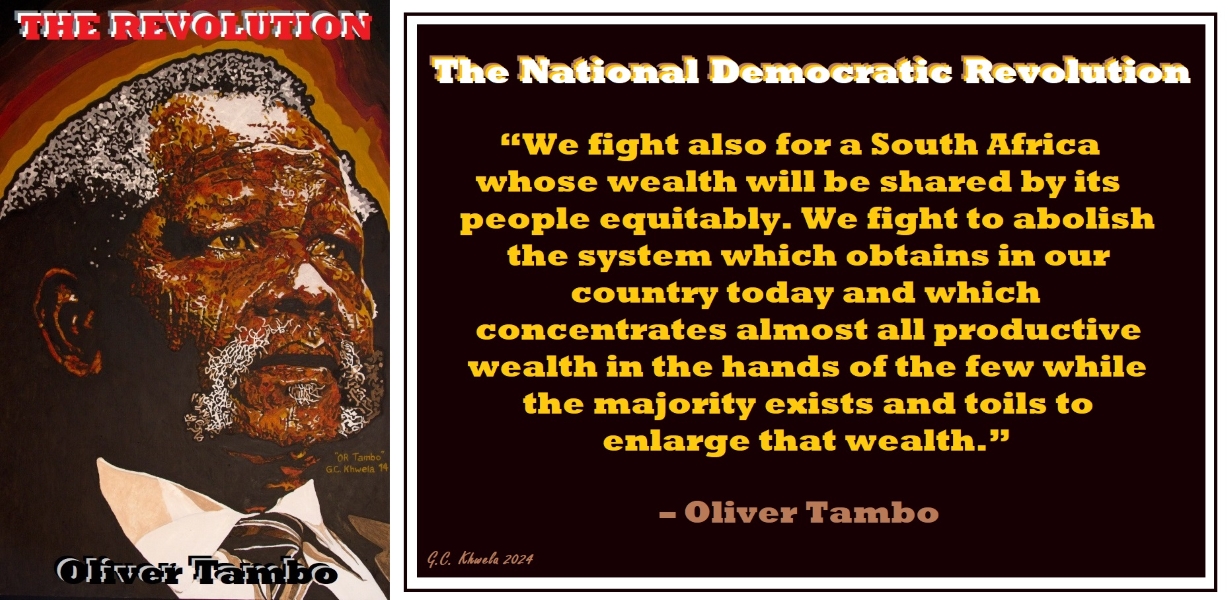
Describing the National Democratic Revolution
“In capitalist society, providing it develops under the most favorable conditions, we have a more or less complete democracy in the democratic republic. But this democracy is always hemmed in by the narrow limits set by capitalist exploitation and consequently always remains, in effect, a democracy for the minority, only for the propertied classes, only for the rich. Freedom in capitalist society always remains about the same as it was in the ancient Greek republics: freedom for the slaveowners. Owing to the conditions of capitalist exploitation, the modern wage slaves are so crushed by want and poverty that ‘they cannot be bothered with democracy’, ‘cannot be bothered with politics’; in the ordinary, peaceful course of events, the majority of the population is debarred from participation in public and political life.” ― Vladimir Lenin, State and Revolution.
The National Democratic Revolution is aimed at addressing this concern that Lenin raised with the limitations imposed by capitalist (‘liberal’) democracy, which is in reality capitalism for the rich, as the formerly oppressed and exploited only witness democracy after every five years (or two-and-a-half years for local government) when they are going to cast their vote. In between the elections there is no democratic participation and an effective way to change their torrid circumstances. As such, the formerly oppressed and exploited tend to disregard any participation in elections and become apathetic to political developments.
This revolution is aimed at addressing this concern, in particular, to ensure that the management of the economy and state resources is democratically done not by the political parties or an elite sitting somewhere in the capitals of national and provincial power, but by the people themselves at a local level. In line with the Freedom Charter’s clauses that the People Shall Govern and that they Shall Share in the Country’s Wealth, such a revolution is aimed at fulfilling that view raised in 1955 by the Congress of the People in Kliptown.
In a ground-breaking move, the ANC in 1987 initiated a process of defining the National Democratic Revolution in the January 8 Statement titled, “Advance to People’s Power”, primarily covered in three paragraphs on pages 5 – 6 of “Sechaba: Official Organ of the African National Congress of South Africa” (February 1987). This was a seminal discourse which was aimed at addressing the acute contradictions of South Africa being characterised as a “colonialism of a special type”, wherein the coloniser and the colonised occupied the same space (settler colonialism), in contrast to classical colonialism. It reflected the future trajectory of the ANC, especially the type of society it was envisaging with the end of apartheid and redressing the imbalances of such a “colonial” past.
According to then President OR Tambo, “For us, it is of especial importance that the new reality should reinforce and entrench what we are accomplishing now, in struggle: the building of a nation of South Africans. It must reflect and enhance our oneness, breaking down the terrible and destructive idea and practice of defining our people by race, colour or ethnic group. The revolution will guarantee the individual and equal rights of all South Africans without regard to any of these categories, and include such freedoms as those of speech, assembly, association, language, religion, the press, the inviolability of family life and freedom from arbitrary arrest and detention without trial. For all this, the victorious revolution demands and must ensure thorough-going democratic practice.”
Tambo continued to say, “For its own success, it imposes the obligation that all should be free to form and join any party of their choice, without let or hindrance. But as a people and a movement, we must state it clearly that democracy in our country cannot succeed if it permits the organised propagation of ideas of fascism, racism and ethnicity. Apart from our own experience, we cannot, in the name of democracy, tolerate the organised sustenance of conceptions which led to the Second World War and which have since been categorised and dealt with as a crime against humanity.”
“Of central importance also”, Tambo added, “is the critical requirement that the new South Africa must guarantee the masses of our people freedom from hunger, disease, ignorance, homelessness and poverty. The democratic state will be representative of all the people of our country, and especially the ordinary working people who own neither land nor factories and neither the mines nor the banks. It will therefore be called upon to ensure that the wealth of the country increases significantly and continuously and that it is shared equitably by all the people to ensure their material and spiritual upliftment and well-being.”
Accordingly, “To achieve these objectives, the new democratic order will necessarily have to address the question of ownership, control and direction of the economy as a whole to ensure that neither the public nor the private sectors serve as a means of enriching the few at the expense of the majority. The transfer of power to the people must therefore be accompanied by the democratisation of the control and direction of the economy so that indeed the people share in the wealth of our country, for the common goal.”
There is no better definition of the National Democratic Revolution and a National Democratic Society than this one. And if the ANC failed to pursue these objectives it meant that it would have failed to fulfil its historic mission, which the people, the continent and the world are expecting the ANC to achieve. For the past thirty years since South Africa had established a new democratic dispensation, it has been difficult to move beyond the guaranteeing of individual and equal rights towards ensuring that the wealth of the country is shared by the people as a whole, which is at the essence of a national democratic society.
The essential reason for this difficulty is that the ANC failed to critically evaluate its weaknesses and strengths, and at the same time identifying succinctly the various threats and opportunities, both as a movement and a country. The reason for such a failure is largely based on a dearth of an appropriate unit of analysis, which could fittingly assist in assessing successes and difficulties in the entire country, despite the various disparities that are characteristic of most, if not all, post-colonial states generally, and South Africa being a post-apartheid state in particular, where resources were unevenly distributed along racial lines.
Attempts were made previously to use the provinces as units of analysis, which was rather myopic, given the enormous levels of inequalities that exist among these nine entities. Some have extreme cases of poverty and wealth alongside each other, most are predominantly rural, while one is intensely urbanised, while only two or three have pockets of urbanisation that are comparative to first world standards. Accordingly, it would have been imprudent to use such entities as suitable units of analysis (To be continued).
Castro Khwela
Good morning fellow Compatriots!🙏🏾✊🏾👊🏾
Discover more from CASTRO KHWELA
Subscribe to get the latest posts sent to your email.