Fish Keitseng’s Land Rover Exploded
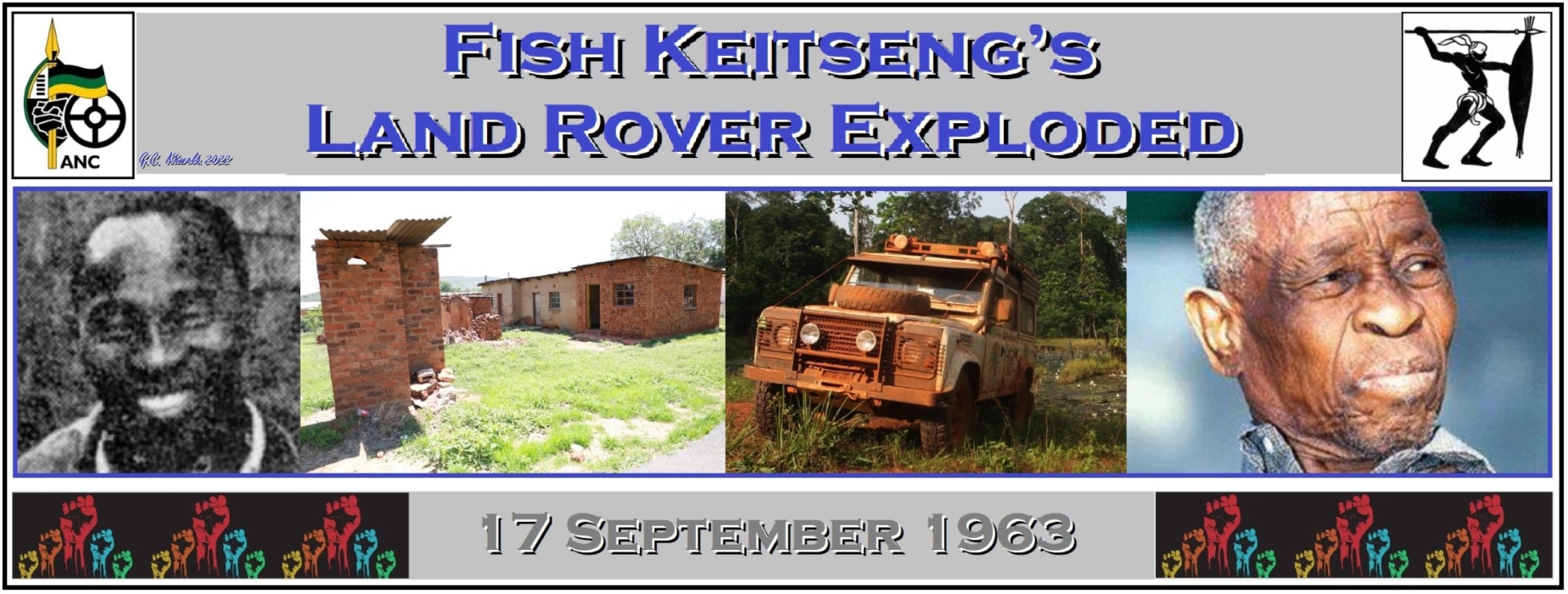
On 17 September 1963, during the night, the Land Rover that Jack Hodgson bought for Fish Keitseng to use in Peleng Village, in Lobatse, was extensively damaged by explosives. Jack Hodgson had received the money to purchase the vehicle from Tanganyika, and he bought the Land Rover in Germiston on 20 July 1963. The vehicle was procured to assist with his demanding tasks of ferrying comrades leaving South Africa into Bechuanaland to get to safer areas towards the north of the sub-continent.
Fish Keitseng was a defendant in the 1956 Treason Trial and was deported to Bechuanaland by the apartheid regime in 1959. He settled in Lobatse and was in charge of the African National Congress (ANC) in Bechuanaland. Towards the end of 1960, after the ANC was banned, the young Joe Modise linked up with Keitseng and recruited him into the ANC underground network. Joe Modise became one of the founders of Umkhonto we Sizwe (MK) and participated in its first operations. He helped establish MK infrastructure throughout the country, spending two years working underground. He played a key role in sending recruits out of South Africa for military training before going into exile in 1963. Together with Keitseng they played a key role with the Bechuanaland pipeline.
Following the procurement of the vehicle, Hodgson arranged for Keitseng to get an intensive driving course to be able to qualify for a driver’s licence, and that was contained in a letter that Hodgson wrote to the Deputy President of the African National Congress (ANC), Oliver Tambo. In the letter, Hodgson maintained that since the Rivonia arrests, communications with South Africa had broken down. Accordingly, he suggested that the situation demanded for some of the comrades to get back into the country to re-organise the underground, as some of the structures and individuals were still surviving.
However, following the explosion of Keitseng’s Land Rover, Jack and Rica Hodgson were deported from the Bechuanaland protectorate on 21 September 1963 on a plane chartered by the country’s administration. They had moved to Lobatse in early 1962, where they continued to support the underground struggle, until being deported later in the year. They were accompanied by a Bechuanaland police inspector, as they landed in Mbeya, Tanganyika, on the afternoon of 22 September 1963.
During the early 1960s, much of the ANC leadership moved north en masse, eventually establishing exile bases in the newly-independent African states of Zambia and Tanzania. Most of these ANC leaders and young militants passed through the Protectorate, since it was on the South African border and was considered safe to enter. It was not always easy for exiles to make their way safely through the Protectorate since agents of the apartheid regime and their fellow travellers operated with impunity in the country, at times kidnapping budding exiles.
To facilitate such nefarious activities, the apartheid South African security forces routinely bribed policemen, a process that was alleged to have continued throughout the entire apartheid era. Nor did bribery end with the police, since the apartheid forces also had a number of paid Batswana informants who acted in various capacities. Apart from the threat of kidnapping, the South Africans were willing to use violence.
The key person involved was Keitseng, who, and none of his comrades, had any training in covert operations. Keitseng’s life as a migrant worker and grassroots union organiser, as well as his lack of schooling, further set him apart from most other leading ANC activists of his generation. When he initially became involved in the struggle, he was still very much the product of his rural background, having grown up at his father’s cattle post. After going to South Africa just before the Second World War to work in the mines, he began to acquire a militant working class consciousness not shared by many Batswana migrants.
Later leaving the mines, he stayed on to work in Johannesburg, usually without the right papers, moonlighting as both a union and ANC activist. Yet, notwithstanding his commitment to South Africa’s liberation, Keitseng has never forgotten his roots as a son of Botswana’s soil. Moreover, it was never a secret that Keitseng was the ANC point man, and everybody knew where he lived in Lobatse. For this reason, Keitseng was not directly responsible for post-1962 MK infiltrations into South Africa or Rhodesia from Bechuanaland, his job being to secure the road to the north, rather than the return route to the south.
Keitseng did not operate alone, relying on intermittent help from a network of Batswana sympathisers, most of whom were ANC veterans and members of the Bechuanaland People’s Party (BPP), a radical nationalist group that Keitseng helped found in 1961. These sympathisers, whose contributions varied, included Klaas Motshidisi, a young union activist in Palapye; Anderson Tshepe, a Francistown resident, who had obtained military training in China; Michael Dingake, who served on the ANC’s underground National Secretariat; Mack Mosepele, who had been with Fish as far back as the 1946 Mine Workers strike and subsequent Newclare protests; and Motsamai Mpho, the ex-Treason Trialist lived in Palapye. These men worked as drivers and provided safe houses when Keitseng asked them to.
In the earliest years of the pipeline, from 1960 to 1962, Keitseng had no phone and no vehicle. He received relayed messages and cash from the young Umkhonto we Sizwe (MK) officer, Joe Modise. Following the reception of information, Keitseng would either await or pick up ANC members and arrange for them to be forwarded to the north, and for some ANC members, especially the leadership, were then kept safe until a charter plane was organised. The aerial pipeline was no ordinary pipeline, such the road and rail networks where the rank and file were taken by Keitseng by train to Francistown from where they then drove to Livingstone in Northern Rhodesia.
The aerial pipeline was the niche operation that moved key South African leaders, political refugees and freedom fighters through Bechuanaland to Tanganyika and Northern Rhodesia (and vice-versa). The aim was to transit them by air as fast as possible to protect them from being kidnapped by agents of the apartheid regime, as this was a constant danger. For example, during March and April 1960, Deputy President Oliver Tambo narrowly avoided being abducted by the apartheid Security Branch.
The air link ran from Lobatse via Kasane and, until Northern Rhodesia (now Zambia) gained independence, then over-flew that territory to Mbeya, where refuelling took place before flying on to Dar es Salaam. The return trip followed the same route in reverse from Dar es Salaam. This mini airline, which was called Bechuanaland Air Safaris, was established by Captain Herbert Bartaune as a charter company in 1961 and it linked Bechuanaland, Basutoland and Swaziland. Fish Keitseng, who played a key role in establishing various pipelines in Bechuanaland in the early 1960s, remembered Bartaune by name, describing him as a person who flew many people to safety.
In other cases, Keitseng took his charges north on the train up to Francistown, where he would borrow a vehicle from an ANC sympathiser, or perhaps rent one, and then have his men driven either across the Kalahari Desert to Kazungula or through Southern Rhodesia to Victoria Falls. From Kazungula or Victoria falls they would then proceed, via Livingstone, to points further north – which became known as “freedom ferry”. The choice of routes was dictated by changing circumstances. In most instances these trips were precarious, as South African police enjoyed a broad network of spies within the Bechuanaland and neighbouring territories, often forcing Keitseng to travel on obscure routes and by cover of darkness to evade detection and arrest.
Late in 1962, Keitseng was taught how to drive by Jack Hodgson who lived with him in Lobatse, following which a Land Rover was purchased for his use. In addition, a phone was installed in his house. With the vehicles in hand, Keitseng, eschewed using the train for the most part and instead routinely drove up to Kazungula through the desert. According to Keitseng, “After they taught me to drive, I started to work with them, using that Land Rover. A lot of people used to come, and some months there were fifty or eighty. Every week I had to go to Kazangula. Man, I was driving like hell. … I would collect people near the border at Lobatse, and then take them to Palapye, where Mpho and Motshidisi were staying.”
On the night of 17 September 1963, Keitseng heard a bang, like a very strong bomb. So when he got up and looked outside, he found his ANC Land Rover, registration BF 320, had been hit. Interestingly, the Land Rover was hit about three weeks after Arthur Goldreich and Harold Wolpe had been driven by Fish Keitseng, on 28 August 1963, from Lobatse to Francistown, as they had escaped South Africa, leaving for Tanganyika about a month later. In those days it was dangerous in Lobatse, and apartheid police and agents were all over. Keitseng took turns with Goldreich and Wolpe driving the Land Rover all night to Francistown. Three weeks later, the apartheid police from South Africa, Keitseng knew, had bombed the Land Rover.
Sources:
Wikipedia.
South African History Online (SAHO).
Garth Benneyworth, “Bechuanaland’s Aerial Pipeline: Intelligence and Counter Intelligence Operations against the South African Liberation Movements, 1960–1965”, South African Historical Journal, Vol. 70, Issue 1, 2018.
Arianna Lissoni, “Umkhonto we Sizwe (MK): The ANC’s Armed Wing, 1961–1993”, Oxford Research Encyclopaedias, 22 December 2021.
Patrick Ricketts, “Routes to Freedom: The Pipeline to Freedom – Botswana and the Liberation Struggles in Southern Africa – People, Places & Events”, Botswana National Museum, (No date provided).
Gregory F. Houston, “Military Bases and Camps of the Liberation Movement, 1961-1990”, Human Sciences Research Council, January 2013.
Stephen Ellis, “External Mission: The ANC in Exile, 1960–1990”, Oxford University, 2013.
Thula Simpson, “Umkhonto we Sizwe: The ANC’s Armed Struggle”, Penguin, 2016.
Fish Keitseng, “Comrade Fish: Memories of a Motswana in the ANC Underground”, Barry Morton and Jeff Ramsay, Pula Press, Gaborone, January 2018.
Stephen Davis, “The ANC’s War Against Apartheid: Umkhonto we Sizwe and the Liberation of South Africa”, Indiana University, 2018.
Castro Khwela
Good evening fellow Compatriots!
Discover more from CASTRO KHWELA
Subscribe to get the latest posts sent to your email.