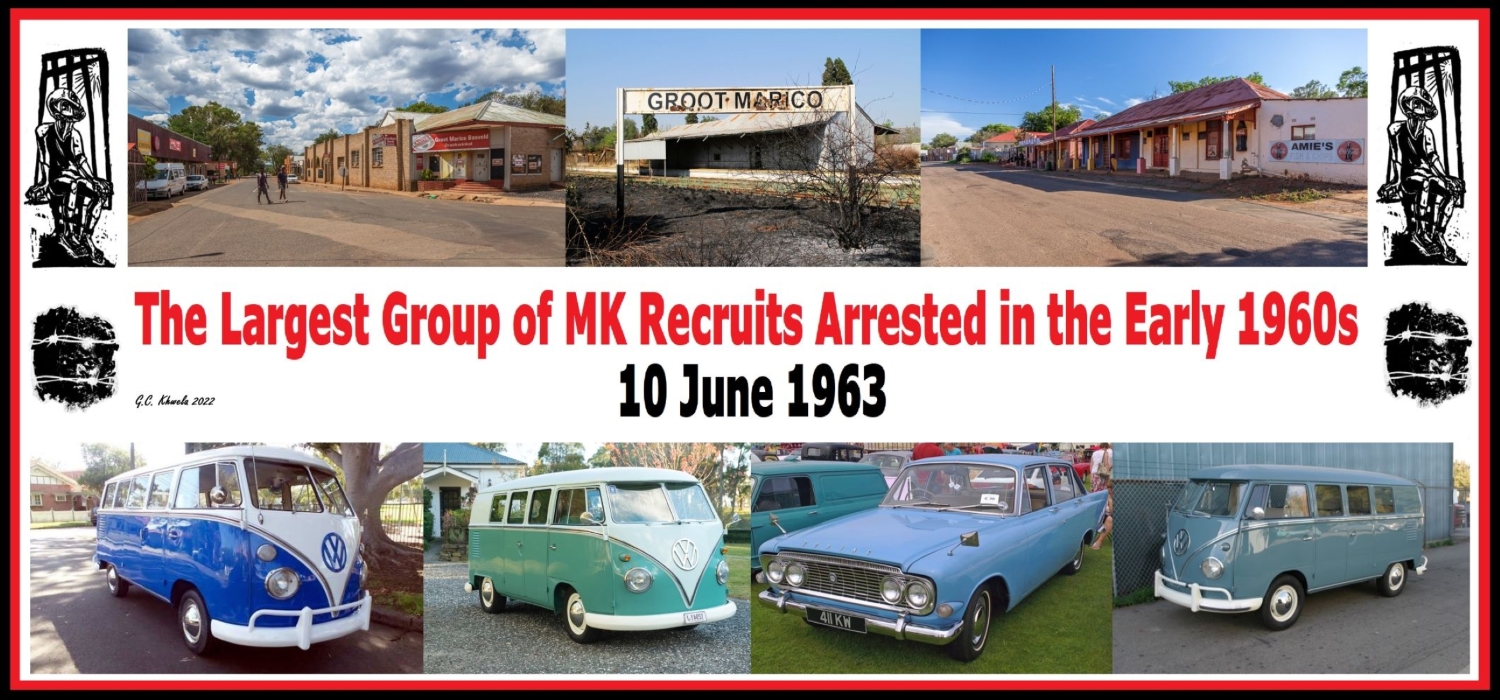
The Largest Group of MK Recruits Arrested in the Early 1960s
On the morning of 10 June 1963, at approximately 06:00, when apartheid Police Sergeant Ferreira arrived at the Rustenburg Police Station, he found a Zodiac Zephyr and three Combis outside the building. Inside the station he found Levy Mbatha, Essop Suleiman and an African woman. From the four vehicles, the Zephyr and the three Combis that were apprehended during the night, in excess of fifty people had been arrested.
Among those arrested was Essop Suleiman and all the drivers used by him to transport African National Congress (ANC) recruits to the Bechuanaland border on this particular and previous occasions, as well as Zazi Ngcongo and Jacob Zuma, who were part of a group of eight sent by Solomon Mbanjwa from Natal. Likewise were Herbert Sitilo and Solomon Montwedi, who were sent by Caleb Matshabe from Bloemfontein. There were other recruits from other parts of the country, including a group that was sent from the Western Cape by Looksmart Ngudle. They were all taken to Pretoria where they were held under the ninety-day detention law.
With these arrestees and the groups that were repatriated from North and South Rhodesia earlier in the year, the apartheid South African security forces had in their custody a large number of prisoners who were presumed to possess a wealth of information about the composition of the Umkhonto we Sizwe (MK) underground in most of its regions in the country. Unless these mostly young, untrained recruits could hold out under indefinite detention, the intelligence gathered from them was anticipated to provide the basis for nationwide police operations against the revolutionary underground. Taken together, the arrests were marked a turning point in the conflict.
It all began at around midnight on 9 June 1963, when Detective Sergeants Uys and Ferreira were passengers in a car driven by Colonel van Niekerk that was parked in the bush a few kilometres from Groot Marico on the road leading to Zeerust. The car was parked to observe the road to Zeerust, as they were tipped about the large group of MK recruits that were destined for Bechuanaland. When a Zodiac Zephyr passed them, followed by two Combis, Van Niekerk followed the vehicles. When one of the Combis turned off the road and headed back from the Lobatse-bound road through Zeerust, the policemen stopped it and Sergeants Ferreira and Uys climbed into it. They noticed that the vehicle was driven by an Indian and had African passengers inside, and it headed off with the two policemen on board.
They eventually reached a road block where they handed the driver and passengers over to the members of the apartheid Police Uniform Branch. Sergeants Ferreira and Uys then drove another police vehicle in order to apprehend the other vehicles that were still at large. Just before leaving Zeerust, they found another Combi, also driven by an Indian and with a large contingent of Africans on board, blocked by members of the apartheid Police Detective Service. Those apprehended were taken to the Zeerust Police Station.
At the Zeerust station, Ferreira began interrogating the passengers of the two Combis that were stopped earlier, and when he got the information he wanted, he urged Sergeant Uys and two members of the Uniform Section to accompany him immediately to Groot Marico. Just outside Groot Marico, they stopped the third Combi, Ferreira climbed inside, and began asking its inhabitants as to where they were going. The so-called Coloured driver said they were going to a football match. All the people in the Combi were arrested and taken to the Groot Marico Police Station.
From Groot Marico Police Station the group was taken to Rustenburg Police Station where they arrived the following morning, and it was where the entire group, consisting of Levy Mbatha, Zazi Ngcongo, Herbert Sitilo, Solomon Montwedi, Judson Diza Khuzwayo and Jacob Zuma, among others, were processed for ninety-day detention. They were detained in solitary confinement at the Hercules Police Station near Pretoria, during which they were interrogated and beaten. The trial was held at the Pretoria Old Synagogue where Judge Fritz Steyn sentenced them, including the 21-year-old Jacob Zuma, who was sentenced to 10 years on Robben Island for conspiring to overthrow the apartheid government.
Responding to these various arrests and sentences, the Deputy President of the ANC, Oliver Reginald Tambo, in a Statement to the Special Political Committee of the United Nations General Assembly on 8 October 1963, said, “An atmosphere of crisis has been whipped up and its effects have been reflected in the severity of sentences passed by the judges, and not infrequently, in the statements they make in the course of pronouncing sentence. … This judgement and these remarks are a sufficient – and deliberate – hint as to what sentences the South African public and the world are to expect in the new trials where leaders of the political struggle against the apartheid policies of the South African Government are the accused.”
According to Tambo, “Already more than 5,000 political prisoners all languishing in South Africa’s jails. Even as recently as the month of September of this year and after the Security Council, in its resolution of 7 August, had called for the release of ‘all persons imprisoned, interned, or subjected to other restrictions for having opposed the policy of apartheid, three detainees have died in jail in circumstances strongly suggesting deliberate killing. And all these are the direct victims of a situation which would never have arisen had the South African Government taken heed of the many appeals which have been addressed to it by the world public and expressed in resolutions of the General Assembly and the Security Council.”
Sources:
Wikipedia.
Vusi Shongwe, “Judson Diza Kuzwayo: In Freedom We Live; For Freedom He Died”, Sunday Independent, 14 December 2024.
Thula Simpson, “Umkhonto we Sizwe: The ANC’s Armed Struggle”, Penguin, 2016.
Oliver Tambo, “South Africa’s Political Prisoners: Statement to the Special Political Committee of the United Nations General Assembly on 8 October 1963”, The African Communist, No. 16, January-March 1964.
Gayton McKenzie, “Kill Zuma by Any Means Necessary”, ZAR Empire, 2017.
Jeremy Gordin, “Zuma: A Biography”, Jonathan Ball, 2008.
Castro Khwela
Good day fellow Compatriots!
Discover more from CASTRO KHWELA
Subscribe to get the latest posts sent to your email.