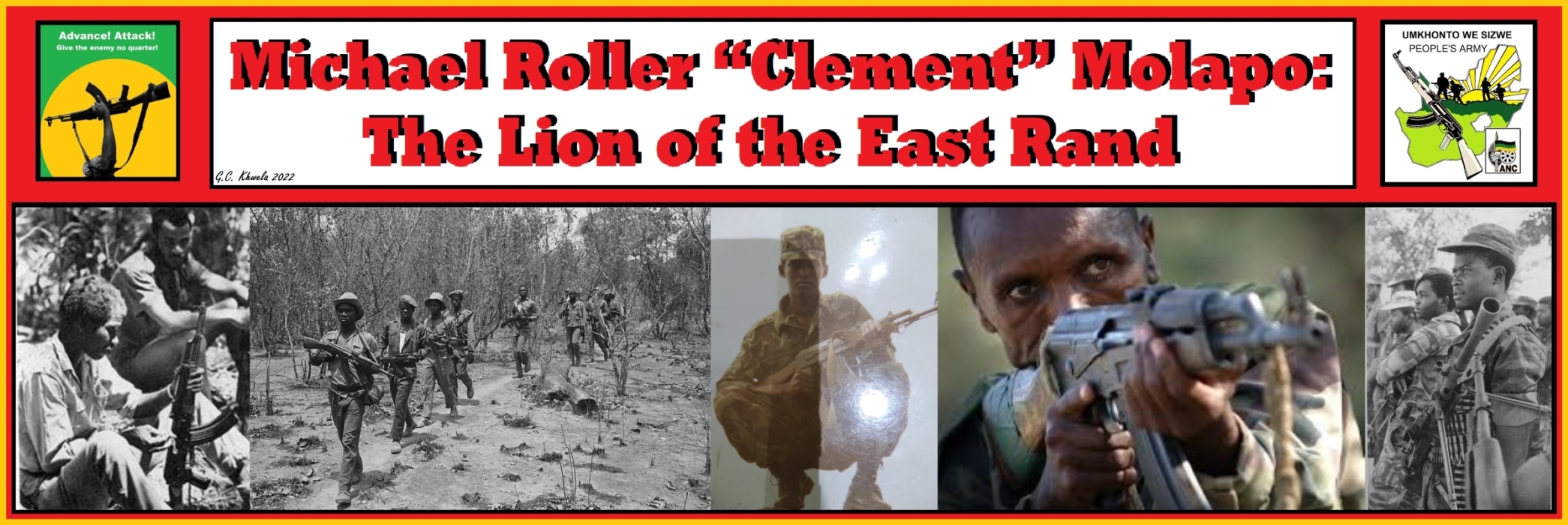
Michael Roller “Clement” Molapo: The Lion of the East Rand
On 26 July 1986, Michael Roller Molapo (aka “Clement”) was shot dead by the apartheid South African policemen, with an AK-47 rifle, an RPG-7 rocket launcher and ammunition found in his possession. “Clement” entered South Africa on 19 June 1986, in a green BMW registered SD 026, driven by Simon Dladla, and in the company of Acton Maseko. Both Dladla and Maseko belonged to the Umkhonto we Sizwe (MK) Transvaal Implementation Machinery that was involved in Operation Cetshwayo, focusing on landmine warfare.
When “Clement” entered the country, he was equipped with hand grenades, limpet mines, AK-47 rifles, an RPG-7 launcher and rockets. He then, together with Maseko, disembarked from the car and jumped the fence before the car went through the border control post. After the BMW went through, Dladla picked up Maseko and “Clement” on the other side of the border fence and transported them further into the country. On 22 June 1986, when Dladla and Maseko had consummated what they had to do inside the country, they returned from Johannesburg to Swaziland, with two other persons, but without “Clement”.
Following the realisation that “Clement” did not return to Swaziland, on 5 July 1986, a few minutes after midnight, six policemen of the East Rand Administration Board were patrolling in Vosloorus Township when a white Cressida with three men inside, including “Clement”, drove past them. “Clement” immediately took out at an AK-47 submachine rifle and opened fire on the East Rand Administration Board vehicle, killing two policemen, wounding three, and one remained unscathed.
About an hour-and-a-half later, the Cressida passed a group of board officials standing beside their official vehicles in the Ncala Section of Katlehong, in Germiston. The Cressida went nearer to the officials and “Clement” opened fire on them, killing three and wounding nine. In the morning, at approximately 04:00, a police patrol vehicle spotted the Cressida in Katlehong, and gave a chase. A few moments later, a gun battle ensued, resulting in two of the occupants of the Cressida being killed. The other occupant, “Clement” survived and managed to escape the scene.
On 20 July 1986, in Katlehong’s Ncala Section, Michael Roller “Clement” Molapo opened fire and killed a black policeman and wounded a black female police informer. “Clement” was deliberately sent to counter, through “armed propaganda”, the effects of the 1986 nationwide State of Emergency. The apartheid regime had on 12 June 1986 declared an unprecedented nationwide State of Emergency. The crackdown, which began at midnight but was not announced until 12 hours later, according to the apartheid regime, was designed to combat a possible explosion of violence on the 10th anniversary of the Soweto June 16, 1976, uprisings that left nearly 600 dead.
During the 1986 State of Emergency, police seized hundreds of activists, priests, and student and trade union leaders in pre-dawn raids. Nearly the entire leadership of the United Democratic Front (UDF), the main anti-apartheid coalition, was picked up, but dozens of activists eluded police. Under the emergency powers imposed by apartheid President P.W. Botha, police could instruct anyone suspected of “endangering public order” to leave an area. If the order was not immediately obeyed, police could use whatever force they considered “necessary under the circumstances.”
Police also had power to make arrests without warrants, impose curfews, seize property and ban journalists from areas of unrest. A ban on television and radio coverage of riots, strikes or police action was re-imposed. During the course of the State of Emergency, the apartheid South African Defence Force (SADF), the police and other security forces were simply invading and occupying African residential areas and weekends became days for burying people killed by the racist police and the defence force.
What the emergency meant for the people was that they had to expect more “disappearances” and less information about them, because the press was forbidden to report anything. Moreover, people had to expect more brutality because the police and the authorities were legally indemnified – they were above the law and could not be taken to court. The government was patently no longer able to govern in the old way. In the townships, its writ was not running at all, its institutions were destroyed, its emissaries and stooges driven out. The police and military, with the aid of bullets, batons, tear gas, dogs, agents provocateur and undercover assassins, managed to blast their way into and out of the townships, but all attempts to establish any form of civil authority responsible or responsive to Pretoria came to nothing.
The strategic emphasis which shaped the struggle from 1979 onwards was the necessity for an organised underground political presence to complement armed activities. It was considered essential that ANC operatives should link up different forms of popular members from the generation of activists in youth and student bodies, in the trade unions, in township civics whose protest campaigns were redefining anti-apartheid politics. The “armed propaganda” of MK attacks served as a secondary means to deepen mass mobilisation.
In an Editorial that the African National Congress (ANC) wrote in its Official Organ, “Sechaba” (August 1986), the Movement said, “The racists have been running mad since the beginning of June, or even earlier. They detained and arrested more than 4 000 people … The racist regime pinned its hopes on the belief that the state of emergency would ‘correct’ a ‘misconception’ overseas that South Africa is on the verge of a revolution. … But the racist regime shot itself in the head. Internationally it is more isolated than before.”
Sources:
Wikipedia.
South African History Online (SAHO).
Sipho Dibakwane, “The Late Umkhonto We Sizwe Commander Cde Rollen Molapo Public Memorial Lecture 2017”, Letter to Mandla Ndlovu ANC Secretary: Mpumalanga Provincial Office”, Impumelelo Educational Trust, 20 February 2017.
Editorial, “Those Whom the Gods Wish to Destroy They First Make Mad”, Sechaba, August 1986.
Editorial Notes, “The ANC’s Reply to the State of Emergency”, The African Communist, No. 103, Fourth Quarter, 1985.
Document, “Statement of the South African Communist Party on the State of Emergency”, The African Communist, No. 107, Fourth Quarter, 1986.
Thula Simpson, “Umkhonto we Sizwe: The ANC’s Armed Struggle”, Penguin, 2016.
Castro Khwela
Good evening fellow Compatriots!
Discover more from CASTRO KHWELA
Subscribe to get the latest posts sent to your email.