Challenges Towards the Kabwe Conference
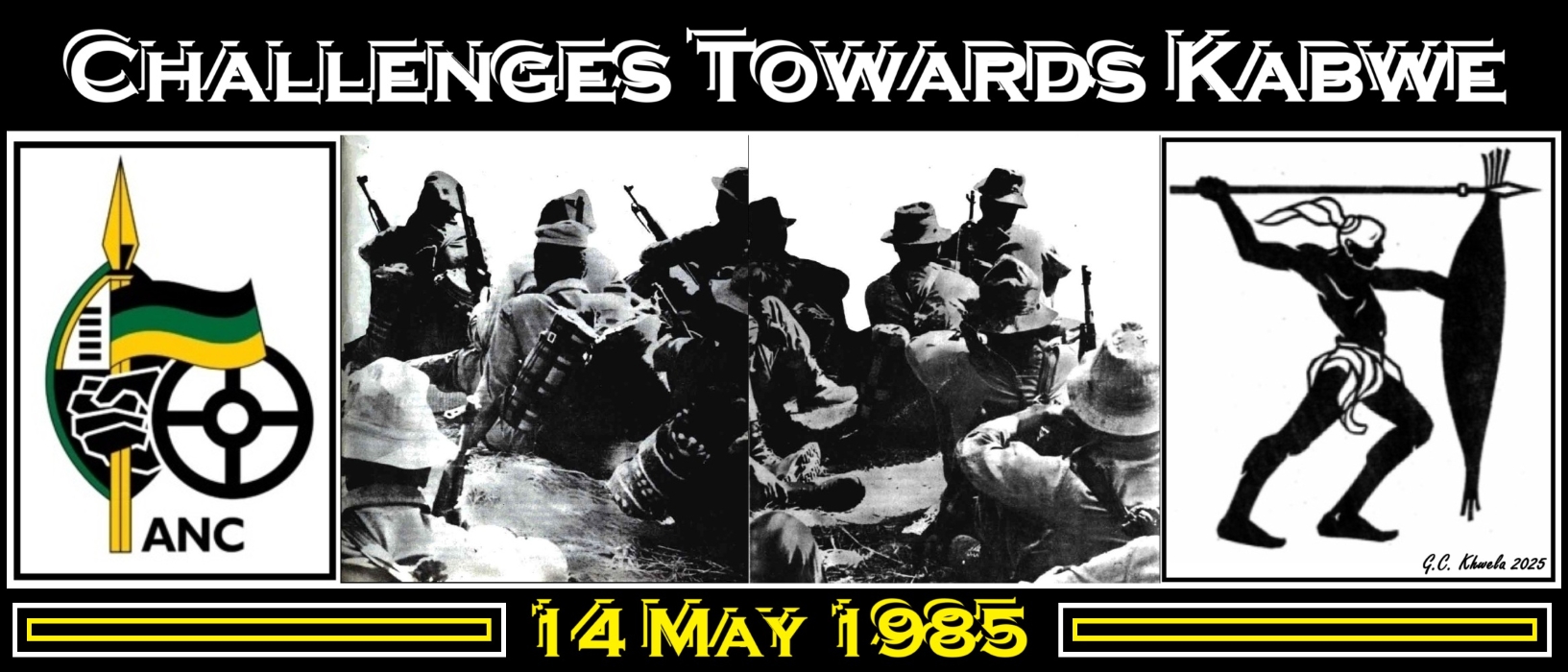
On 14 May 1985, at around 10:00 in the morning, behind a block of flats near Northside Primary School in Gaborone’s Extension 9, an African National Congress (ANC) operative, Rodgers Nkadimeng (aka “Rogers ‘TYY’ Mevi”), who was the camp commissar at Quibaxe and was involved in infiltrating Umkhonto we Sizwe (MK) cadres from Botswana into South Africa, entered his Datsun Skyline sedan. As he turned on the key in the ignition, the car exploded, destroying the vehicle and killing him instantly. The bomb also caused extensive damage to the block of flats and houses in the immediate vicinity.
Meanwhile, the consultative conference that the ANC had announced in June 1984 was in the horizon. In his capacity as ANC Chief Representative in Maputo, Jacob Zuma forwarded a letter to the conference’s National Preparatory Committee (Prepcom or NPC). The letter had another covering letter, which said that the letter was from a military unit, “Unit U”, that was at the time based in the Mozambican region and that some of the members were involved in the Ingwavuma episode.
The letter from “Unit U” said, “Historically the ANC has rightfully won the vanguard position in the South African liberation struggle”. But “the point in question now is to ask ourselves as to whether the ANC and her gallant army MK (Umkhonto we Sizwe), has at the present and the recent past of (about 8–9 years back) or even more, done justice to the armed struggle of our people at home. The response of Unit U engaged in deliberation and discussion is that the ANC as a vanguard has done very little indeed.”
So “what are and were the problems? How can we solve them?” Unit U felt the “first and foremost problem is our failure to escalate the military sphere of our struggle so as to match the tremendous achievements already scored in the political sphere”. The “key problem to the whole issue”, they argued, “has been and is still with the incompetence of those in command”. Therefore “It is high time, now and later to remove such people and we must be frank about it”.
Speaking more specifically, they then said, “In short from practical experience we have lost hope that the commander of this army (Joe Modise), Umkhonto we Sizwe can or will ever beyond any reasonable doubt provide the green light from the army to march forward and engage the enemy in all fronts”.
In Angola, also the office ANC Chief Representative, Uriah Mokeba, sent a document to the Prepcom/NPC, titled “Report of the Regional Preparatory Committee – Angola Region”, which summarised the feedback received from MK units based in Angola. Mokeba noted in a covering letter that “There was and still is to a certain extent a trend which wants to interpret the call for the National Conference as a direct result of the mutiny – as a victory for the mutineers. Accordingly, we would like to bring to the attention of the NPC (Prepcom) – the existence of a definite core which conscious and deliberately and persistently striving to frustrate the objectives of the National Conference.”
According to Mokeba’s document, this core “is striving to create a rift between the general membership and the leadership of the Movement. The main areas of distortion are: the situation in the front – paint a very bleak and gloomy future of the state of affairs at the front and about armed struggle in general. The conclusion leadership has failed. 2 Period – during 1979–1984 the beatings and accidental death of comrades, the logistics and health situation, the training process – the eastern campaign etc. For them this was the most horrible period in the history of MK – the conclusion again – the leadership has failed. They came out to openly demand the release of the mutineers. The security Organ is the main target here.”
The conclusion in Mokeba’s letter was that “The main task now is to defeat this core politically”. Concerning the prevalence of the trend, Mokeba said that it was there in different degrees in all ANC sections in Angola except one. And he was possibly referring to Caculama camp, where trainees who had just arrived from South Africa were accommodated, and which had a different political profile. Other camps in Angola, particularly Quibaxe and Pango, were adamant that “it would have been inopportune and inappropriate to have held a Regional Conference in Angola at that time before attending the NCC (National Consultative Conference) bearing in mind that the wounds caused by the recent conflict were still fresh and too deep to ignore” (Manong).
The conflict that Manong was referring to here were the skirmishes that took place in Viana and Pango, during the heightened periods of “Mkatashinga” – the mutiny within MK. According to Manong, “What would be the common ground between the rank and file and those who were defending the status quo? What prospects and chances existed for reconciliation between the two antagonistic groups as each warring party still stuck to its respective positions? After carefully analysing and deliberating the issue, comrades decided to reject the idea of holding a Regional Conference. It was decided the best thing to do would be to send our delegates from the camp straight to the NCC without having to dilute our views through a Regional Conference.”
Despite the determination from the trained cadres in the camps, particularly in Quibaxe, to reject the Regional Conference, it ultimately took place in Viana in February 1985. The ANC Headquarters in Lusaka later announced that the ANC’s Second National Consultative Conference would be held somewhere in Africa from 16 to 25 June 1985, which for security reasons, the location of the venue was kept top secret.
Sources:
Thula Simpson, “Umkhonto we Sizwe: The ANC’s Armed Struggle”, Penguin, 2016.
Stanley Manong, “If We Must Die: An autobiography of a Former Commander of uMkhonto we Sizwe”, Nkululeko, 2015.
James Ngculu, “The Honour to Serve: Recollections of an Umkhonto Soldier”, David Philip, 2009.
Castro Khwela
Good day fellow Compatriots!
Discover more from CASTRO KHWELA
Subscribe to get the latest posts sent to your email.