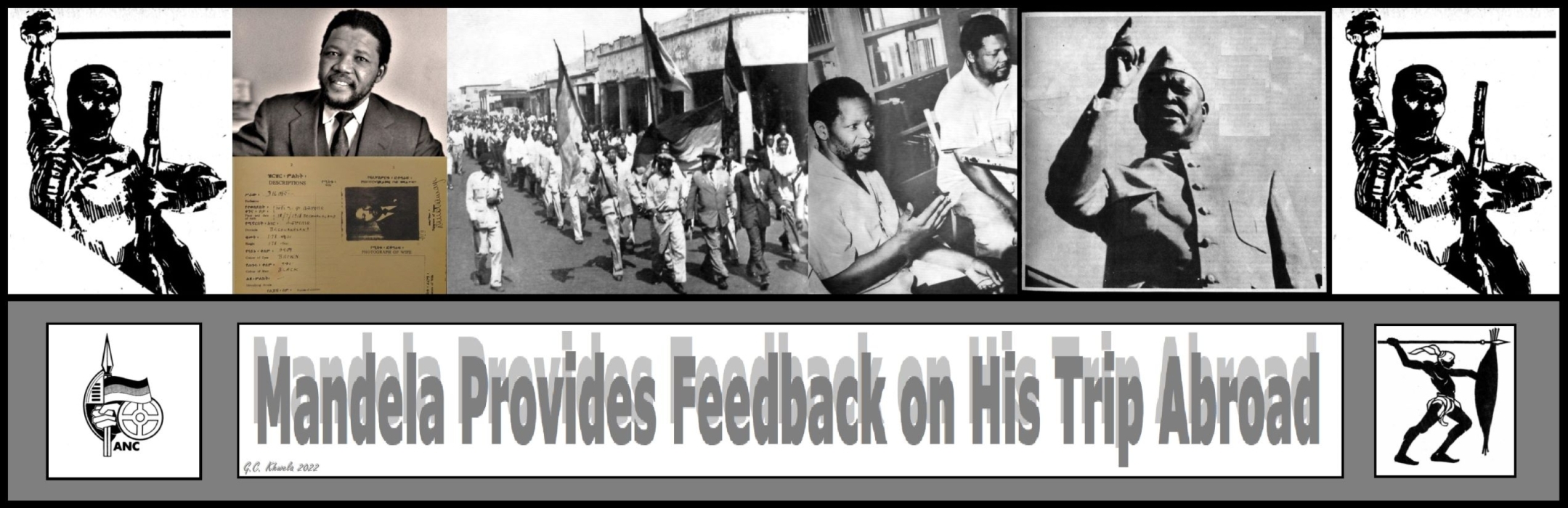
Mandela Provides Feedback on His Trip Abroad
On 28 July 1962, Joe Slovo informed his wife, Ruth First, that a convergence of people working in the South African Communist Party (SACP) and the African National Congress (ANC) was about to take place and they had to attend. The couple then travelled to Liliesleaf Farm, in Rivonia, in the morning, where they found Nelson Mandela and other members of the Congress Alliance, including Moses Kotane, Michael Harmel, Duma Nokwe, Rusty Bernstein, Walter Sisulu, Govan Mbeki, Mark Shope, Dan Tloome, J.B. Marks, Ahmed Kathrada and two other African members from Durban. Mandela was there to brief them about his overseas trip, especially a general overview of his travels.
Mandela began by itemising the monies received and the offers of training that were extended, as well as the reservations that were expressed about the ANC’s cooperation with whites, Indians and especially communists. During a meeting with the Zambian leaders, they informed Mandela that while they knew that the ANC was stronger and more popular than the Pan-Africanist Congress (PAC), they understood the PAC’s pure African nationalism but were bewildered by the ANC’s non-racialism and cooperation with communists.
Mandela then went on to explain that himself and Oliver Tambo, the Head of the External Mission, felt that the ANC had to appear more independent in order to reassure the organisation’s new allies, since they would ultimately be the ones providing training and financing to Umkhonto we Sizwe (MK). When Mandela arrived in London, Tambo, in keeping with prudent habits, was inclined not to tackle the PAC publicly, but to wait to see how things would develop.
During his address to the Addis Ababa conference, Mandela — on Tambo’s advice — did not refer to the rift that was clearly on the cards. This was despite a leaflet attacking the ANC, distributed by Philip Kgosana (the young leader of the Langa march to Cape Town nearly two years earlier, who was now at odds with another faction of the PAC). Observing a fair amount of prejudice against the ANC — and again following Tambo’s counsel — Mandela’s speech focused instead on a description and history of the ANC, and the need for organised support in the battle against apartheid. Primarily, in his speech, Mandela reviewed the history of the freedom struggle in South Africa and listed the brutal massacres that had been committed against the African people, from Bulhoek in 1921, when the army and police killed 183 unarmed peasants, to Sharpeville forty years later.
Mandela thanked the assembled nations for exerting pressure on South Africa, citing in particular Ghana, Nigeria and Tanganyika, who spearheaded the successful drive to oust South Africa from the British Commonwealth. Mandela retraced the birth of Umkhonto we Sizwe, explaining that all opportunities for peaceful struggle had been closed to the people. Referring to the ANC’s shift in policy, he said: “a leadership commits a crime against its own people if it hesitates to sharpen its political weapons where they have become less effective”. When he added that “On the night of 16 December last year, the whole of South Africa vibrated under the heavy blows of Umkhonto we Sizwe”, the Ugandan Chief Minister exclaimed: “Give it to them again!”
At this conference, the Pan-African Freedom Movement of East, Central and Southern Africa (PAFMECSA) was formed. Its constitution was committed to non-violence, Pan-Africanism, and to setting up a Freedom Fund to aid the liberation movements. Mandela then proposed reshaping the Congress Alliance to ensure that the ANC was seen to clearly be the leader, particularly on issues affecting Africans directly. This was a serious proposition, according to Mandela, and hence the entire leadership was supposed to be consulted before its adoption. The Working Committee then urged him to go to Durban to brief the President of the ANC, Chief Albert Luthuli.
Govan Mbeki, a member of the MK High Command, was not comfortable with the arrangement that Mandela should go himself and brief the ANC President. He suggested that somebody else should do so, since it was too risky for him to go there, and the organisation was not supposed to jeopardise his safety, especially since he had just returned and ready to push ahead with MK. However, at the conclusion of the meeting, the following day, Mandela mentioned that he would go to report to the ANC President Luthuli. The intention was to clarify the situation regarding the reports that surfaced, while he was away, that he had deviated from the ANC’s historical position of non-racialism because of criticisms of that policy by African leaders.
When he left Liliesleaf Farm for Natal in the company of Cecil Williams later that night, Mandela posed as his chauffeur. Mandela had planned a series of meeting in Durban, the first of which was with Monty Naicker and Ismail Meer to brief them about his trip and to discuss the new proposal. For Mandela, Monty and Ismail were extremely close to Chief Luthuli, and Luthuli trusted their view. It was thus going to make it easy for him to tell Luthuli that he had spoken to his friends and convey their reaction.
Unfortunately, Monty and Ismail were disturbed by Mandela’s belief that the ANC needed to take the lead among the Congress Alliance and make statements on its own concerning affairs that affected Africans. They were totally opposed to anything that unravelled the Alliance. Mandela had to argue that the experiences of other African countries were totally different to the situation in South Africa. Due to differences of historical development and existing conditions, African liberation movement in many other parts of the African continent did not find allies in their struggle among other populations groups.
It was therefore not unrealistic to expect that amongst them there were those who genuinely believed that the salvation of African people lay in a fanatical African racialism and denunciation of everything that was not African. And such a policy was, according to Walter Sisulu, quoted in Sechaba (November 1981) “not without its potential mass appeal. It would be unrealistic to pretend that a policy of extreme nationalist must, in the nature of things, always be unpopular. The people are quick to detect the insincerity of the mere demagogue, and they have confidence in the courage and wisdom of their tried and trusted leaders.”
“But in a country like South Africa,” Sisulu continued, “where the Whites dominate everything, and where ruthless laws are ruthlessly administered and enforced, the natural tendency is one of growing hostility towards Europeans. In fact most Africans come into political activity because of their indignation against the Whites, and it is only through their education in Congress and their experience of the genuine comradeship in the struggle of such organisations as the Congress of Democrats that they rise to the broad, non-racial humanism of our Congress movement.”
Sources:
Didintle Setzin, “Nelson Mandela Travels Through Africa”, Nelson Mandela Foundation, 31 May 2022.
Pages from History, “What is PAC?”, Sechaba, November 1981.
Nelson Mandela, “Long Walk to Freedom”, Abacus, 1994.
Thula Simpson, “Umkhonto we Sizwe: The ANC’s Armed Struggle”, Penguin, 2016.
Luli Callinicos, “Oliver Tambo: Beyond the Engeli Mountains”, David Philip, 2004.
Castro Khwela
Good evening fellow Compatriots!
Discover more from CASTRO KHWELA
Subscribe to get the latest posts sent to your email.