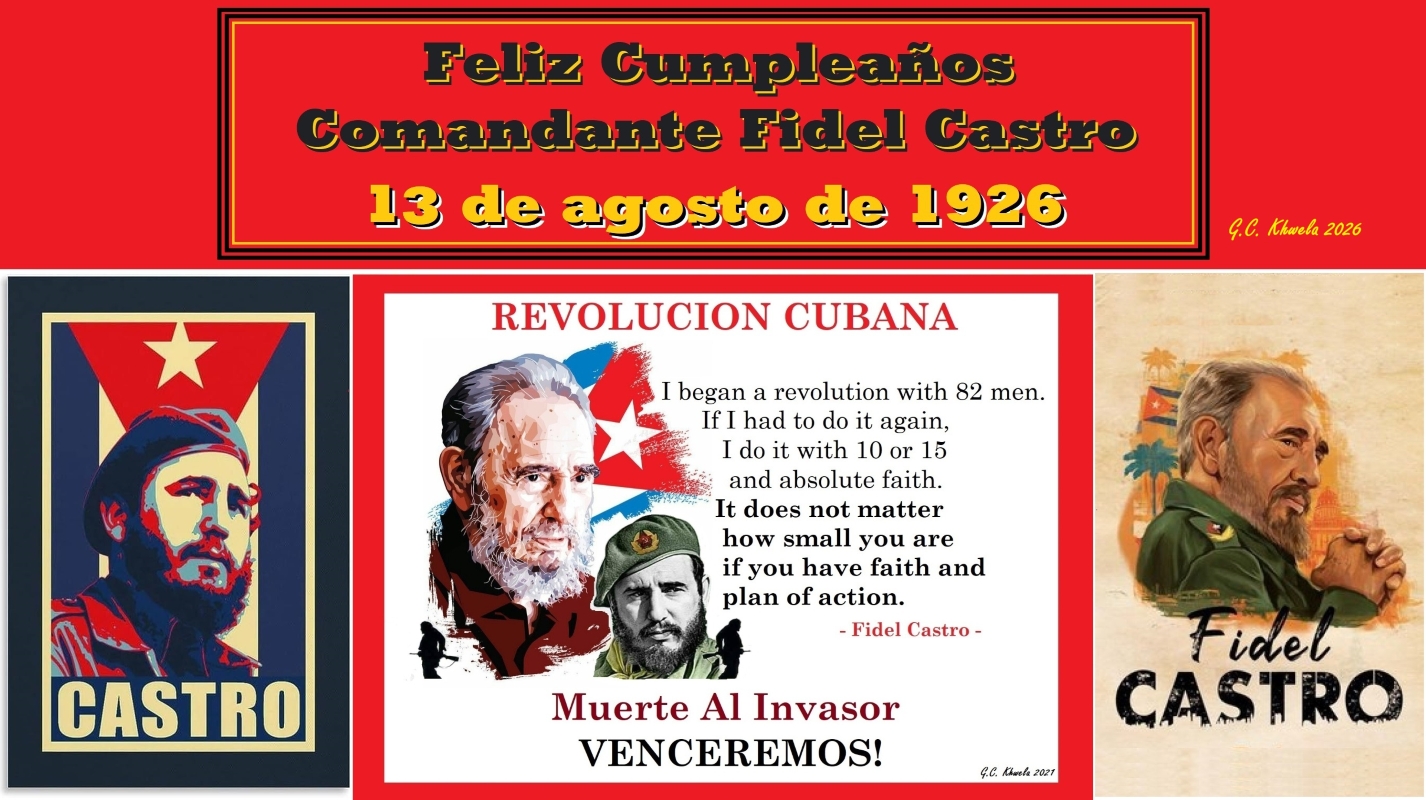
100 Years Feliz Cumpleaños Comandante Fidel Castro
On this day, 13 August 1926, 100 years ago, Fidel Alejandro Castro Ruz was born in Biran, Cuba, a son of a wealthy Spanish farmer. Castro adopted leftist and anti-imperialist ideas while studying law at the University of Havana. After participating in rebellions against right-wing governments in the Dominican Republic and Colombia, he planned the overthrow of Cuban president Fulgencio Batista, launching a failed attack on the Moncada Barracks in 1953.
After a year’s imprisonment, Castro travelled to Mexico where he formed a revolutionary group, the 26th of July Movement, with his brother Raúl Castro and Ernesto “Che” Guevara. Returning to Cuba, Castro took a key role in the Cuban Revolution by leading the Movement in a guerrilla war against Batista’s forces from the Sierra Maestra.
After Batista’s overthrow in 1959, Castro assumed military and political power as Cuba’s prime minister. The United States came to oppose Castro’s government and unsuccessfully attempted to remove him by assassination, economic embargo, and counter-revolution, including the Bay of Pigs Invasion of 1961. Countering these threats, Castro aligned with the Soviet Union and allowed the Soviet government to place nuclear weapons in Cuba, resulting in the Cuban Missile Crisis – a defining incident of the Cold War – in 1962.
Abroad, Fidel Castro supported anti-imperialist revolutionary groups, backing the establishment of revolutionary governments in Chile, Nicaragua and Grenada, as well as sending troops to aid the fight against imperialism in the Yom Kippur, Ogaden and the Angolan Wars. The Cuban forces were also involved in the training and development of national liberation movements in southern Africa, including the African National Congress (ANC), the South West African People’s Organisation (SWAPO), the Mozambican Liberation Front (FRELIMO), the Zimbabwean African People’s Union (ZAPU) and the People’s Movement for the Liberation of Angola (MPLA), as well as the African Party for the Independence of Guinea and Cape Verde (PAIGC) in West Africa, among others.
These actions, coupled with Castro’s leadership of the Non-Aligned Movement from 1979 to 1983 and Cuban medical internationalism, increased Cuba’s profile on the world stage. Following the “Special Period”, he also embraced the environmentalist and anti-globalisation ideas. In the 2000s, Castro forged alliances in the Latin American “pink tide” – namely with Hugo Chavez’s Venezuela – and formed the Bolivarian Alliance for the Americas. In 2006, Castro transferred his responsibilities to Vice President Raúl Castro, who was elected to the presidency by the National Assembly in 2008.
As a Cuban revolutionary and statesman, Castro was the longest-serving non-royal head of state in the 20th and 21st centuries, serving as the leader of Cuba from 1959 to 2008. Castro was viewed as a champion of socialism and anti-imperialism whose revolutionary government advanced economic and social justice while securing Cuba’s independence from US hegemony. His critics called him a dictator whose administration oversaw human rights abuses, the exodus of many Cubans, and the impoverishment of the country’s economy.
It is not a distortion to aver that Castro was one of the most controversial political leaders of his era, as he both inspired and dismayed people around the world during his lifetime. Everybody agreed that he was “a towering figure” who “transformed a small Caribbean island into a major force in world affairs”. Despite its small size and limited economic weight, Castro’s Cuba gained a large role in world affairs. Throughout Latin America, and the developing world, Castro served as “a symbol of defiance against the continued economic and cultural imperialism of the United States”. Castro’s determined opposition to US dominance and transformation of Cuba into a significant world player resulted in him receiving a “warm applause” throughout the World.
Fidel Castro’s contribution to the African continent was monumental, playing a pivotal, decisive role in dismantling colonialism and ending white minority rule (apartheid) in Southern Africa. Under the philosophy of proletarian internationalism, Cuba deployed hundreds of thousands of troops, doctors, and educators across the continent. Unlike Western powers or global superpowers, Castro’s intervention was uniquely driven by solidarity rather than economic exploitation. His impact can be understood through his military interventions and his long-lasting “soft power” diplomacy. The cornerstone of Castro’s African legacy is Cuba’s direct military intervention in the Angolan War.
When Angola gained independence from Portugal in 1975, the People’s Movement for the Liberation of Angola (MPLA) was immediately attacked by US-backed factions and an invading South African apartheid army, Castro, acting on his own conviction rather than orders from Moscow, launched “Operation Carlota”, sending tens of thousands of Cuban troops to successfully halt the apartheid advance and secure the capital, Luanda. This historic clash in southern Angola is widely considered a turning point in African history. Cuban forces, fighting alongside Angolan government troops and Namibian freedom fighters, the People’s Liberation Army of Namibia (PLAN), decisively defeated the apartheid South African Defence Force (SADF).
The victory at Cuito Cuanavale shattered the myth of white military invincibility in Southern Africa. It forced the apartheid regime to the negotiating table, directly leading to the independence of Namibia in 1990, the withdrawal of South African troops from Angola, and the eventual collapse of the apartheid government inside South Africa. According to Nelson Mandela, upon visiting Havana shortly after his release from prison, he said, “The Cuban internationalists have made a contribution to African independence, freedom, and justice, unparalleled for its principled and selfless character”.
Beyond Southern Africa, Castro provided robust military and logistical assistance to the liberation movements across Africa from the 1960s through the 1980s: In Guinea-Bissau and Cape Verde, Cuban strategists and soldiers fought alongside Amílcar Cabral’s forces to defeat Portuguese colonial rule; in Algeria, Cuba supported the National Liberation Front (FLN) in its struggle against French colonial rule; in Ethiopia, in 1977, Castro sent thousands of troops to assist Ethiopia during the Ogaden War against Somali military incursions; and Cuban military advisors and doctors were stationed in nations like Mozambique, Congo, Guinea, and Libya.
Castro’s legacy is equally defined by what he called the “army of white coats” – exporting doctors and teachers instead of weapons. Cuba has sent tens of thousands of healthcare professionals to rural and underserved communities across Africa. Notably, when the Ebola crisis struck West Africa, Cuba deployed the largest single contingent of foreign medical professionals to fight the outbreak. Under Castro’s directives, Cuba provided free medical and engineering scholarships to thousands of African students. Programmes like the South Africa-Cuba medical training partnership continue to see thousands of South Africans qualify as doctors in Cuban universities.
Cuban engineers, teachers, and agricultural experts were sent to newly independent African nations to help rebuild fragile state infrastructures left behind by fleeing colonial powers. While Western nations historically viewed African liberation struggles through a rigid Cold War lens – often backing oppressive colonial regimes or the apartheid government out of fear of communism – Fidel Castro aligned Cuba with the continent’s independence movements. His contributions remain highly revered across Africa, cementing his status as an honorary Pan-African Hero.
South Africa and the broader African continent can support Cuba through diplomatic pressure, humanitarian aid, and decentralized renewable energy partnerships. The current fuel and energy crisis in Cuba has been severely exacerbated by intense US sanctions that penalise any international entities trading fuel or oil with the island. Because open-market oil and fuel shipping are highly restricted by sanctions, the most effective forms of assistance focus on bypassing traditional fuel lines and offering direct material relief.
South Africa remains one of Cuba’s most vocal international allies and must leverage its unique global standing to push for policy changes. South Africa must repeatedly utilise the United Nations General Assembly, BRICS, the African Union (AU), and the Non-Aligned Movement to demand an immediate end to the US embargo. South Africa should explicitly lobby for the reversal of the US designation of Cuba as a “state sponsor of terrorism”, a label that paralyses Cuba’s access to global banking systems. African nations, particularly progressive movements and governments across the continent, should be urged to issue joint declarations and build diplomatic resistance against unilateral energy blockades, reinforcing the historic debt of gratitude for Cuba’s role in African liberation.
Because sending tankers of crude oil risks triggering severe United States’ secondary sanctions, the primary focus has shifted from fossil fuels to green, decentralised energy alternatives. Civil society platforms, such as the South African-led international network Cuba Solidarity Now (CSN), are actively raising funds specifically to purchase and export solar panels and localised renewable energy equipment directly to Cuban communities. By sending decentralised solar installations, South African and African organisations can help power critical Cuban infrastructure – like hospitals, schools, and local clinics – independent of the failing, fuel-starved central electrical grid.
The energy crisis has paralysed domestic industries, leading to a domino effect of food and medicine shortages. South Africa can help alleviate this pressure through direct state-backed funds and grassroots campaigns. South Africa’s Department of International Relations and Cooperation (DIRCO) must utilise the African Renaissance and International Cooperation Fund (ARF) to process financial support, grant structural loans, and sponsor humanitarian material shipments to Cuba. Organisations like the Friends of Cuba Society (FOCUS) and South African trade unions must actively gather medical supplies, non-perishable food and essential goods. Easing the humanitarian burden allows the Cuban government to divert its scarce foreign currency reserves strictly toward buying heavily marked-up oil on the open market.
Rather than structured charity, South Africa must look to build mutually beneficial economic programmes that provide Cuba with liquidity. The South African Parliament’s Portfolio Committee on International Relations must highlight agriculture, tourism and infrastructure as vital areas for trade. By paying for Cuban technical expertise in public works, water sanitation and specialised engineering, South Africa can inject much-needed capital into the Cuban economy. South Africa must continue to fund and expand the Nelson Mandela-Fidel Castro Medical Training Programme, ensuring that financial flows for the education of South African medical students in Cuba remain steady, providing a lifeline of economic exchange.
“SOLIDARITY WITH CUBA – NOW AND ALWAYS!”
Castro Khwela
Good evening fellow Compatriots!🙏🏾✊🏾👊🏾
Discover more from CASTRO KHWELA
Subscribe to get the latest posts sent to your email.