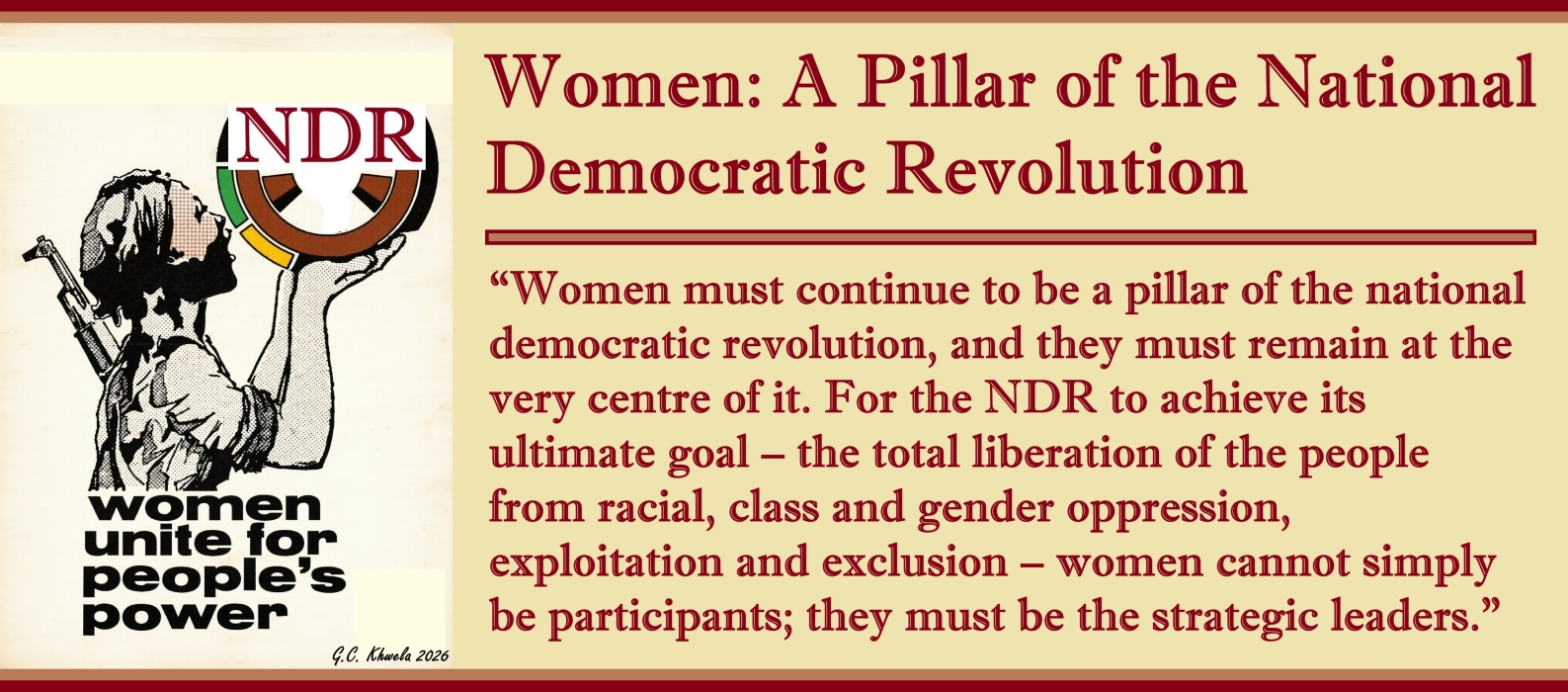
Women: A Pillar of the National Democratic Revolution
“To drive this profound societal shift, the country must move from treating women’s empowerment as a social welfare issue to treating it as a hard macroeconomic strategy.”
During the 1950s and 1960s in South Africa, the apartheid regime heavily suppressed liberation movements, forcing organisations like the African National Congress (ANC), the South African Communist Party (SACP) and the Pan Africanist Congress (PAC) underground. As thousands of male leaders were banned, imprisoned prior, during and after the Rivonia Trial, or forced into exile, women stepped directly into the vanguard. They transformed from supportive figures into the primary custodians and executioners of the underground liberation struggle. They became the pillar of the National Democratic Revolution.
To harness the legacy of the liberation struggle for modern socio-economic development, women must transition from the custodians of political survival to the primary drivers of economic transformation, institutional governance and community development. Just as women sustained the underground movement in the 1960s, their role today is critical to overcoming South Africa’s triple challenges of poverty, unemployment and inequality.
During the liberation struggle, Women formed networks like the Federation of South African Women (FEDSAW) to care for the families of political prisoners. They organised community childcare and informal economies to sustain households when male breadwinners were arrested or exiled. Mothers, wives and daughters, maintained community morale in the face of constant police harassment and raids. Women utilised traditional gender stereotypes – which made authorities less suspicious of them – to smuggle letters, funds and instructions across borders.
Activists like Florence Mophosho and Albertina Sisulu helped print and distribute banned literature, leaflets and the ANC’s and SACP’s publication. Women managed the logistics of secret meeting spaces, ensuring that underground cells could communicate without detection. Women in Umkhonto we Sizwe (MK) hid weapons, ammunition and explosives within their homes, often burying them in backyards. They provided food, medical care, and civilian disguises to internal operatives and guerrillas returning from training abroad. Women working as domestic workers or in administrative roles gathered critical information on police movements to protect underground operatives.
Leaders like Lillian Ngoyi, Winnie Madikizela-Mandela, Ruth First, Rahima Moosa, Sophie de Bruyn, Albertina Sisulu, Helen Joseph and Dorothy Nyembe, amongst others, continuously defied their individual banning orders to keep the spirit of resistance alive. Despite the ban on political organisations, women led targeted local protests against pass laws, forced removals and rent hikes throughout the decades. Women faced the same brutal consequences as men, enduring solitary confinement, banishment to remote areas and physical torture under the 90-day and 180-day detention laws. They carried the burden of liberation and have to remain a firm pillar towards the achievement of the objectives of the national democratic revolution.
To fully realise the National Democratic Revolution (NDR) and redress South Africa’s stark racial wealth and land disparities, women must transition from the historical foot soldiers of resistance, such as reiterating the August 9 women’s march to the Union Buildings, into the chief architects of asset redistribution, capital re-allocation and agrarian transformation. Because women bear the heaviest burden of structural poverty and landlessness – particularly in rural areas – their active leadership is the only way to ensure that democratic redress results in genuine economic emancipation rather than superficial elite enrichment.
Women are currently occupying decisive leadership roles in government, state-owned enterprises and private boards to dictate fiscal allocations. They should be enforcing state budget allocations that directly evaluate and fund the specific socio-economic needs of women and be using the legal system to challenge systemic discrimination, land tenure inequalities and economic exclusion. Women should absolutely play a leading role in defining the country’s trajectory, particularly because the challenges facing today’s youth – such as structural unemployment, educational gaps and economic exclusion – require the precise holistic and systemic approach that women leaders historically and currently champion.
Within parliament and National Treasury women must move beyond viewing budgets through a gender-neutral lens. National budgets must be explicitly designed to fund infrastructure that reduces women’s unpaid labour – such as massive investments in Early Childhood Development (ECD) and safe public transit – freeing women to fully participate in high-yield economic activities. Women leaders must use strategic litigation and strict Department of Employment and Labour enforcement to eliminate the lingering racial and gender wage gaps, immediately boosting the disposable income and savings capacity of black households.
Within the labour unions and associations, they should be reforming workplace policies to guarantee equal pay, closing the gender wage gap and protecting women in informal economies. They must be formalising and monetising childcare, eldercare, and community healthcare systems to relieve themselves of unpaid, economically limiting labour and be heading sustainable urban and rural agricultural projects to secure community nutrition and build localised food supply chains. And they must be involved in designing neighbourhood-level defence and support networks to combat Gender-Based Violence (GBV), which acts as a primary barrier to economic participation.
In local, provincial and national government women must spearhead administrative reforms to clear the title deed backlog. Organisations like the Institute for Race Relations (IRR) emphasise that providing secure, legally recognised title deeds to women gives them a protected asset they can build on, use as banking collateral and pass on to clear intergenerational poverty. Statistically, single women have made immense strides, purchasing 39% of residential properties in 2025 – outpacing single men. Women leaders must use this momentum to design affordable social housing projects closer to urban economic hubs, directly lowering the heavy transport and living costs that keep black families economically excluded.
Women running state-owned enterprises (SOEs) and government departments must strictly champion and enforce the rule that at least 40% of public procurement budgets go to women-owned enterprises. This moves billions of Rands out of legacy corporate networks and directly into the hands of black female entrepreneurs. To bypass commercial banks that refuse to fund black women due to lack of traditional collateral, women must establish state-backed or cooperative venture funds. These funds can offer micro-equity and asset-backed loans specifically tailored to industrialising black-owned businesses.
They must lead the legislative charge to guarantee independent land tenure for rural women. Historically, female farm workers and rural dwellers have had their tenure tied to male partners, leaving them highly vulnerable to eviction upon divorce or death. Women leaders must actively shape the implementation of major land legislation – such as navigating the intense Western Cape High Court legal challenges surrounding the Expropriation Act – to ensure redistributed land directly targets female-led agricultural cooperatives. Beyond basic land access, women must direct state agricultural subsidies and training into moving black women farmers from subsistence operations into high-yield commercial food processing, export logistics and retail supply chains.
To effectively steer the country toward advancement for the youth, women leaders must focus on several critical areas, including directing fiscal allocations to build tech hubs, broadband access and coding academies in townships and rural areas. They should be involved in youth entrepreneurship, by creating venture capital funds specifically targeted at youth-led tech startups and digital innovations. They should take part in ensuring youth, particularly young women, receive secure land tenure and commercial farming training, thus moving youth from subsistence farming into commercial food processing, logistics and retail supply chains.
Women must be fully involved in redesigning macroeconomic and youth policy, ensuring youth-centric budgeting through hardcoding youth employment, apprenticeships and mental health support directly into national fiscal policies. They should drive industrial policies that support labour-absorptive manufacturing sectors to absorb the millions of currently unemployed youth. This includes enforcing transparency and accountability in state institutions to ensure resources meant for youth development actually reach them. Ultimately, they should ensure the transformation of the public service into a highly efficient, merit-based system that actively recruits and rewards talented young professionals.
Despite progressive legal frameworks and increasing representation on boards and in government, women in South Africa remain constrained by deeply entrenched structural barriers. These systemic obstacles actively prevent women from fully dictating the country’s macro-trajectory and macro-economic blueprint. Internal political structures are frequently governed by highly insular, male-dominated factions and cliques. These dynamics actively suppresses women from securing top-ticket nominations or primary executive positions. To dismantle these gatekeeping mechanisms, political organisations, movements and parties must be driven to move beyond passive “mentorship” and implement hard-coded, measurable structural reforms.
To drive this profound societal shift, the country must move from treating women’s empowerment as a social welfare issue to treating it as a hard macroeconomic strategy. Society will only realise that empowering women is the ultimate catalyst for national success when the direct economic returns of women-led development are clearly demonstrated, institutionalised, and protected. Achieving a National Democratic Revolution (NDR) led by working-class and peasant women requires executing several structural interventions.
The invisible, unpaid labour of rural and working-class women (childcare, eldercare, subsistence farming) is treated as a free societal resource, keeping them “time-poor” and economically sidelined. National Treasury must formally count unpaid care work in South Africa’s Gross Domestic Product (GDP), build state-subsidised Early Childhood Development (ECD) hubs and community kitchens in every township and rural ward. This immediately frees up millions of working-class women to enter the formal workforce, start businesses and lead local political structures.
Traditional authorities and legacy legal systems often gatekeep land, leaving rural peasant women as manual labourers rather than asset owners. Bypass bureaucratic intermediaries by enforcing a policy where at least 50% of all state-expropriated and redistributed land is deeded directly to working-class and peasant women, either individually or through all-female agricultural cooperatives. Back this land transfer with mandatory state off-take agreements, forcing public institutions, such as hospitals, schools and prisons, to buy their food supplies directly from these women-led farms.
Wealth redistribution remains slow because capital is still heavily concentrated in legacy corporate networks. Progressive movements and parties must legally mandate that 40% of all public and corporate procurement spend be ring-fenced exclusively for black, working-class, and youth-women-owned enterprises. Disqualify any state-owned enterprise (SOE) or private corporation from receiving government contracts or licenses if they fail to meet these strict gender-procurement thresholds.
Women in South Africa still earn significantly less than men for identical work, draining the financial reserves of female-headed households where poverty is most acute. The Department of Employment and Labour must enforce mandatory, public pay-transparency audits for all medium and large enterprises. Provide state-funded class-action legal aid to trade unions and peasant associations. This allows working-class women to launch strategic litigation against companies and sectors that perpetuate gender-based wage exploitation.
Media and political rhetoric frequently frame women as passive victims of poverty, unemployment and inequality who need “help”, rather than the primary economic engines of the nation. Data-driven national campaigns must be launched highlighting that women statistically reinvest up to 90% of their income back into their families and communities on health, nutrition and education, compared to 30–40% for men. Such a campaign must prove to society through clear economic data that a Rand in the hands of a working-class woman is the single most effective tool for destroying intergenerational poverty and lowering the national Gini coefficient.
Women must continue to be a pillar of the national democratic revolution, and they must remain at the very centre of it. For the National Democratic Revolution to achieve its ultimate goal – the total liberation of the people from racial, class and gender oppression, exploitation and exclusion – women cannot simply be participants; they must be the strategic leaders. To ensure women remain the unshakeable pillar of this ongoing transformation, certain non-negotiable actions must be sustained. Firstly, women must occupy the highest decision-making seats in state-owned enterprises, the National Treasury and land reform boards to directly control how national wealth is redistributed.
Secondly, the voice of the rural peasant and the urban working-class woman must dictate local municipal budgets, ensuring that community resources fund infrastructure that directly eases their daily burdens. Lastly, society must aggressively execute gender-responsive procurement, title deed transfers and equal-pay mandates, recognising that the financial liberation of women is the only true blueprint for ending national poverty. The struggle of the 1960s proved that the revolution survives because of the resilience of women. The struggle of today requires that the fruits of that revolution are defined and enjoyed by them.
Sources:
Rachel Ann Rawlings, “Barriers to Women in Economic Development”, Utah State University: Undergraduate Honors Capstone Projects. 636. 2014
Engelsmanmagabane, “Women in South Africa: Facts, Figures & Progress”, Engelsman Magabane Incorporated, 8 August 2025.
Gcwalisile Khanyile, “Addressing the Gender Pay Gap In South Africa: The Call To Penalise Employers For Non-Compliance”, The BEE Chamber News, 18 August 2025.
Simon Dippenaar, “Expropriation Act South Africa (2026): What the Court Challenge Means for Property Owners”, Simon Dippenaar& Associates, 28 March 2026.
M.L. Dunjwa, “Engagement with CGE on Women’s Representation in the 2021 Local Government Elections”, Parliamentary Monitoring Group, 25 June 2026.
Abel Mputing, “Women’s Parliament 2026 to Reflect on Seven Decades of Women’s Resistance and Advance Gender Justice”, Parliament of the Republic of South Africa, 7 August 2026.
Anlu Keeve, “IRR on Women’s Month: Property Rights Are Women’s Rights”, South African Institute of Race Relations, 7 August 2026.
Asanda Zondi, “New Report Exposes Gaps Between Women’s Rights Laws, Enforcement in Africa”, Channel Africa, 8 August 2026.
Castro Khwela
Good morning fellow Compatriots!🙏🏾✊🏾👊🏾
Discover more from CASTRO KHWELA
Subscribe to get the latest posts sent to your email.