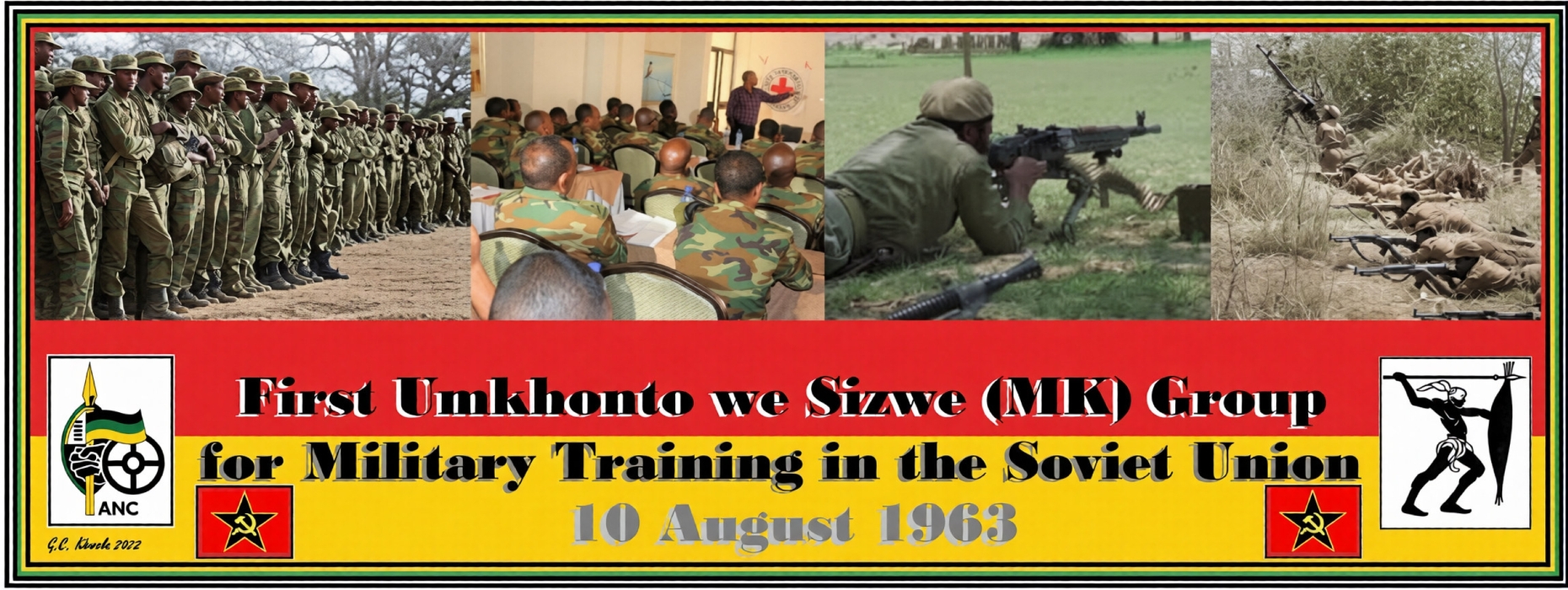
First MK Group for Military Training in the Soviet Union
On 10 August 1963, a group of thirty Umkhonto we Sizwe (MK) recruits were flown on a British Overseas Airways Corporation plane from Dar es Salaam, Tanganyika, to Khartoum, Sudan. From the Sudan they were flown on a Russian aeroplane to Moscow, in the Union of Soviet Socialist Republics, the Soviet Union. They were then met by Russian officials in civilian clothes, who took them in two buses to a double-storey building surrounded by bushes, about eight kilometres outside Moscow, in an area called Ivanov. The house had a high wooden fence around it, and they were welcomed by a Soviet colonel and a major. Within this group were, amongst others, Lawrence Phokanoka, Leonard Nkosi, Lennox Mongameli Tshali, Isaac Makopo, Archie Sibeko, Chris Hani, Justice Mpanza and Mark Shope.
This group was the first contingent of MK cadres to be trained in the Soviet Union, as the ANC had succeeded in gaining the support of the Soviet Union for the provision of military training to its cadres. This historical event on 10 August 1963 marked a crucial turning point in the anti-apartheid struggle, as it was one of the early structured steps in building Umkhonto we Sizwe (MK) into an effective guerrilla army with international backing. Following the banning of the ANC and the internal crackdowns by the apartheid regime, the alliance turned towards armed resistance and actively sought external aid in upgrading its efforts from sabotage into effective guerrilla warfare.
Prior to this arrangement, the ANC and the South African Communist Party (SACP) had sent representatives, including ANC Deputy President Oliver Tambo and Moses Kotane, to Moscow to secure military and financial assistance. This specific cohort sent in August 1963 was selected primarily based on their educational background – focusing on cadres who had passed matric or could read, write, and process complex instructions. The training of these early cadres was fully funded by the Soviet Union state budget and overseen by the Soviet Ministry of Defence.
Following this initial cohort, Soviet assistance expanded drastically. By 1964, larger groups were sent to Odessa (now Ukraine) and other specialised camps across the USSR, including Baku for naval training and the Crimea for field exercises. The crucial diplomatic breakthroughs that secured this direct, state-funded Soviet military backing were spearheaded primarily by Oliver Tambo alongside leading figures of the SACP, most notably Moses Kotane and Yusuf Dadoo. Following his escape into exile to establish the ANC’s External Mission, Tambo officially visited Moscow in April 1963, where he met with senior Soviet officials to formally appeal for heavy logistical support, which directly paved the way for the August 1963 airlift of recruits.
As General Secretary of the SACP and an ANC National Executive member, Kotane had well-established ideological ties with the Kremlin. He travelled to Moscow to solidify the operational alignment, convincing Soviet leadership that a combined ANC-SACP Revolutionary Alliance was ready to sustain an armed campaign. The formal request was evaluated and approved at the highest level of the Soviet state by the Central Committee of the Communist Party of the Soviet Union (CPSU). Once funding was unlocked from the Soviet state budget, the day-to-day logistics and organisation of the channel were managed by the newly formed MK Military Headquarters (MKHQ) in exile.
Being a critical part of the MK Military Headquarters that had been established in exile, Joe Slovo played a fundamental, foundational role in initiating the very process of sending cadres for foreign military training. While the initial, high-level diplomatic agreements for Soviet funding were secured just before his arrival by Oliver Tambo and Moses Kotane, Slovo’s deployment into exile was a direct operational response by the MK National High Command to institutionalise and expand that exact training conduit. As a founding member of the MK National High Command alongside Nelson Mandela, Walter Sisulu, Govan Mbeki, and Raymond Mhlaba, Slovo was selected to go on an external mission in June 1963. His specific directive from the High Command was to travel abroad to secure sustained international funding, set up military logistics and oversee the training of cadres.
On 21 June 1963, just weeks before the infamous Rivonia Raid that shattered the internal leadership, Slovo and J.B. Marks flew out of Francistown, then Bechuanaland (Botswana) to Dar es Salaam. Once in exile, Slovo worked intensely alongside Yusuf Dadoo and the SACP network to establish functional communication lines between East Africa, Western Europe (the London office) and Moscow. Slovo’s departure in June 1963 was incredibly timely. By leaving South Africa to arrange the external training and supply lines, he narrowly avoided the 11 July 1963 police raid on Liliesleaf Farm in Rivonia.
Because he was already in exile setting up the international structure, he avoided the Rivonia Trial and was able to prevent MK from collapsing entirely after the internal High Command was arrested. His initial 1963 mission laid the groundwork for his lifelong role as the primary military strategist of the armed struggle. He went on to become the Chief of Staff of MK, directly managing how those Soviet-trained cadres, resources, and weapons were filtered back into South Africa over the subsequent decades.
In October 1963, the group of MK cadres who had undergone military training in Egypt were also sent to Moscow to undergo further training. This is where they got proper grounding in underground work. They did what others, particularly those who were in Odessa, did not concentrate on, that is mastering conspiracy and how to work to establish underground structures within difficult circumstances. They were being prepared to go and create these structures inside the country and then to be completely self-sufficient in handling weapons and explosive chemicals. Moreover, they were taught how to handle all sorts of weapons, including 82mm mortars and were given a further training course on how to deal with small guerrilla units, right up to the aggregate level.
Training was given in seven different areas: politics; guerrilla tactics; demolition (explosives); communications (communications among guerrilla units, including use of walky-talkies, fixing radios, and how to use a radio on a small scale); topography; weapons (pistols, rifles, machine guns, etc.); and conspiracy. Conspiracy involved training in preparation for underground work inside South Africa. Training in conspiracy meant the ability to keep secrets, to avoid arrest, the use of dead letter boxes, and how to operate underground such as observing the laws, obeying rules and regulations to avoid being arrested for something insignificant, and so on.
The training programme was scheduled to last 6 months after which they were to be flown back to infiltrate South Africa. Their role was to prepare the underground by recruiting and providing civilians inside the country with the same training they received in Moscow, primarily providing training in guerrilla tactics. Their task therefore was also to carry out reconnaissance, as they would receive the army guys and show them how to go around, as they would have studied the country, established intelligence units and trained some people inside the country on how to organise small guerrilla units of 5, 7 or 12. This was to prepare for the infiltration of the other cadres who had been trained in Odessa – the real army – in their hundreds. The cadres from Odessa were trained to lead battalions, regiments and divisions. Their mission was to look for recruits for big operations.
After their arrival in Moscow, the cadres received a thorough medical check-up, and were given uniforms, bags, clean blankets, sheets and pillowcases, as well as civilian suits. They were also provided with a regular allowance of 25 roubles each, including cigarettes and beer. The cadres began their training immediately, and the rules were rigid. For example, when working with explosives, everything had to be “clean”, meaning that there was not supposed to be anything else, except the deliberate mixing of chemicals, as mistakes could be fatal.
The plan was that this group of combatants would be in the vanguard of the guerrilla army – well trained and self-sufficient. They were to train small intelligence and guerrilla units to lay the groundwork for a conventional army. Most of those assembled had not received much formal education, but Chris Hani and others, assisted their comrades ensuring that they kept up to speed with their keen Soviet instructors.
The original blueprint for returning these highly trained combatants relied entirely on overland infiltration through neighbouring states, coupled with targeted air drops. This strategic layout was explicitly detailed in Operation Mayibuye, the structural “Plan of Action” drafted by the MK High Command at Liliesleaf Farm in early 1963. The early infiltration strategy evolved through distinct phases before collapsing due to shifting regional geopolitics. The original plan treated the initial cohort of Moscow-trained recruits as the elite core of a massive underground army. The plan was to subsequently infiltrate a force of 7 000 trained guerrillas back into South Africa.
They were envisioned to enter the country via two primary modes. The High Command assumed they could secure the collaboration of sympathetic foreign governments, like the Soviet Union, to fly aircraft directly into South African airspace. These planes were meant to drop armed cadres and heavy military supplies at pre-selected, remote rural zones. Once on the ground, this vanguard force was designed to immediately split into four distinct geographic regions across South Africa to blend into local communities: Transkei, Zululand, Western Transvaal, including Sekhukhuneland, and North-Western Cape.
When the 1963 cohort actually finished their Soviet training in August 1964, the internal High Command had already been arrested at Rivonia, and Operation Mayibuye was compromised. The new external commander, Joe Modise, had to revise the infiltration tactics. The plan pivoted to a strict underground overland channel. As cadres were stationed at Kongwa Camp in Tanzania, from there, the baseline route was designed to funnel small, self-sufficient intelligence and guerrilla units southwards through Northern Rhodesia (Zambia). They were then to be moved into Bechuanaland (Botswana) or Southern Rhodesia (Zimbabwe), and finally across the South African border.
Rather than waging a conventional war right away, these small units were instructed to cross the borders disguised as ordinary migrant workers, travellers or local residents. Their objective was to use their specialised Soviet training to blend in, build secret underground cells, and begin training local populations in basic sabotage and rural guerrilla tactics. However, the overland approach quickly ran into a massive geopolitical brick wall. South Africa was entirely protected by a “buffer zone” of white minority-led regimes (Southern Rhodesia and Portuguese-controlled Mozambique and Angola) that were deeply hostile to the liberation struggle.
Even after Northern Rhodesia gained independence as Zambia in late 1964, Prime Minister Kenneth Kaunda heavily restricted MK’s movement. He explicitly stated he would not allow Zambia to be used as a military launchpad against South Africa out of fear of devastating economic and military reprisals. Because the overland channels through Botswana and Zimbabwe were effectively choked off by dense border patrols and hostile governments, the MK leadership realised their cadres were effectively stranded in Tanzania. This strategic bottleneck is exactly what forced Joe Slovo and the High Command to reconsider the overland-only strategy and start developing the maritime and air infiltration plans to bypass the land borders completely.
Sources:
South African History Online (SAHO).
Nathi Mthethwa, “The Revolutionary Alliance in South Africa: Historical Reflections and Contemporary Tasks of the African National Congress”, African National Congress Parliamentary Caucus, 15 May 2008.
Raymond Suttner, “The ANC Underground in South Africa”, Jacana, 2008.
Cornelius Johannes Brink Le Roux, “Chapter 8: The Recruitment, Training and Arming of Umkhonto We Sizwe’s Cadres”, in “Umkhonto we Sizwe, Its Role in the ANC’s Onslaught Against White Domination in South Africa, 1961-1988”, PhD: University of Pretoria, 23 June 2009.
Paul Hartley, “Ruth First and Joe Slovo in the War against Apartheid”, Counterfire, 13 December 2013.
Thula Simpson, “Umkhonto we Sizwe: The ANC’s Armed Struggle”, Penguin, 2016.
Lucille Davie, “Mayibuye Planned a Massive Onslaught”, The Heritage Portal, 2 March 2018.
Thula Simpson, “The Turn to Armed Struggle: International Dimensions, 1960-1967”, The Thinker, Vol. 80, 2019.
Vladimir Shubin, “Moscow and the Liberation Struggle in South Africa: The Beginning”, The Thinker, Vol. 80, 2019.
Peter Dickens, “The Smoking Gun: Joe Slovo”, Torch Commando Series – Part 5, The Observation Post, 30 September 2023.
Admin, “We Call on Support for Universal Human Rights and Democracy”, Ukrainian Association of South Africa, 17 September 2024.
Sandi Sijake, “Fighting for My Country: The Testimony of a Freedom Fighter”, Jacana, 2024.
Seane Mabitsela, “The 1967 – 1968 Wankie and Sipolilo Campaigns: An Evaluation of the Effects of Transformation from Nationalist into Revolutionary Armed Struggle in Southern Africa”, African Renaissance, Vol. 22, No. 3, 1 September 2025.
Padraig O’Malley, “Umkhonto we Sizwe (MK) Operations Report”, Nelson Mandela Foundation, omalley.nelsonmandela.org/index.php/site/q/03lv02424/04lv02730/05lv02918/06lv02985.htm. Accessed 9 Aug. 2026.
Castro Khwela
Good day fellow Compatriots!🙏🏾✊🏾👊🏾
Discover more from CASTRO KHWELA
Subscribe to get the latest posts sent to your email.