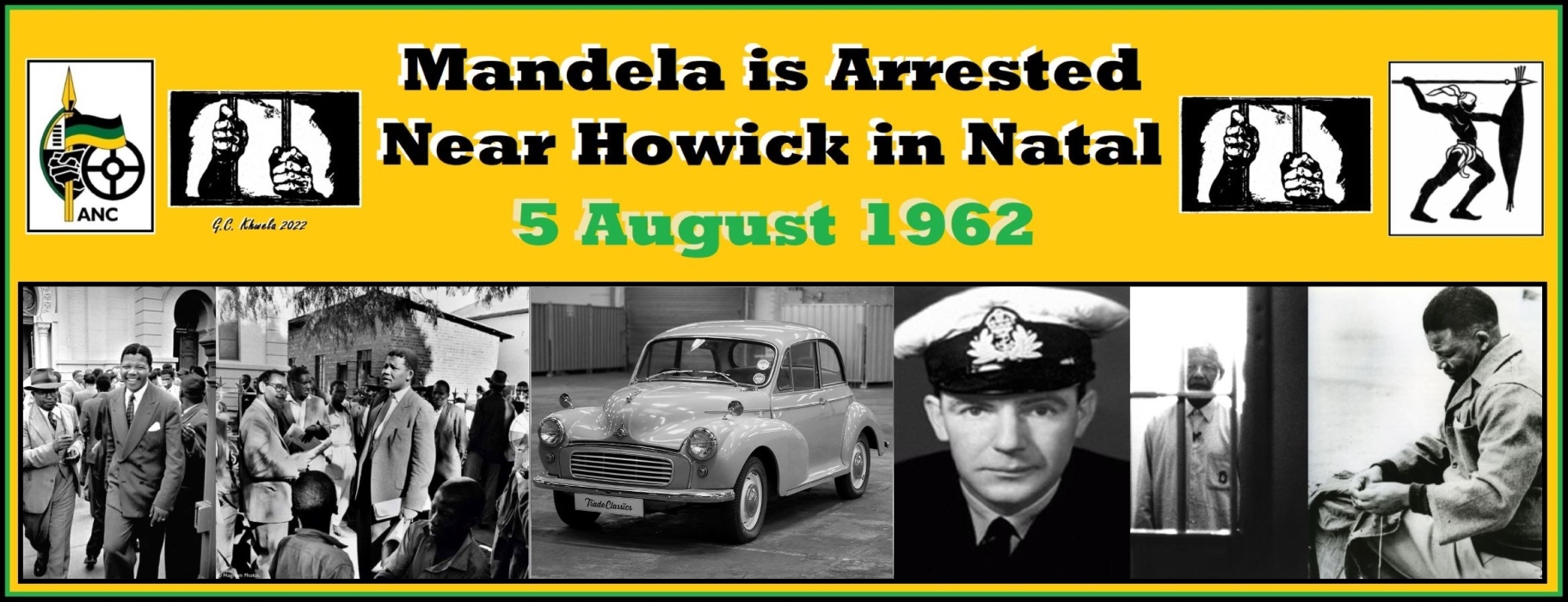
Mandela is Arrested Near Howick in Natal
On the afternoon of 5 August 1962, Nelson Mandela was wearing his white chauffeur’s dust coat, as Cecil Williams was driving him in an Austin motor car. When they left the industrial precincts of Durban, they moved through hills that offered majestic views of the surrounding valleys and the blue-black waters of the Indian Ocean. Durban was the principal port for South Africa’s main industrial area, and the highway that led to Johannesburg ran parallel to the railway line for a great distance.
Mandela began engaging Cecil about the fact that since the railway line, being so close to the highway, offered a suitable target for sabotage. He then a made a note of this in the small notebook he always carried with him. They were engrossed in discussions about the sabotage plans as they passed through Howick, approximately 32 kilometres northwest of Pietermaritzburg. At Cedara, as they passed through Howick from Pietermaritzburg, Mandela noticed a Ford V8 full of white men, which was advancing to overtake them. As he looked behind, he saw two more cars filled with white men.
After the Ford V8 had overtaken them, it signalled the Austin to stop. Mandela knew at that moment that his life on the run was over, as his seventeen months of “freedom” were about to end. Cecil Williams started to slow down, as there was a steep, wooden bank to the left. He then asked Mandela, “Who are these men?” Mandela decided to remain silent until the car had stopped, as of both knew very well who they were. The apartheid police had chosen an appropriate hiding-spot, as there was no chance to escape. Even if Mandela had tried to jump out and making an escape into the woods, he would have been shot in a short space of time.
When the car stopped, a tall, thin, unshaven man approached the car on the passenger’s side, and at the window introduced himself to Mandela as Sergeant Vorster of the Pietermaritzburg Police. Apartheid Sergeant Vorster then produced a warrant of arrest and asked Mandela to identify himself. Mandela responded by saying he was David Motsamayi, with Vorster nodding and asking a few questions about where they were coming from and about their destination.
After a while, Vorster then said, “Ag, you’re Nelson Mandela, and this is Cecil Williams, and you are under arrest!” He then informed them that a police Major from the other car was going to accompany them back to Pietermaritzburg. During those days the apartheid police were not yet that vigilant, as they did not bother to search them. At that time Mandela had a loaded pistol in his possession, which he secretly hid with his notebook in the upholstery between his seat and that of Cecil. Auspiciously, the police never found the pistol and the small notebook, which could have led to many more people being arrested.
When they arrived at the Loop Street Police Station in Pietermaritzburg, Mandela was led into Sergeant Vorster’s office, where he saw a number of officers, including Warrant Officer Truter, who had testified in the Treason Trial in the 1950s. Truter had made a favourable impression on the accused in the Trial, as he had accurately explained the policy of the African National Congress (ANC), without lying or exaggeration. He greeted Mandela in a friendly way, as he entered the office.
When Mandela insisted that he was David Motsamayi, Truter asked him, “Nelson, why do you keep up this farce? You know I know who you are. We all know who you are.” Mandela insisted on remaining as David Motsamayi, and when he was refused a lawyer, he declined to make a statement. They were then locked in different cells with Cecil, and as Mandela reminisced on the situation, he realised that the apartheid police had known that he was in Durban, and that he would be returning to Johannesburg.
For weeks before his return, the police believed that he was already back in the country, as in June newspaper headlines referred to the “Return of the Black Pimpernel”, while he was still in Addis Ababa. It was obvious that they had information that he was in Durban at the time, since the Movement had been infiltrated with informers. According to Paul S. Landau, details relating to Mandela’s arrest are still unclear, even though the British intelligence operatives in Bechuanaland knew about his movements when he came back from military training abroad.
However, Landau further insists that the US Central Intelligence Agency (CIA) had someone in South Africa who ran an Indian “activist” as an informant who revealed Mandela’s plans to the Security Branch. At a party hosted in the house of the mercenary Mike Hoare, just after Mandela was arrested, Don Rickard, a CIA operative, admitted that he was behind the operation. However, no records of this were kept anywhere and Rickard only confirmed this, as a retiree in Arizona, just before his death in March 2016, to a camera crew, led by Director John Irvin, after a 15-minute interview with the historian James Sanders. In the interview, Rickard described Mandela as “the world’s most dangerous communist outside of the Soviet Union”, and someone who “had to be stopped”.
Sources:
Wikipedia.
South African History Online (SAHO).
South African History Archives (SAHA).
Graham Dominy, “The Capture of Nelson Mandela 5 August 1962”, The Heritage Portal, 3 August 2022.
Paul S. Landau, “Spear: Mandela and the Revolutionaries”, Jacana, 2022.
Thula Simpson, “Umkhonto we Sizwe: The ANC’s Armed Struggle”, Penguin, 2016.
Nelson Mandela, “Long Walk to Freedom”, Abacus, 1994.
Castro Khwela
Good day fellow Compatriots!
Discover more from CASTRO KHWELA
Subscribe to get the latest posts sent to your email.