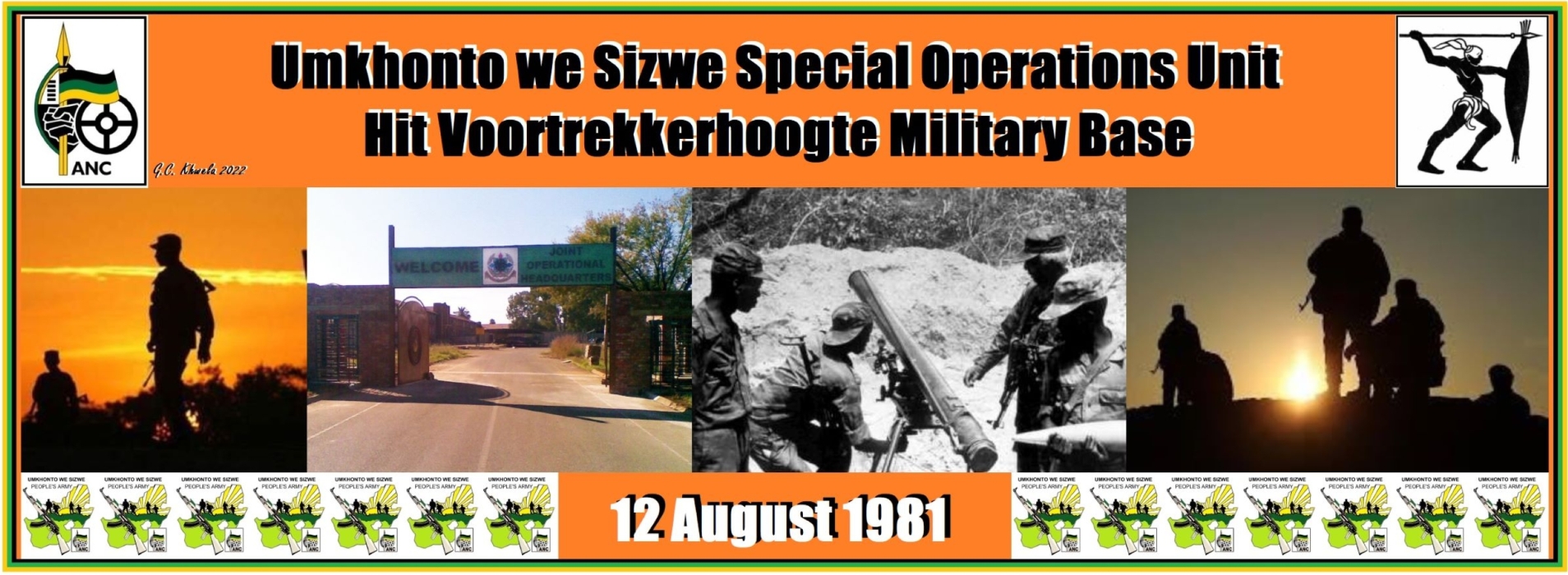
MK Special Operations Unit Hit Voortrekkerhoogte Military Base
On 12 August 1981, in the evening, at a spot between the Indian areas of Erasmia and Laudium, approximately four kilometres from the apartheid South African Defence Force’s (SADF’s) Voortrekkerhoogte military base in Verwoerdburg (now Centurion), between Pretoria and Johannesburg, members of Umkhonto we Sizwe (MK) Special Operations Unit had a GRAD-P rocket launcher system set-up.
This Special Operations Unit was formed with the mandate of undertaking high profile attacks, and its members consisted of Barney Molokoane (aka “Bhuda”), as the operational commander, Johnny Mashigo (aka “Vuyisile Matroos”), Johannes Mnisi (aka “Victor Molefe”), Vincent Sekete (aka “Sidney Sibepe”) and Velaphi Mbele (aka “Ta Vicks”). Stationed nearby was Philemon Malefo, who was often based in Mamelodi to provide transport and logistics, was waiting in a Ford Ranchero motor vehicle.
Meanwhile, around 22:30, Lieutenant van Dyk was busy writing a situation report at the Voortrekkerhoogte military base, when he heard a large explosion. He then called the guards at the gate to confirm what had happened. A guard responded that there was a great explosion somewhere near the base, and, as he was responding, another explosion occurred on the other side of the street. Ten minutes later three more explosions ensued, which Van Dyk determined were from the west of the base.
Following these five explosions, a large crowd was beginning to gather on the hill from which the Special Operations Unit had finished firing their rockets and were preparing to withdraw. Some of the spectators mistakenly believed that the explosions were part of an SADF military demonstration. Recognising that the crowd was increasing, the guerrillas agreed that Malefo should leave alone, with him obliging, to prevent the vehicle from being identified.
Molokoane and Mnisi then decided to head towards Laudium without a getaway car, where they encountered seventeen-year-old Zahied Patel, as he stepped out of his home, at around 23:15, to park his father’s car. They approached him to ask for a lift, and he refused. Yet Molokoane and Mnisi ignored him and got into the car. As he attempted to resist, Molokoane shot him. With his injuries, Patel fled into the house with the car keys. They then decided to abandon the car and returned back to where their comrades were waiting.
As they were running towards the spot, local residents, who had heard the gunshots, emerged from their homes and began firing in the direction of the cadres. Molokoane and Mnisi were then provided covering fire by their comrades, “Ta Vicks” and Matroos, while Sibepe threw a grenade, which exploded in front of the residents, thus enabling the group to escape to their base at Erasmus area of Pretoria, called “Mooiplaas”.
The following day when assessments of the damage were made, it was discovered that the impact was minimal, as it was limited to the destruction of the servant’s quarters at the home of a senior officer. The other rocket hit a part of a pillar of the military college, another an ablution block, an open field as well as one or two houses. One of the rockets did not explode, however, another one cut through the roof of a garage, struck the ground, with the blast dislodging the roof, bursting the windows and turning everything inside upside-down.
The attack achieved little in military terms but presented the ability of MK to operate within South Africa and to strike at a time and place of its choosing. “The operation was a huge success”, as it “signalled a shift in Umkhonto we Sizwe’s armed struggle, from economic to military targets and from power stations to the very power at the heart of apartheid”, according to Aboobaker Ismail (aka “Rashid”). “Operations such as the attack on Voortrekkerhoogte clearly showed that the combatants were highly disciplined – they did not attack other targets or whites in the surrounding areas while they were being hunted by the regime.”
Rashid continued to state that “While MK had the means and capacity to attack civilians, it did not take the easy route. Instead, it concentrated on military targets and state infrastructure. Cadres in the camps in Angola interpreted the success of the operation as a signal that they were going home soon. In little more than a year, MK’s invigorated ‘armed propaganda’ had progressed from hitting Sasol I and II to power stations and then to a military base at Voortrekkerhoogte.”
The attack on Voortrekkerhoogte, which was a huge military base outside Pretoria had symbolic significance. Next to it is the famous Monument of the same name which for the Afrikaaners symbolises the Great Trek, their sufferings and bitterness and their heroism during the Anglo-Boer war. African National Congress (ANC) President OR Tambo opposed an attack on the Voortrekker Monument arguing that there were certain symbols that one should not destroy. An attack on those was to be seen as an attack on the Afrikaner people themself. But the military base would prove that the ANC had the capacity to take on the heart of Afrikaner military might, in the heart of Pretoria, the Capital. That would have a great psychological impact.
Subsequent to the surprise attack, the apartheid SADF and the Police undertook a massive search for the “terrorists”, erecting roadblocks throughout the Pretoria, Bronkhorstspruit, Hammanskraal, East Rand, Midrand and other surrounding areas. Access and egress into the black townships of Atteridgeville, Saulsville and Soshanguve were blocked and cordoned off, and police were frisking and searching commuters in all the modes of public transport, including buses and trains.
The apartheid SADF attempted to suppress all information regarding the attack, with the Minister of Defence, General Magnus Malan maintaining that “the primary aim of the enemy is to unnerve, through maximum publicity … we have to obtain the cooperation of the South African media in not giving excessive and unjustified publicity to terrorists.” Similarly, the Commissioner of Police, General Johann Coetzee, categorised the attack as “a significant event because it had a psychological effect on the government by striking at the heart of its military forces”.
For the Voortrekkerhoogte Operation a British couple, Nicholas Heath and Bonnie Muller, had been recruited from London. They rented a small five-roomed holding in the Erasmus area of Pretoria, called “Mooiplaas”, for R500 a year from Gerhard Basson, as a married couple, and began doing some reconnaissance work for the Special Operations Unit. The couple, which was not actually married, came into the country on 20 March 1981, to create a base for the Special Operations Unit that had to carry out the attack on the military base. Actually, they were recruited through the British Communist Party by MK Chief of Staff Joe Slovo to assist with the operation.
Rashid prepared the equipment in Maputo, with the assistance of Carimo, a sympathetic Mozambican panel beater, who created hidden compartments in the Ford F250 bakkie. The barrel of the artillery piece, the Grad-P, was 2.54 meters long, a bulky piece very difficult to mount on the bottom of the Ford F250 bakkie, which was ultimately done. This included the tripod mount, which weighed around 28 kilograms and the rockets, each weighing approximately 46 kilograms. The bakkie had been bought in Johannesburg by Edward Wethli and was taken inside the country with the equipment by Nicholas Heath and Bonnie Muller on 2 August 1981 from Mbabane, Swaziland.
Barney Molokoane joined the couple a few days later at Mooiplaas, where he posed as a gardener, while conducting reconnaissance of Voortrekkerhoogte and doing the calculations as a well-trained Gunner. Ultimately, after they were certain that everything was in place, they signalled for the other members of the Unit to enter the country, which they did on 8 August 1981, following the British couple having left the country. Mooiplaas was then used as an operational base from 9 August, where all the cadres behaved as labourers until the day of the operation.
On the night of 11 August 1981, at approximately 21:00, the cadres were dressed in blue overalls, as they carried the parts of the Grad-P to the firing point in the countryside. The weight of the Grad-P forced them to request Philemon Malefo to assist with his Ford Ranchero bakkie to get the artillery pieces to the firing point, approximately 4.5 kilometres from Voortrekkerhoogte. Just after 22:30, the first rocket was fired, which made a huge roar, drawing crowds from Laudium and Erasmia to come out and watch at the spectacle, as one rocket followed another. Most of these spectators presumed the firing to be an apartheid SADF exercise, as they marvelled at the display.
After they had fired the last rocket, they left a big sheet at the scene of the operation, on which it was written that when the apartheid security forces attacked Matola, it was not a military base, however Voortrekkerhoogte was a legitimate military base. Unfortunately, they had to consider other ways of packing the artillery pieces, as Malefo’s bakkie had already left, due to the crowds that were surrounding the operational area. Following the exchange of gunfire that occurred with the residents of Ladium and being able to escape to their base in Mooiplaas, the police discovered the partly dismantled artillery piece together with the banner, with the words “Remember Matola”.
Sources:
Wikipedia.
Jo-Ansie van Wyk, “Nuclear Terrorism in Africa: The ANC’s Operation Mac and the Attack on the Koeberg Nuclear Power Station in South Africa”, Historia, Vol. 60, No. 2, November 2015.
Aboobaker Ismail (Rashid), “The ANC’s Special Operations Unit”, The Thinker, Vol. 58, 2013.
African National Congress, “Statement to the Truth and Reconciliation Commission”, August 1996.
Cornelius Johannes Brink Le Roux, “Umkhonto we Sizwe: Its Role in the ANC’s Onslaught Against White Domination in South Africa, 1961 – 1988”, Thesis: Doctor of Philosophy, University of Pretoria, 1992.
Yunus Carrim, “Attacking the Heart of apartheid: The ANC’s MK Special Operations Unit”, Penguin, 2025.
Stephen Ellis, “External Mission: The ANC in Exile, 1960–1990”, Jonathan Ball, 2012.
Thula Simpson, “Umkhonto we Sizwe: The ANC’s Armed Struggle”, Penguin, 2016.
Stephen R. Davis, “The ANC’s War Against Apartheid: Umkhonto we Sizwe and the Liberation of South Africa”, Indiana University, 2018.
Castro Khwela
Good evening fellow Compatriots!
Discover more from CASTRO KHWELA
Subscribe to get the latest posts sent to your email.