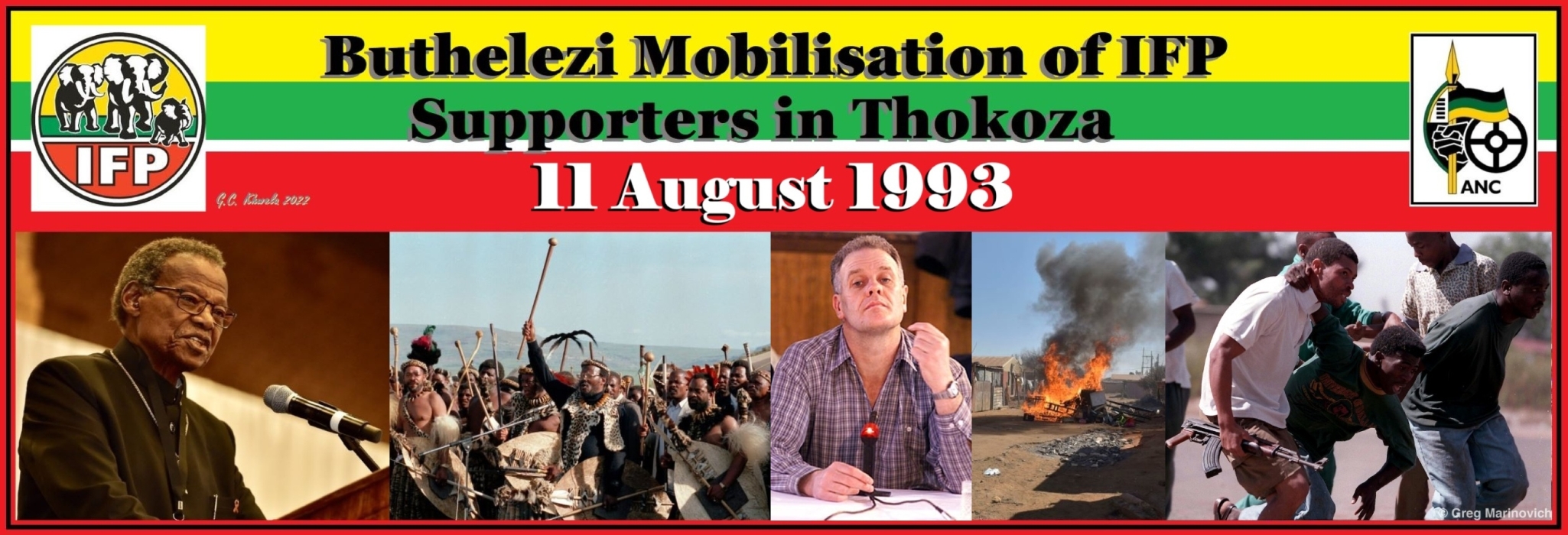
Buthelezi Mobilisation of IFP Supporters in Thokoza
On 11 August 1993, Chief Mangosuthu Gatsha Buthelezi was addressing a crowd of approximately 2 500 Inkatha Freedom Party (IFP) supporters in Thokoza, in which he indicated that “as president of the IFP, I direct that every member and supporter of my party, the Inkatha Freedom Party, translates the letters I-F-P into the slogan ‘I’m for peace’”. According to Buthelezi, the reason why there was no peace was the continued existence of Umkhonto we Sizwe (MK), to whose “evil activities” the apartheid government was turning a blind eye.
Buthelezi added that he was “bitterly opposed” to the inclusion of MK in a multiparty peacekeeping force, as “Nowhere in the world has an ill-trained, underdeveloped and wrongly-motivated liberation army ever been able to act as an honourable peacekeeping force”. For Buthelezi, “the handing over of responsibility by the South African government to such a peacekeeping force will only exacerbate the circumstances in which endemic violence is now flourishing in South Africa”.
Buthelezi then called for the “disbandment of MK”, and warned the apartheid government and the whole world, that “the absorption of MK into the South African Defence Force, and the absorption of MK into a so-called multi-party peacekeeping force is a total prescription for disaster”. These utterances by Buthelezi were driven by the activities of the Phola Park “Self-Defence Unit (SDU)”, which opened fire on a crowd of Inkatha members, killing sixteen people, just before the signing of the National Peace Accord in September 1991.
This “SDU”, led by Mcungisi Ceba, whose “leaders” claimed to be members of MK, began a reign of terror in the community. Under Ceba and his small band of “comrades”, the Phola Park unit began launching random attacks against the police, passing motorists and former leaders of residents of Phola Park. The Truth and Reconciliation Commission (TRC) found that on 8 September 1991, twenty-three people were killed at the Thokoza Stadium on the eve of the signing of the National Peace Accord.
Furthermore, forty-two people died and at least fifty people were severely injured in violence that broke out between supporters of the ANC and the IFP in the two days that followed. The initial attack was initiated by Michael Phama, a member of an ANC SDU, acting on the instructions of his Commander, Mcungisi Ceba, who was a police informer in the pay of the apartheid Security Branch.
On 11 November 1992, the Goldstone Commission raided offices of the South African Defence Force (SADF) Military Intelligence’s (MI’s) Directorate: Covert Collection (DCC) and seized various files. In a press statement released on 16 November 1992, the Commission stated that it had found that Ferdi Barnard, a convicted murderer and former Civil Cooperation Bureau (CCB) member, was employed by the Directorate: Covert Collection (DCC), and had written up a project proposal in June 1991 for the task force he was to lead.
Ferdi Barnard’s group was to “specialise solely on the activities of Umkhonto we Sizwe (MK)” and concentrate on discrediting MK by involving cadres in criminal activities and syndicates. Where they could not be recruited, the unit would aim to ensure they were “criminally compromised. For that purpose use would be made, inter alia, of prostitutes … and drug dealers”. Barnard’s plan was submitted to senior MI officials and approved.
On 17 November 1992, a report was published on violence in the Thokoza area by a committee established by the Goldstone Commission, which included an inquiry into the notorious Phola Park “SDU”. There were striking similarities between the Military Intelligence’s DCC proposal to criminally compromise MK members and the activities of this SDU. It was found that Mncugisi Ceba’s “SDU”, had been responsible for many criminal acts including the assassination of a highly regarded community leader, Prince Mhlambi, and the attack on Inkatha members. Nearly all the actions of this “SDU” were criminal in nature.
The Commission later established that Ceba was an apartheid police informant and that the apartheid police “probably knew of the planned attack on hostel dwellers on 8 September”, after which many other residents died in attacks and counter-attacks set off by this massacre. An African National Congress (ANC) member, Michael Phama, was convicted of the murders of the Inkatha marchers, but Ceba was not brought to trial. The Goldstone Commission also found that there was no evidence at all that MK was in any way involved with the establishment and command of this “SDU”, and in no way knew about or sanctioned its criminal activities.
At the same IFP rally in Thokoza, on 11 August 1993, Gatsha Buthelezi called on every Zulu to pay a R5 levy for the establishment of a “private army” to “guard against the obliteration of KwaZulu (Bantustan)”. Monies to sponsor the project were in fact drawn from the budget of the KwaZulu Bantustan government and these were authorised at a KwaZulu Legislative Assembly meeting on 25 August 1993, wherein a resolution was taken to establish a self-protection unit training project.
Subsequently, in September 1993, the training of Self-Protection Units (SPUs) began at Mlaba Camp, on the edge of the Umfolozi Game Reserve. Senior IFP member Philip Powell later acknowledged that prior to the opening of Mlaba, training of IFP recruits had been going on for more than a year and about 1 200 men had been “informally” trained. Between 5 000 and 8 000 IFP supporters were trained at Mlaba camp, and some of the Caprivi trainees were deployed to assist in the project. Trainees received instruction in offensive methods and the use of AK 47s by Daluxolo Luthuli, a former soldier of MK, who was part of the Wankie Campaign and later defected to the IFP after being released from Robben Island.
With the assistance of former Vlakplaas commander Eugene de Kock, Powell arranged for the delivery of a number of truckloads of sophisticated weaponry to be delivered to the region. In his testimony to the Truth and Reconciliation Commission (TRC), De Kock said Inkatha member Phillip Powell asked him for the arms and ammunition in order to train Inkatha self-protection units. According to De Kock, “He once told me with tears in his eyes that he was tired walking amongst the bodies of his people which were mowed down by the ANC. This was only about defence, because they were being destroyed by the ANC.”
According to evidence produced in court, De Kock and former Vlakplaas operative, Snorre Vermeulen, the weapons were collected in two consignments, which included four truckloads of ammunition and explosives from Mechem, a state-owned arms manufacturing entity in Pretoria, in October 1993. By then De Kock had already left the police, but he was introduced to Marthinus Gouws, who was in charge of the armoury of Mechem, as a member of the force and he said that the police wanted the explosives for the training of students. Gouws said Mechem had had an enormous amount of arms and ammunition in its armoury and had decided to get rid of the excess.
De Kock claimed that the weapons were to be used for self-defence and training, which was about the survival of Inkatha. “They (the ANC)”, De Kock maintained, “were busy exterminating Inkatha on the East Rand and in parts of KwaZulu, and it was decided to form self-defence units so that they could protect their own people”. Phillip Powell asked De Kock to assist him in training Inkatha self-protection units (SPUs) at their secret Mlaba camp near the Umfolozi game reserve, but De Kock said when he arrived there that conditions were atrocious. There were virtually no sanitary services, or running water and some of the people were sick. He then told Powell that he couldn’t help him unless conditions were improved.
Two weeks later, Powell called him again and said facilities had been upgraded. One of the Inkatha commanders in the camp was a man with a most remarkable story: Daluxolo Wordsworth Luthuli, who had received military training in the Luthuli camp in Tanzania and Odessa in the Soviet Union. He was arrested upon his return to South Africa in 1967 and sentenced to ten years’ imprisonment. After his release from the island, he joined Inkatha, by the middle 1980s, he had been drawn into the Natal conflict and eventually became commander of Inkatha’s armed wing and was amongst the 200 impis who were secretly trained by Military Intelligence in the Caprivi.
Luthuli said he was instructed by the Inkatha leadership in 1993 to train self-protection units for Inkatha at the Mlaba camp. “The central committee”, according to Luthuli, “had decided that this was a system whereby the armed wing of Inkatha could be increased”. Powell appointed six instructors, two white men and four black men, to assist in the training. Luthuli said in an affidavit, dated March 1995, “When these instructors arrived they were accompanied by a third white man who wore thick glasses. He was thick-set in build and quite tall … Problems arose from the outset. My men were against white involvement … and did not trust their set-up. Many groups came and went from this camp and they numbered 400 to 600 on each occasion. I last heard that there were 8 000 trained SDUs.”
Investigations by the Independent Task Unit that was established by the democratic government revealed that the apartheid South African Police had supplied Inkatha with large quantities of weapons, providing further concrete proof that Inkatha had been in cahoots with the apartheid state. Melchizedek Zakhele Khumalo (Gatsha Buthelezi’s long-standing aide and former Inkatha Administrative Secretary) shouldered the blame, as he had done previously when a massive scandal blotted Buthelezi’s standing as a freedom fighter and which bolstered claims that he was an apartheid surrogate.
In a major Inkathagate exposé, the then Weekly Mail newspaper revealed that Inkatha had been funded by the feared apartheid Security Branch. It emerged in court that Zakhele Khumalo had been the key link between the apartheid generals and the trainees. All the arrangements had been made through him. To Gatsha Buthelezi’s eternal embarrassment, the newspaper revealed that the massive launch of the United Workers Union of South Africa (UWUSA) in Durban, to counter the hugely popular Congress of South African Trade Unions (COSATU), had been a project of the apartheid government. Thousands were transported by buses and trains to Durban to listen to Buthelezi denounce economic sanctions and the work of ANC-aligned trade unions.
Sources:
SAHO, “Chief Mangosuthu Gatsha Buthelezi”, South African History Online (SAHO), 17 February 2011.
African National Congress, “Statement to the Truth and Reconciliation Commission”, August 1996.
Anthea Jeffery, “Anthea Jeffery on Prince Mangosuthu Gatsha Buthelezi (1928-2023) – ‘An Exceptional South African’”, BizNews, 11 September 2023.
Truth and Reconciliation Commission, “Truth and Reconciliation Commission of South Africa Report”, Vol. 3, 29 October 1998.
Thula Simpson, “Umkhonto we Sizwe: The ANC’s Armed Struggle”, Penguin, 2016.
Jacques Pauw, “Into the Heart of Darkness: Confessions of Apartheid’s Assassins”, Jonathan Ball, 1997.
Castro Khwela
Good day fellow Compatriots!
Discover more from CASTRO KHWELA
Subscribe to get the latest posts sent to your email.