Who Betrayed Bram Fischer?
On 16 November 1964, a leader of the South African Communist Party (SACP) stood up in court and pointed out eight persons who he said were in the party with him. Petrus Arnoldus Bernhardus “Piet” Beyleveld, an acknowledged member of the party’s Central Committee, was the state’s first witness as the trial of 14 persons charged with being Communist party officers or members opened in a Johannesburg Regional Court.
The fourteen originally charged were: Abram Fischer, Q.C., leading defence lawyer in the Rivonia sabotage trial; Ivan Schermbrucker. former manager of the banned “New Age” and “Spark” newspapers; Eli Weinberg, for over thirty years a prominent trade union official until banned by the Nationalist Government, and later a professional photographer; Esther Barsel, former member of the Friends of the Soviet Union and the Congress of Democrats; Dr Costa Garides, former member of the Congress of Democrats; Lewis Baker, a well-known Benoni attorney and secretary of the East Rand Branch of the Communist Party until it was banned in 1950.
They also included Paul Trewhela, a journalist and former member of the Congress of Democrats; Norman Levy, a teacher and former national executive member of the Congress of Democrats; Molly Doyle, a former member of the Congress of Democrats; Sylvia Neame, a student and former member of the Liberal Party and later the Congress of Democrats; Anne Nicholson, art student and former member of the Congress of Democrats; Jean Middleton, schoolteacher and former member of the Congress of Democrats; Hymie Barsel, former secretary of the Society for Peace and Friendship with the Soviet Union; and Florence Duncan, physiotherapist and former member of the Congress of Democrats.
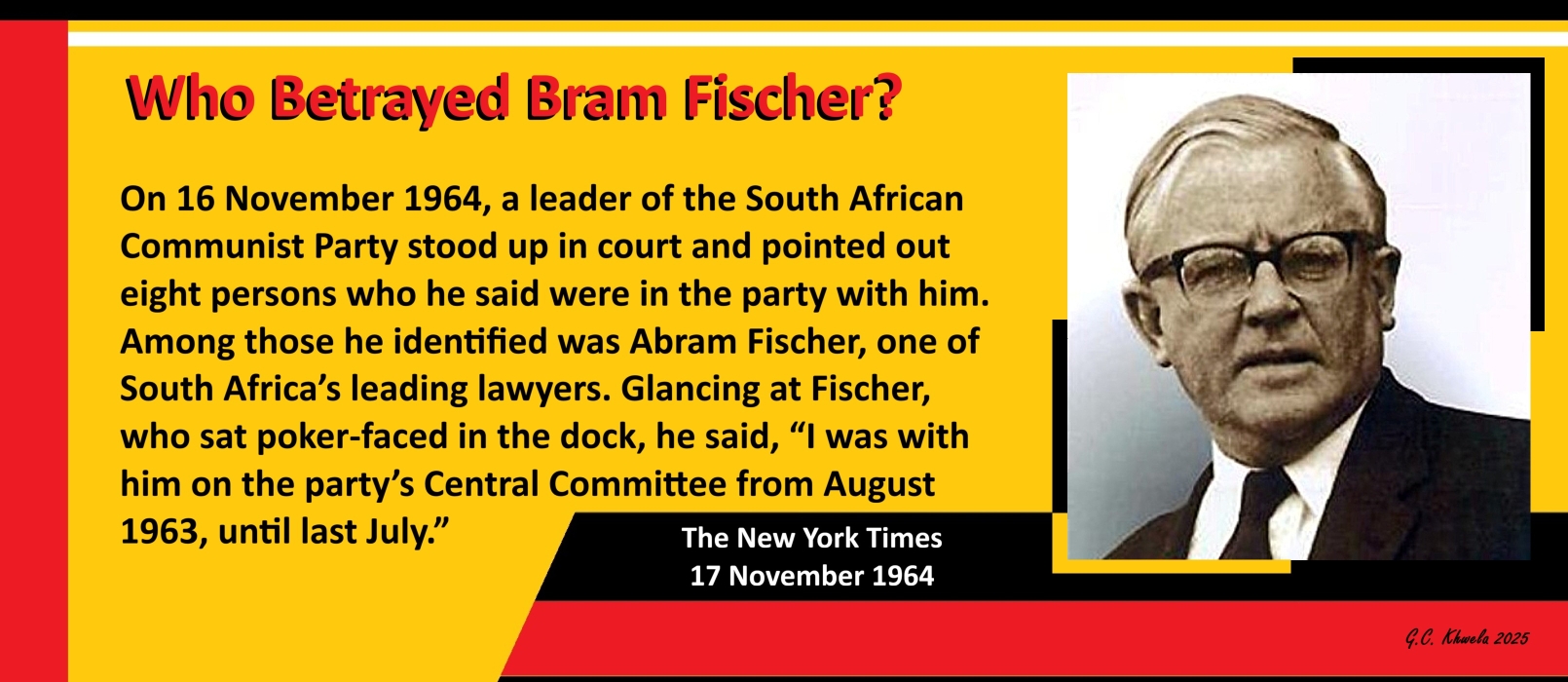
Among those identified by Beyleveld was Abram Fischer, one of South Africa’s leading lawyers. Glancing at Fischer, who sat poker‐faced in the dock, Beyleveld said, “I was with him on the party’s Central Committee from August 1963, until last July.” Petrus Beyleveld identified two other defendants as members of the party’s Central Committee. They were Ivan Schermbrucker, a businessman, and Eli Weinberg, a photographer. He pointed out five more of the defendants as party members. Beyleveld said he knew the remaining six defendants and had seen some at party gatherings, but he said he could not identify them positively as members.
Petrus “Piet” Beyleveld was a well‐known trade union leader in the South African Congress of Trade Unions (SACTU) and former chairman of the banned South African Congress of Democrats (COD). As he took the stand the magistrate, S. C. Allen, said he was being called as an accomplice but that if his testimony was “satisfactory” he would be granted immunity from prosecution.
Bram Fischer therefore was primarily betrayed to the apartheid police by Petrus Beyleveld, a fellow member of the SACP. Beyleveld became a key state witness in Bram Fischer’s trial, providing evidence that directly implicated Fischer in underground activities at Liliesleaf, the secret headquarters of the liberation movement’s armed wing, Umkhonto we Sizwe (MK). The evidence provided by Beyleveld was extensive and detailed, covering the restructuring of the Communist Party’s Central Committee after the initial Rivonia arrests, the flow of funds from London to the ANC and MK, and Fischer’s central role in strategizing and directing sabotage efforts.
Of the fourteen originally charged, Hymie Barselwas, eventually, found to be not guilty; Abram Fischer went into hiding in January 1965 in order to continue the struggle against apartheid from underground; and the remaining twelve were sentenced to various prison terms. Two of the three counts on which the accused were charged were eventually ruled to be alternative to one. another; thus, the maximum penalty the accused could have received was six years. Considering this was the first offence for many of the accused. the sentences must be regarded as undoubtedly severe. Fischer had gone underground as a fugitive from the law in January 1965 after breaking his bail undertaking to stand trial, believing it was his duty to remain in the country and oppose the ‘monstrous policy of apartheid’. He was eventually captured in November 1965 and subsequently sentenced to life imprisonment.
Later, Beyleveld was asked whether he was in favour of principles adopted by the South African Communist Party in 1962. “Yes, I was and I still am.” he replied. The trial was the first of persons alleged to be Communist Party leaders. Hendrik F. Verwoerd’s Government contended that resistance to its policy of apartheid, or racial separation, was being led by Communists and had vowed to crush the party. The lengthy indictment against the defendants, all of whom were white, alleged that they sought to overthrow the government. They all pleaded not guilty.
Petrus Beyleveld, an olive-skinned Afrikaner, who ran a secretarial agency with his wife, Stella, in the centre of Johannesburg, was a former detainee who broke down under the ninety-day detention in July 1964. He was assisted in his testimony against his former comrades by another apartheid police agent Gerhard Gunther Ludi, who was recruited into the Security Police in 1960 and succeeded in worming his way into the underground Communist Party in 1963. Both gave evidence of meetings of Communist Party committees and groups and details of Party discussions and activities. Beyleveld claimed to have been a member of the Communist Party’s Central, District and Area Committees.
In addition to blasting the lives of the accused, against whom, he said in justification of his treachery, there was in any case plenty of other evidence, he named people not previously known to the police, some of whom were later arrested. He also gave evidence which helped convict the accused charged with sabotage in the Wilton Mkwayi Trial and was reported to be touring South Africa giving evidence in other political trials.
He even revealed that the SACP had regrouped after the Rivonia arrests, with Fischer as chairperson and Mkwayi being responsible as the Commander-in-Chief of the High Command of MK. Piet Beyleveld further confirmed that the Central Committee was still composed of those members who had remained following the banning of the first party, the CPSA, which included Hilda Bernstein, Ivan Schermbrucker, Bartholomew Hlapane, Mac Maharaj and himself.
The main reason for Beyleveld to betray the Communist Party and Bram Fischer, in particular, was that he opted to serve the apartheid Security Branch and to be a state witness instead of his illicit affair with Jean Strachan, an SACP cell leader, being exposed. The Security Branch had bugged Strachan’s cell and had discovered that she had an illegal abortion that was arranged by Beyleveld. He was then given an offer to have the abortion exposed and being charged, or to help the Security Branch bust the Communist Party cell and to testify against the detained members.
Following Bram Fischer opting for the underground and skipping bail, he decided to flee to Rustenburg after his contact within the Communist Party, Violet Weinberg, was also detained. In his hideout in Rustenburg, Fischer underwent a facial disguise, which made him unrecognisable, as he had his hair removed, grew a beard and obtained new glasses that made him into a different character, with a new name, identity book and drivers’ licence of Desmond Black. He then moved into a flat at 215 Corlett Drive, Bramley, in Johannesburg, wherein he began reorganising the SACP underground.
When Bram Fischer was rearrested on 11 November 1965, he became the only person accused in his trial that commenced on 26 January 1966. He was accused of having chaired the meetings of the Communist Party and of Umkhonto we Sizwe at Rivonia, having planned and supported the Sabotage Campaign, and also controlling the finances of the Party which were used to support the acts of “sabotage and terrorism” and subverting the State.
Certain members of the Party became state witnesses in the trial, such as Doreen Tucker, who admitted to being a Party courier, moving large sums of money between various areas and individuals and opening several bank accounts. It was revealed that the money handled by Bram Fischer originated from the Soviet Union and the People’s Republic of China, whilst trivial amounts came from donors, such as the Canon Collins’ Christian Aid, the Defence and Aid Fund, which provided assistance for legal defence, as well as other sources in the anti-apartheid movements in Europe and the Americas.
However, the most damning evidence came from fellow SACP Central Committee and MK High Command member, Bartholomew Hlapane, who implicated Fischer in numerous financial transactions that involved Umkhonto we Sizwe. According to Hlapane, Fischer also supported the ANC External Mission, and assisted in providing lucrative salaries, travelling allowances and rent subsidies to Communist Party operatives. Witnesses also included Beyleveld, Gerard Ludi and Patrick Baphela, who claimed to have been trained in the Soviet Union, in China and in Tanzania.
When Bartholomew Hlapane was arrested in September 1964, he was already working for the apartheid security forces, as he betrayed Wilton Mkwayi to the police and was soon to become a professional state witness. This was confirmed when Mkwayi was arrested at his girlfriend’s house in Orlando West on 1 October 1964, Bartholomew Hlapane was in the company of the apartheid Security Branch that arrested him.
Hlapane had been a member of the ANC’s National Secretariat and, disturbingly, was also a coordinator between the ANC and the underground Communist Party, particularly Bram Fischer and Eli Weinberg. Hlapane was an example of a particularly dangerous informer as the most senior office-bearer to betray the struggle – he had been a member of the ANC’s National Executive Committee (NEC) and of the Central Committee of the SACP.
In a statement issued on 6 May 1966 by the Chairman of the United Nations Special Committee Against Apartheid, Mr Achkar Marof of Guinea, following the conviction of Abram Fischer on 4 May 1966, he said, “The main ‘crime’ of Mr Fischer, in the eyes 6f the South African authorities, is his constant and brave fight against that racist regime’s policies of apartheid. They have not forgiven him for his able defence of the accused in the five-year-long treason trial of 1956-1961 in which all 156 accused were acquitted. He was also the leader of the defence in the Rivonia trial of Nelson Mandela, Walter Sisulu and others. … All this was done because he had dared to oppose the inhuman and the cruelest of cruel policies of an authoritarian regime.”
Sources:
Wikipedia.
South African History Online (SAHO).
The New York Times Archives, “14 South Africans on Trial as Reds: Prominent Lawyer Termed A Leader of the Party”, The New York Times, 17 November 1964.
Z. Nkosi, “The ‘Fischer’ Trial”, The African Communist, No. 11, Third Quarter 1965.
Padma Bahadur Khatri, “Report of the Special Committee on the Policies of Apartheid of the Government of the Republic of South Africa”, United Nations: General Assembly, Twenty-first Session, Agenda Item 34, 25 October·1966.
Advocate Respondent, “Reinstatement of Bram Fischer QC”, Advocate, December 2003.
Gcina Malindi, “We Remember Bram Fischer: An Intellectual, A Jurist and Leader”, Advocate, December 2008.
Gerard Ludi, “The Communistisation of the ANC”, Galago, 2011.
Sifiso Ndlovu and Gregory Houston (Eds.) “Chapter 24: Wilton Mkwayi”, The Road to Democracy – South Africans Telling Their Stories – Volume 1, South African Democracy Education Trust (SADET), 2015.
Gregory Houston, “Chapter 15: The Post-Rivonia ANC/SACP Underground”, The Road to Democracy in South Africa, Volume 1, 1960-1970, South African Democracy Education Trust (SADET), 2015.
Norman Levy, “On Trial: State versus Abram Fischer and Thirteen Others by Norman Levy”, South African History Online (SAHO), 19 June 2015.
Nicholas Stadlen, “Bram Fischer’s Legacy”, The Cairo Review of Global Affairs, Spring 2015.
Thula Simpson, “Umkhonto we Sizwe: The ANC’s Armed Struggle”, Penguin, 2016.
Tembeka Ngcukaitobi, “Bram Fischer: Contradiction, Moral Clarity and Political Promise”, Advocate, December 2023.
Castro Khwela
Good evening fellow Compatriots!
Discover more from CASTRO KHWELA
Subscribe to get the latest posts sent to your email.