The Commonwealth EPG Visit: Part 1
On 17 May 1986, the Commonwealth Eminent Persons Group (EPG), consisting of its co-chairmen, Malcolm Fraser of Australia and Olusegun Obasanjo of Nigeria, along with members Lord Barber, Nita Barrow, John Malecala, Swaran Singh and Edward Scott, flew into Lusaka for an engagement with African National Congress (ANC) President Oliver Tambo. The day before, the EPG had been provided permission by the apartheid South African government to visit Nelson Mandela in Pollsmoor Prison. The apartheid government had also agreed in December 1985 to cooperate with the peace initiative that the Commonwealth had launched two months previously.
The first EPG was established at the Commonwealth Heads of Government Meeting (CHOGM) in 1985, held in Nassau and it was tasked to investigate and report on apartheid in South Africa. The EPG reported ahead of the special Commonwealth Heads of Government Meeting in 1986, held in London, which was the eighth Meeting of the Heads of Government of the Commonwealth of Nations. It was held in Nassau, the Bahamas, between 16 October 1985 and 22 October 1985, and was hosted by that country’s Prime Minister, Sir Lynden Pindling.
During their visit to Nelson Mandela on 16 May 1986, the EPG discussed a paper that they had developed, titled “A Possible Negotiating Concept”. It detailed actions that might be taken to ensure the success of negotiations and breaking the cycle of violence in South Africa. Specifically, it called on the government to end martial law in the townships, release Mandela and other political prisoners, and the unbanning of the ANC, which for it was urged to suspend its armed struggle.
Mandela told them that he had no problem accepting the document as a starting point, but he emphasised that he was responding as an individual, whereas it was important to have the ANC’s reaction “I’m not the head of the movement”, he told them. According to Mandela, “The head of the movement is Oliver Tambo in Lusaka. You must go and see him. You can tell him what my views are, but they are my personal views alone. They don’t even represent the views of my colleagues here in prison.” The ANC in Lusaka would want to take these internal views into account. “All that being said”, Mandela added, “I favour the ANC beginning discussions with the government”.
Some members of the EPG were concerned about Mandela’s political ideology and the type of South Africa that he envisaged under the leadership of the ANC. Mandela informed them that he was not a communist, but a South African nationalist, who was committed to a non-racial society, as envisaged in the Freedom Charter. For Mandela, the charter embodied the principles of democracy and human rights, and not a blueprint for socialism. Accordingly, the white minority was not supposed to feel a sense of insecurity in a different South Africa, and that the major cause of the problems in the country was a result of a lack of communication between the apartheid government and the ANC.
With regard to violence, Mandela told them that even though he was not willing to renounce violence, he strongly believed that violence could never be the ultimate solution to the situation in South Africa, which could only be resolved by some kind of a negotiated settlement. In his personal view, Mandela suggested that if the apartheid government withdrew the army and the police from the townships, the ANC might agree to a suspension of the armed struggle as a prelude to talks. After the EPG had concluded the discussions with Mandela, they planned to go and talk to Oliver Tambo in Lusaka and to the apartheid government in Pretoria.
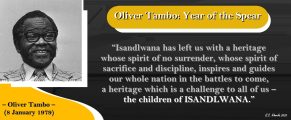
During their interaction with ANC President Oliver Tambo, he also said he can’t give a considered response to the document until he had had a chance to consult with the movement. He also added that in so far as it was in line with the principles and requirements of the Nassau Accord, his initial feeling was that it would command the ANC’s support. The Nassau Accord was agreed upon to calling on the government of South Africa to dismantle its apartheid policy, enter into negotiations with the country’s black majority and end its occupation of Namibia. At the very end of the meeting, Tambo indicated that he and his colleagues would require about ten days for consultations before giving a firm answer.
Twenty-five years before this visit, Prime Minister Verwoerd was virtually compelled to withdraw South Africa from the Commonwealth because his apartheid government’s racist practices were so abhorred by the former British colonies elsewhere in Africa and in Asia and the Caribbean. Yet the spectre of South Africa still haunted the Commonwealth, so much so that it threatened the very unity of this British club, which prided itself on being able to conduct affairs of state without rancour. In 1977, the Gleneagles Agreement urged Commonwealth members to discourage official sporting links with South Africa.
The communiqué issued after the Commonwealth meeting at New Delhi in 1983 stated that apartheid was “the root cause of repression and violence in South Africa and of instability in the region”, but did not propose any new measures against P.W. Botha’s government. Subsequently, the Commonwealth Eminent Persons Group was appointed to investigate this issue in consonance with the values and desires of the Nassau Accord and report back with recommendations ahead of the special 1986 CHOGM in London.
The EPG concluded that while the racist regime claimed to be ready to negotiate, it was in truth not yet prepared to negotiate fundamental change, nor to countenance the creation of genuine democratic structures, nor to face the prospects of the end of White domination and White power in the foreseeable future. Its programme of reform did not end apartheid but sought to give it a less inhuman face. Its quest was power-sharing, but without surrendering overall White control.
According to the EPG, “There can be no negotiated settlement in South Africa without the ANC; the breadth of its support is incontestable; and this support is growing. …Put in the most simple way, the Blacks have had enough of apartheid. They are no longer prepared to submit to its oppression, discrimination and exploitation. They can no longer stomach being treated as aliens in their own country. They have confidence not merely in the justice of their cause, but in the inevitability of their victory.”
The ANC in Lusaka also emphasised that it was calling for “one person, one vote in a unitary South Africa. Apartheid cannot be reformed – it must be destroyed. Sanctions will go a long way in doing just that. Not that sanctions will bring the apartheid monster to its knees. But they will definitely weaken apartheid and therefore make our struggle less costly in terms of lives lost and blood flowing in the streets of South Africa. That is why we say: Sanctions Now! This will be a direct contribution to our struggle, and this is what the Black people in South Africa are calling for.”
Sources:
Editorial, “Apartheid Cannot be Reformed”, Sechaba, June 1986.
Ralph Lawrence, “Mission to South Africa: The Commonwealth Report”, Penguin Books for the Commonwealth Secretariat, 1986.
Thula Simpson, “Umkhonto we Sizwe: The ANC’s Armed Struggle”, Penguin, 2016.
Nelson Mandela, “Long Walk to Freedom”, Abacus, 1994.
Castro Khwela
Good day fellow Compatriots!
Discover more from CASTRO KHWELA
Subscribe to get the latest posts sent to your email.