Oliver Tambo: On Talks
(ANC President O. R. Tambo Interviewed by Radio Freedom on Visits of Multi-National Corporations to the ANC, January 1986).
The ANC met many people both openly and in other circumstances last year. They came from the cream of democratic trade unions locked in mortal battle with the racist system of apartheid. They came from the civic associations and other democratic organisations, from student organisations to left and right, academics seeking solutions to the problem of South Africa.
They came from the board rooms of both South African and international industrial and financial power houses. They came from the very heart of yellow political parties of the Republic administration of Ronald Reagan and to the bloodred friends of the Blacks from the socialist countries and left political parties in the West.
Journalists came – from obscure newspapers right up to the pinnacle of the opinion makers of the world. It was however the meeting with the South African businessmen and soon thereafter with the Progressive Federal Party which greatly excited the media and drew a lot of comment from virtually everyone both locally and on the international level.
Why are the barons of international and local multi-national corporations desperately meeting the ANC now when the ANC has been in existence for 74 years? The president of the ANC, Oliver R Tambo, told Radio Freedom what the ANC is telling this particular group:
“They assess the apartheid system in terms of the profits or the losses it yields. It has always been clear that for them the apartheid system will be useful so long as it delivers the goods … If they reach the conclusion that indeed, the apartheid system is going to destroy their interests, destroy their business, the whole economy, at that point they will want to remove the apartheid system and will even join with forces that are set to destroy that system provided they are sure that the system will not be replaced with something worse for their economy, for their pockets, for their profits.
“But to the extent that our struggle had demonstrated that there is no future for them or for the economy – to that extent they will begin to move against the regime. Because, within limits, they are still part of it, it means that can be an additional lever, a position which favours our struggle. And that is how we see their role.
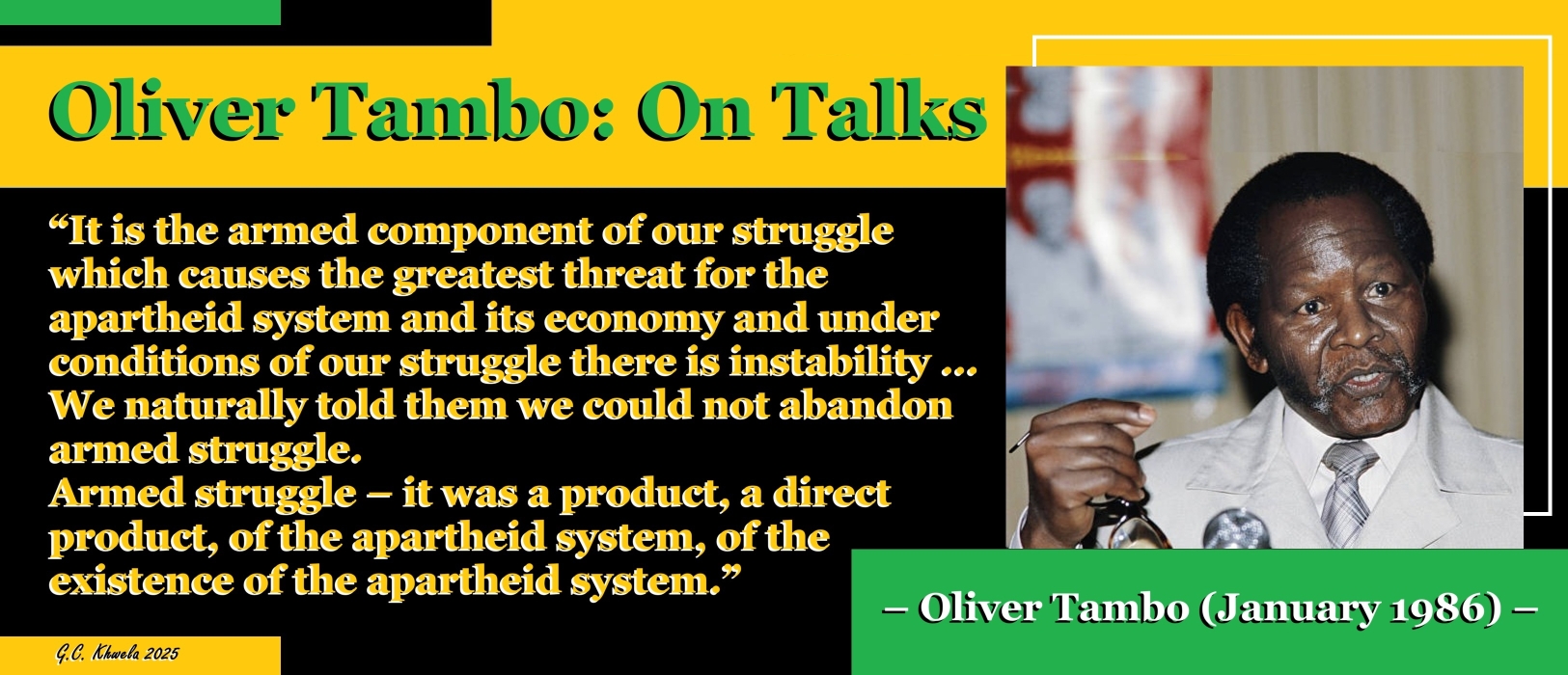
“Therefore, if it serves the purpose of weakening the ability of the regime to resist, if it helps to destroy the system, then we welcome that … It is the armed component of our struggle which causes the greatest threat for the apartheid system and its economy and under conditions of our struggle there is instability. They would rather, therefore, that the change were smooth, so that they have time to be adjusting to the change, by way of reforms, which means that there would be no rapid change transformation, and that we would be talking and arguing about things while they are making their profits, for 10 years, 20 years for 30 years, while they are making profits … It is the armed component which has made them want to come to the ANC … to see whether there is prospect of this being suspended.
“We naturally told them we could not abandon armed struggle. Armed struggle – it was a product, a direct product, of the apartheid system, of the existence of the apartheid system. And this affects the extent to which they can really come on our side.
“What replaces the apartheid system? What would be their position in the new system? Well, they cannot look forward to the kind of system that the ANC has in mind under the Freedom Charter, but at least they understood the reasons why the Freedom Charter had those provisions or why our people thought of putting those provisions in the Freedom Charter.
“They also want to reform the apartheid system in such a way that the end result is a system which secures their business but is minus racial discrimination. And that is what they are looking for – a system that falls short of the stipulations of the Freedom Charter but moves away from a system that thrives on violence and produces counter-violence.
“Well, we do not think that such a system is different. We certainly do not think that the regime and its supporters are really thinking of something which may be slightly different. We certainly do not think that the regime and its supporters are really thinking of an alternative to the apartheid system. They are thinking of something which may be slightly different. It might even be called something else, not apartheid, but would in practice be apartheid.
“We must protect our struggle against forces which sound correct but whose objective is entirely to destroy the cause, the·objective, of our revolutionary struggle”.
Source:
Oliver Tambo, “On Talks”, Sechaba, February 1986, pp. 31 – 32.
Castro Khwela
Good day fellow Compatriots!
Discover more from CASTRO KHWELA
Subscribe to get the latest posts sent to your email.