ANC Politico-Military Strategy Commission (PMSC) Appointed
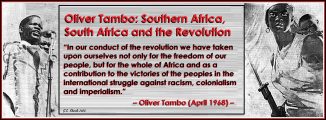
On 1 January 1979, a Politico-Military Strategy Commission (PMSC) was appointed at a Special African National Congress (ANC) National Executive Committee (NEC) Meeting in Luanda, Angola, following the visit to Vietnam by a small delegation, led by ANC President Oliver Tambo, in October 1978.
A copy of the report on the Vietnam visit was presented to that NEC meeting by Joe Slovo in Luanda, from 27 December 1978 to 1 January 1979, to consider the ANC’s strategic impasse. The context of the meeting was, among other issues, to consider the report on the Vietnam visit and to appoint a structure – which became the PMSC – to review the ANC strategy, tactics and operational structures. The composition of the PMSC combined both political and military leadership, which consisted of Oliver Tambo as chairperson, Joe Slovo, Thabo Mbeki, Joe Modise, Moses Mabhida, and Joe Gqabi, who had just been released from Robben Island.
The June 16, 1976, uprisings in Soweto and elsewhere indicated an immediate potential for popular insurrectionary activity in urban areas. Furthermore, these uprisings had also shown that armed struggle was not a necessary ‘detonator’ of, or precondition for, popular upsurge, as there had been no major armed activity inside South Africa for 13 years before 1976, except for armed actions that resulted in independence in the neighbouring former Portuguese colonies of Mozambique and Angola.
The ANC had to reassert itself as the vanguard of the liberation movement inside the country as there were emerging forces, such as the Black Consciousness Movement and the KwaZulu Bantustan-linked Inkatha (led by Gatsha Mangosuthu Buthelezi), which were contesting the support of the Black population, without clear revolutionary direction. Such concerns, and the inability of the ANC to provide appropriate political direction, exposed how divorced the ANC was from the masses and from possible future socio-political and economic action in South Africa.
Major concerns also revolved around the ascendence of former apartheid Defence Minister PW Botha as Prime Minister, who brought in the military as a dominant factor into the National Party-led government. The counter-insurgency trajectory of the Botha government adopted what it called “Total Strategy”, which envisaged, besides strengthening security measures within the country, employing reformist endeavours to draw in the Indian and so-called Coloured communities into a tri-cameral government system and entrench Black local authorities within the ethnic Bantustans and the townships. This was to be done to legitimise the Botha “reforms” without necessarily removing the fundamental basis of the apartheid system.
Furthermore, the PMSC also had to reflect on the Communist Party’s (SACP) crucial role within the ANC-led national liberation struggle, notably within the liberation movement’s operational structures. As the vanguard party of the working class, the SACP, alongside the South African Congress of Trade Unions (SACTU) had to provide appropriate direction with regard to the revolutionary role of the trade union movement, since the Wiehahn Commission had made proposals for the legal recognition of independent trade unions and their incorporation into the statutory industrial relations framework.
Beyond South Africa’s borders, the apartheid state strategy was to deploy military, economic and diplomatic pressures to ensure that neighbouring independent African states declined to support the ANC. The Botha regime intended to recreate a geopolitical buffer against threats to white minority rule through the establishment of a “constellation of southern African states”, which was to be dominated by South Africa with members including Botswana, Lesotho, Swaziland, Zimbabwe-Rhodesia, SWA-Namibia and the supposedly independent Bantustans. The bottom-line was that those states that became part of the “constellation” were to be supported using South Africa’s economic muscle, as long as they denied any access to the ANC, while the intransigent ones were to be militarily harassed and denied favourable conditions within the regional infrastructural feasibilities.
What the NEC expected of the PMSC was that it should develop a report to be presented in March of that year in which it was to address the strategic trajectory of the liberation struggle and particularly the role of the armed component within that struggle. As expected, the PMSC did present a report in March and most, but not all, of its central recommendations were formally adopted as the “Green Book” by the ANC five months later in August 1979. This heralded the second stage of the strategic review after the Morogoro Conference.
The NEC meeting in Tanzania, in August 1979, endorsed the four strategic lines recommended by the PMSC. They were that the ANC should: “elaborate an over-all strategy based on the mobilisation of ‘the masses’ inside South Africa; create the broadest possible national front of organisations and people inside the country for national liberation and to manage this front into alignment with the ANC’s objectives; draw into ANC underground structures those promising activists thrown up in popular organisations and anti-apartheid struggles; and accept that military operations evolved out of political activity and should be guided by the needs and level of political mobilisation and organisation” (Howard Barrell, 1993)
Political mobilisation and the creation of a broad front of popular and community-based organisations, were identified by the PMSC as requiring most urgent attention. The reasoning was that the ANC had to relate politically to the majority of its potential constituency. What was implied was that the liberation movement had to become deeply involved in popular and community-based organisations operating in the legal and semi-legal spheres.
The primary focus of the PMSC report was that the ANC had to make a deliberate turn to the masses for the purpose of teaching them and learning from them. It had become evident that the ANC had for too long acted as if the repressive conditions made mass legal and semi-legal work impossible. Accordingly, the realisation was that the Regis Debray or Che Guevara militaristic ‘foco’ theory of the past, known as the ‘detonator’ strategy, had apparently not yielded any tangible results. For success to be achieved, the PMSC said that ANC underground operatives would have to be present wherever and whenever people took action against apartheid repression in order to steer popular organisation in a revolutionary direction. For the foreseeable future, building the front was to be the primary task of the ANC underground.
Clandestine forms of political work would remain a necessity because of the ANC’s illegality. But the popular movement would provide the basis for the growth of the underground. The underground would then be able to identify within the ranks of the popular movement a number of recruits to its ranks. The ANC and its allies, the SACP and the South African Congress of Trade Unions (SACTU), had to stand at ‘the core of the revolutionary struggle’ that had to maintain ‘its independence’ in relation to the envisaged broad front.
The PMSC suggested that a campaign should be launched to re-popularise the ANC’s vision contained in the Freedom Charter. For its part, Umkhonto we Sizwe (MK) should choose targets highlighting demands made in the ‘Freedom Charter’. The ANC highlighted in its strategic review that its emphasis on armed activity had failed to foster an organised domestic political base. Yet it needed such a base in order to wage a sustained armed struggle. The ANC concluded, therefore, that its stress on armed activity had, paradoxically, undermined its ability to mount a sustained revolutionary armed struggle.
The intention was to harness the various efforts into a single struggle which would be represented by a front led from the underground by the ANC, a struggle which would progressively transform itself into a popular armed challenge for state power. During the briefings in Vietnam, Tambo noted the importance of the “armed propaganda strategy”, in which he wrote that in Vietnam the first stage of the armed struggle, in a particular area, involved the revolutionaries sending an armed propaganda team into the territory in order to establish a base and start recruiting from the masses.
The first military actions of such a team would be the execution of the die-hard elements of the oppressive regime, such as notorious policemen and informers. The intention with these operations was to spread the influence of the revolutionary forces in the locality, since such actions would demonstrate that the revolutionaries were strong enough to deal with the enemy. And these would be publicised through leaflets or other forms of information methods.
Primarily, the intentions of the propaganda team were to plant the seeds of revolution and stimulate political activity. The teams would be of platoon strength, emanating from a larger formation referred to as the “Vietnamese Armed Propaganda Brigade”. Movements of the platoons were constantly kept secret so as to maintain the legal position of the masses and to protect above-ground political organisations. According to these observations, the PMSC recommended that the MK Chief of Staff, Joe Slovo, should form a military Special Operations Unit (SOU), which would be able to mount spectacular ‘armed propaganda’ attacks. Its effect would be to reinforce political-military parallelism in ANC operational structures.
Critically and emphatically, the Vietnamese officials maintained that the principal initial aim was to build political forces among the people, and the most appropriate action was determined on the basis of its political impact, being tactically flexible in pursuing the strategic aim. At times, it would have greater political impact to explode a bomb in a particular location than to eliminate a hated enemy agent.
What struck the ANC delegation during their visit to Vietnam, which also had a huge impact on the PMSC’s report, and ultimately the Green Book, was the manner in which the Vietnamese had embraced the notion that a revolution should “walk on both feet”, the one political and the other military, the latter being driven by the former. This contrasted strongly with the strategic presumptions that were pursued prior to the visit, which made the armed struggle the basis of the political struggle.
The Chief of Staff of Umkhonto we Sizwe (MK), Joe Slovo, surmised that “If our own independent efforts had taught us anything in the recent period, it was that our efforts would reach a dead end unless they had a broader political base” (Howard Barrell, 1993).
Sources:
South African History Online (SAHO).
Ginyibhulu Xhakalegusha, “National Question and Ethnic Processes”, The African Communist, No.79, Fourth Quarter 1979.
Howard Barrell, “The Turn to the Masses: The African National Congress Strategic Review of 1978 – 79”, Journal of Southern African Studies, Vol. 18, No. 1, April 1992.
Cornelius Johannes Brink Le Roux, “Umkhonto we Sizwe: Its Role in the ANC’s Onslaught Against White Domination in South Africa, 1961 – 1988”, PhD: University of Pretoria, 1992.
Howard Barrell, “Conscripts to Their Age: African National Congress Operational Strategy, 1976 – 1986”, PhD Thesis, Oxford University, 1993.
Luli Callinicos, “Oliver Tambo: Beyond the Engeli Mountains”, David Philip, 2004.
Dale T. McKinley, “Umkhonto We Sizwe: A Critical Analysis of the Armed Struggle of the African National Congress”, South African Historical Journal, Vol. 70, Issue 1, 2018.
Greg Mills and Emily van Der Merwe, “We Learnt from Vietnam in the Past – So Why Not Now?”, Daily Maverick, 27 November 2018.
Castro Khwela
Good day fellow Compatriots!
Discover more from CASTRO KHWELA
Subscribe to get the latest posts sent to your email.