The Majestic Paul Robeson: An African Anti-Imperialist
The death of Paul Leroy Robeson on 23 January 1976 removed from the world stage not only one of its outstanding cultural figures, but one who allied his art to the cause of human freedom and liberty everywhere. Born in Princeton, New Jersey, on 9 April 1898, the son of a Presbyterian pastor and teacher and the grandson of a slave, Robeson had to struggle against racial and political discrimination all his life, but he never wavered in his dedication to the cause of his people, to the cause of human emancipation and social progress, to the cause of peace.
Possessed of talents which raised him to the heights as scholar, lawyer, sportsman, singer and actor, Robeson never succumbed to the temptations which must often have been placed in his way to “look after No. 1” and forget his people. He records in his autobiography “Here I Stand” that:
“In 1936, when I was in London, John Hamilton, then national chairman of the Republican Party, visited me with a proposition that I return to America and campaign among Negroes for Alf Landon against President Roosevelt. My reward would be that as an actor I could write my own ticket in regard to future Hollywood contracts and starring productions, since the big film magnates were staunchly Republican and hated the man in the White House. I declined the offer and today I can smile at the thought that anyone could imagine me stumping the country, urging Negroes to spurn the New Deal and return the party of Herbert Hoover to power! Much earlier in my career, in New York, I had declined the offer of an important impresario to sign me a lucrative ten-year contract while he would take full charge of my public life. I did not have many fixed ideas in those days, but one of them happened to be a strong conviction that my own conscience should be my guide and that no one was going to lead me around by a golden chain or any other kind.”
Because Hollywood could not offer him any roles except those of Negro stereotypes of the “Uncle Tom” variety, because of his refusal to sing before segregated audiences, because of the humiliations daily heaped upon him by the white racists of America, Robeson was driven to seek a better life abroad. From 1927 to 1939 his home was London, and it was there that his philosophical and political ideas crystallised. The British upper classes fawned on him, trying to absorb and neutralise him as they have done with so many rebels who sought sanctuary in their class-ridden country. But he went into as many working class homes as country houses, and remained true to himself.
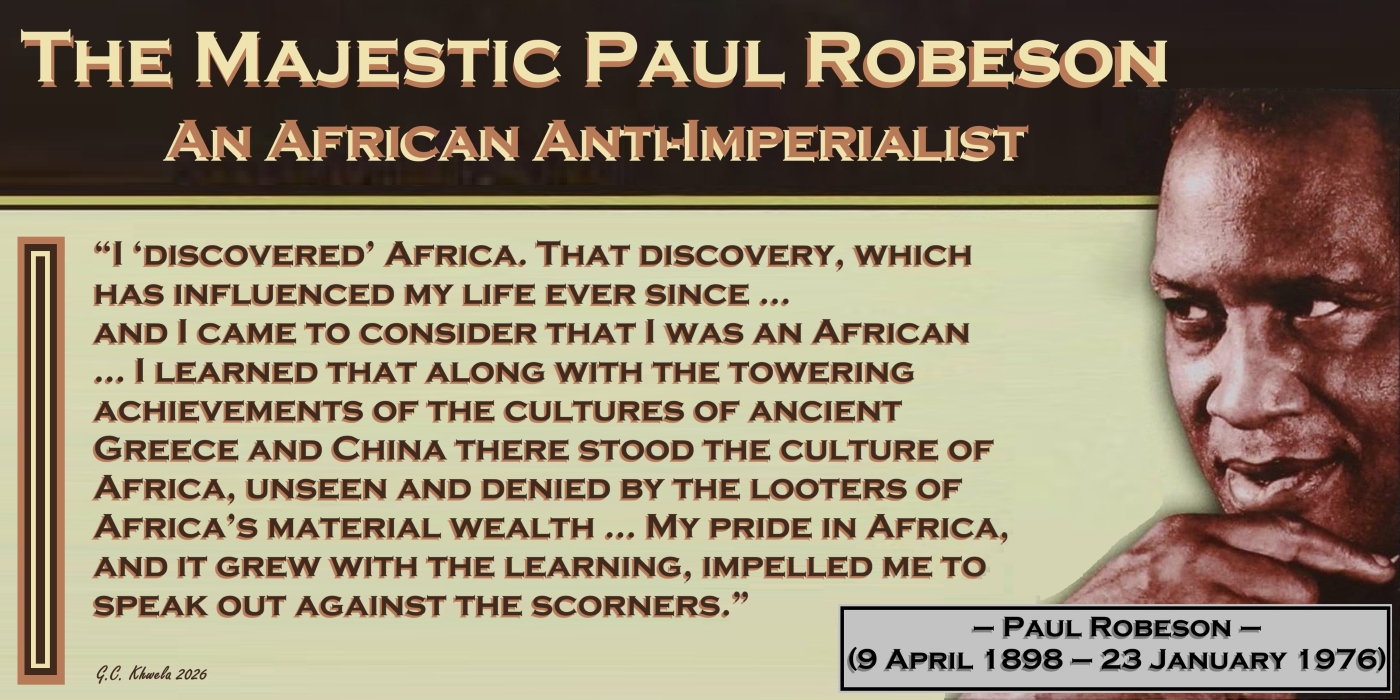
More, since London was the centre of the British Empire, “I ‘discovered’ Africa. That discovery, which has influenced my life ever since, made it clear that I would not live out my life as an adopted Englishman, and I came to consider that I was an African.”
“Like most of Africa’s children in America, I had known little about the land of our fathers, but in England I came to know many Africans. Some of their names are now known to the world – Nkrumah and Azikiwe, and Kenyatta who is imprisoned in Kenya. (Robeson was writing this in 1955 – Ed.) Many of the Africans were students, and I spent long hours talking with them and taking part in their activities at the West African Students’ Union building. Somehow they came to look upon me as one of them; they took pride in my successes; and they made Mrs Robeson and me honorary members of the Union. Besides these students, who were mostly of princely origin, I also came to know another class of Africans – the seamen in the ports of London, Liverpool and Cardiff. They too had their organisations and had much to teach me about their lives and their various peoples.”
Although of African descent, Paul Robeson did not come in contact with the cause of African freedom until the end of the 1920s. It was in 1928 that he placed the song “Ole Man River” on the musical map of the world. He had come to London then to appear in “Show Boat”. It is perhaps typical of a man from an oppressed community to feel more at home among others in the same plight, rather than in the company of the celebrities who feted him in London.
So, Paul Robeson felt much easier when in the company of British dockworkers and Welsh miners, and the many Africans whom he met. Many of the Africans in London then were students and political workers, and from these Paul Robeson found a revival of Africa within himself. Among the Africans he must have met in London then were several who were to become noteworthy afterwards – men like Jomo Kenyatta, Kwame Nkrumah and others.
As an artist it was natural that his first interest in Africa was cultural. He studied several African languages and was amazed to discover the richness and variety of the African cultural heritage at that time largely unknown to the Western world and even to the American Negroes, many of whom “believed that the African Negro communicated his thoughts by means of gestures, that, in fact, he was practically incapable of speech and merely used sign language.”
It became one of his main concerns to dispel this abysmal ignorance of its own heritage in the Negro race itself. “I felt as one with my African friends and became filled with a glowing pride in these riches, new found to me. I learned that along with the towering achievements of the cultures of ancient Greece and China there stood the culture of Africa, unseen and denied by the looters of Africa’s material wealth … My pride in Africa, and it grew with the learning, impelled me to speak out against the scorners.”
It might be of interest to take a quick glance at what was happening in Africa at that time. It was a period when more and more efforts were being made by the colonialists to extract the maximum of wealth from Africa in order to bolster up their tottering economy. Law upon law, regulation on regulation were introduced in the regions of East and West Africa to ensure the maximum cheap labour and the highest production of raw materials and other wealth.
He became involved in the overall struggle against imperialism and was helped in his political reorientation by visits to the Soviet Union. “It was like stepping into another planet, I felt the full dignity of being a human being for the first time”. He was especially impressed with the progress which had been made by the so-called “backward races” of the Soviet Union, the Asian communities who had been freed from Czarist oppression by the 1917 revolution. He was a lifelong supporter of the Soviet Union and the cause of socialism.
It is not coincidental that the visit to the Soviet Union by Paul Robeson in 1934 had the same effect on him as it did on the South African leader Josiah Gumede. Paul Robeson on visiting the Soviet Union said that he had seen whole nations of so-called “primitive peoples” now building highly-developed socialist republics, working and building countless new factories, schools, universities, all within twenty years. To him this proved the falsity of the colonialist claim that black people would not be able to rule themselves for thousands of years.
Similarly, Josiah Gumede, a leader of the African National Congress (ANC), told a mass meeting of Africans when he returned from the Soviet Union: “I have seen the new world to come, where it has already begun. I have been to the new Jerusalem.” He claimed that he had brought the key which would unlock the door to freedom.
Robeson specifically espoused the cause of the oppressed black peoples of South Africa, and gave concerts to raise funds for the 156 who were on trial for treason between 1956 and 1960, and also to help the newspaper “New Age”, voice of the Congress and progressive movement. Paul Robeson the singer, since those days placed his voice and his talent at the service of the struggle for emancipation of the black oppressed, and at the service of all progressive mankind.
For his pains, Robeson was hounded and victimised by the McCarthyites in the United States, his concerts were broken up by hooligans, his passport was taken away from him. But he stood his ground, refused to submit or conform. His last years were shadowed by illness, but, as his son Paul said at his funeral in Harlem, he “retired undefeated and unrepentant”.
Robeson was not only a great artist but also a great human being, great in his physique, great in his talent, great in his courage and his loyalty to his ideals. Nobody who ever met him, or was moved by his songs or his acting, could ever forget him or his message of peace and human brotherhood which he transmitted to his audiences. The American essayist Allexander Woollcott wrote of him:
“By his unassailable dignity, and his serene, incorruptible simplicity, he strikes me as having been made out of the original stuff of the world. In this sense he was coeval with Adam and the redwood tree of California. He is a fresh act, a fresh gesture, a fresh effort of creation. I am proud to belong to his race. For, of course, we are both members of the one sometimes fulsomely described as human.”
He was an artist who did not see art in isolation from the problems which beset society, the whole world, the whole of humanity. Becoming more and more aware of the problems of the Afro-American and African people, he was endowed with the wisdom to see the link between black oppression and the rest of the world’s problems. It was therefore inevitable that he was drawn into the world-wide anti-fascist struggle of the thirties and subsequent years.
Caught in the whirlpool of the fight to destroy fascism, a fight that was both dramatic and horrible, it was at this time that he saw clearly that he as an artist, a singer, a man of talent, could not possibly stand aloof from the furore of humanity. He saw that the artist who was honest could never belong in an ivory tower while mankind was engaged in one of the titanic struggles of its history.
In a speech made in the Albert Hall London at a rally in support of the Spanish republic, and reported in the South African anti-imperialist magazine, “The Liberator”, in 1937. Paul Robeson said then:
“Every artist, every scientist, must decide now where he stands. He has no alternative. There is no standing above the conflict on Olympian heights. … The battlefield is everywhere, there is no sheltered rear … Fascism fights to destroy the culture which Society has created; created through pain and suffering, through desperate toil, but with unconquerable will and lofty vision … Fascism is no respector of persons. It makes no distinction between combatants and non-combatants…”
“The artist must take sides; he must elect to fight for freedom or for slavery. I have made my choice. I have no alternative. The history of the capitalist era is characterised by the degradation of my people; despoiled of their lands, their women ravished, their culture destroyed… I say the true artist cannot hold himself aloof. The legacy of culture from our predecessors is in danger. It is the foundation upon which we build a still more lofty edifice. It belongs not only to us, not only to the present generation — it belongs to posterity and must be defended to the death.”
We South Africans know full well who are our friends and allies in the United States. They are people like Paul Robeson who has raised his voice in song and worked in the interest of solidarity with the South African people. They are people like the late Martin Luther King, W.E.B. Du Bois, and Angela Davis and all the Afro-Americans and genuine democrats fighting for the cause of justice, freedom and humanity in their country.
All progressive mankind, enriched by his living, are the poorer by his passing …
Sources:
Wikipedia.
Alex la Guma, “Documents: Paul Robeson and Africa”, The African Communist, No.46, Third Quarter, 1971.
Editorial Notes, “A Great Friend of Africa”, The African Communist, No. 65, Second Quarter 1976.
Castro Khwela
Good evening fellow Compatriots!
Discover more from CASTRO KHWELA
Subscribe to get the latest posts sent to your email.