Increasing Number of Banned Persons Under Apartheid
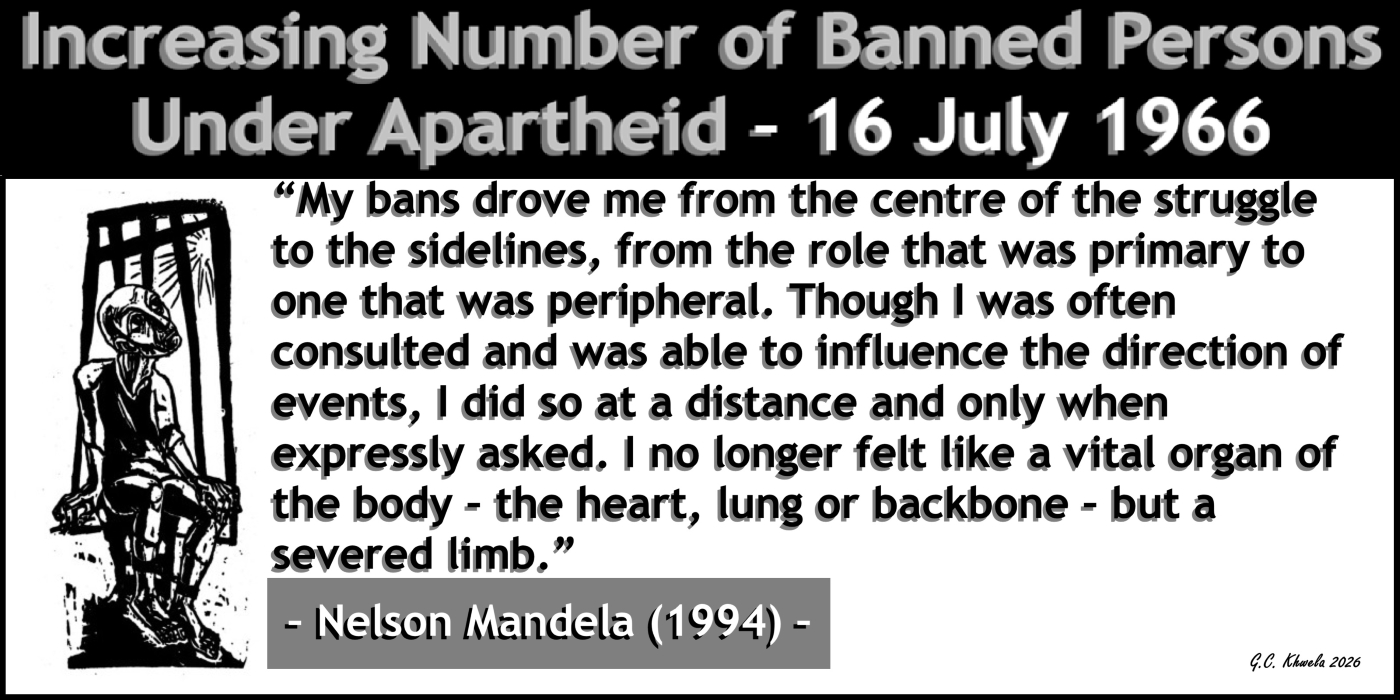
On 16 July 1966, the apartheid government released its updated consolidated registry of banned individuals and the data published on this day provided a stark statistical milestone of the state’s expanding crackdown. In apartheid South Africa, the state routinely published lists of restricted persons in the “Government Gazette” to notify the public and the media. However, on this day the state’s registry revealed that the number of active banning orders had reached 936 individuals.
The official release categorised these 936 individuals into three distinct legal groups under the state’s security apparatus. Among these, 467 people were listed strictly as “communists” under the Suppression of Communism Act; 515 people were banned under combined provisions of both the Suppression of Communism and Riotous Assemblies Acts; and 3 people were banned exclusively under the Riotous Assemblies Act. Of these individuals, 49 overlapped, appearing concurrently as both listed communists and actively banned persons. Because the total hovered just under 1,000, local and international observers used the July 16 data release as a quantitative benchmark to report on how aggressively the regime was using administrative house arrest and censorship to neutralise the anti-apartheid activists and the movement as a whole.
Following the 1960 Sharpeville massacre and subsequent banning of the primary liberation movements, the African National Congress (ANC) and the Pan Africanist Congress (PAC), the apartheid government rapidly escalated its legal framework. By mid-1966, this campaign had successfully targeted nearly 1,000 individual “dissidents”. Banned individuals were subjected to heavy restrictions under the Suppression of Communism Act of 1950, as they were prohibited from attending public gatherings, traveling outside specific magisterial districts, entering certain spaces (like factories or universities) or being quoted or published by any media outlet.
The apartheid regime used broad, non-judicial criteria that bypassed the courts entirely, allowing the Minister of Justice to issue a banning order based purely on administrative suspicion. The regime targeted extra-parliamentary activists rather than the liberal opposition in Parliament because of a deliberate legal distinction between constitutional dissent and revolutionary resistance. The Suppression of Communism Act of 1950 intentionally defined “communism” so loosely that it encompassed almost any practical challenge to the racial status quo.
The Minister of Justice could ban any individual deemed to be involved in any action or doctrine aimed at bringing about political, social, economic or industrial change through “disturbance or disorder”. This was defined as any act calculated to encourage “feelings of hostility between the European and non-European races” to further disorder. Ironically, the state used this to ban anti-apartheid activists who advocated for a non-racial democracy, claiming their protests provoked racial friction. Under the accompanying Riotous Assemblies Act, individuals could be restricted if the Minister believed they would gather people to actively challenge state security or local municipal bylaws.
The architecture of the law required no trial, no evidence, and no legal right of reply – ‘audi alteram partem’. If the Minister determined a person’s aims aligned with “subversion”, they were added to the ‘Government Gazette’. During the mid-1960s, the official white opposition in Parliament – primarily the United Party and Helen Suzman of the Progressive Party – formally opposed many apartheid policies but were completely spared from banning orders due to several factors. Liberal parliamentarians operated strictly within the white minority constitutional framework. They advocated for gradual reform, incremental change or the rule of law through existing parliamentary debates.
Because they did not seek to overthrow the state structure through mass action, they did not meet the state’s legal definition of “promoting disturbance or disorder”. Members of Parliament were protected by legal privilege inside the assembly. Banning an elected white MP would have completely shattered the illusion of a Westminster-style democracy that the National Party vigorously projected to Western allies to maintain international legitimacy.
The 936 individuals banned by the July 1966 security amendments belonged to extra-parliamentary movements like the ANC, PAC, trade unions and the Congress Alliance. These groups demanded immediate, universal adult suffrage and – following their 1960 prohibition – had turned toward underground resistance and sabotage. This crossed the regime’s line from “disagreement” into “existential threat”. To be a banned person meant enduring “civil death” – a state-enforced isolation designed to completely erase your public existence without physically putting you behind bars.
This meant you were legally prohibited from gathering with more than one person at a time, excluding your immediate family. Having a conversation with two friends on a street corner or even playing a game of tennis with three others, was a criminal offense. You were also confined to a single magisterial district, or placed under house arrest, often from 18:00 to 06:00 on weekdays, and 24 hours a day on weekends. As a banned person, you could not leave this zone without written permission from a magistrate, and you were prohibited from entering any educational institution, factory, harbour or printing press. Teachers, journalists, lawyers and union organisers automatically lost their livelihoods.
It became an offense for any newspaper, book or radio station to publish or broadcast your words, past or present. You were thus a non-person in the media, as your name could not be mentioned. You had to report to a local police station every single week, often every Monday morning, to sign a register, proving you had not fled the area. Because your home was bugged and the Security Branch watched you constantly, ordinary life became deeply paranoid. Friends, neighbours, and sometimes even relatives, avoided you out of fear that associating with you would get them banned or interrogated.
Walking down the street meant watching people cross the road to avoid greeting you. If someone did talk to you, you had to actively scan the area to ensure a third person did not join, which would technically violate your “gathering” restriction. Stripped of the right to work in your profession, many banned individuals faced severe poverty. They had to rely on secret donations or take menial, low-paying jobs that allowed them to stay within their restricted zones. Survivors described the experience as a slow, agonizing psychological torture. You were free to breathe the air, but you were completely cut off from the collective life of your community, living as a ghost in your own country.
Families under house arrest during apartheid endured a parallel form of confinement, where the entire household was effectively subjected to the state’s punitive surveillance apparatus. Coping required a mixture of legal hyper-vigilance, psychological endurance and community solidarity. Because right-wing extremist attacks and routine police raids targeted the home, the whole family’s physical security was compromised. Spouses and children frequently stayed indoors to shield the restricted individual, accidentally imposing a curfew on themselves.
Visitors were either legally barred or too terrified of police intimidation to visit. Family members had to serve as the sole link to the outside world, bearing the emotional burden of keeping the household connected. Families lived in constant fear of minor accidental infractions. If a restriction order allowed only four people in a room, lawyers and spouses had to painstakingly calculate whether immediate family members or co-residents counted toward that limit. The state deliberately used house arrest to starve families out of their livelihoods. Restricted persons were blacklisted from entering industrial or educational spaces, meaning main breadwinners instantly lost their income.
Spouses frequently stepped into high-risk roles. When partners were transitioned from house arrest into active detention, families relied on complex covert networks – hiding notes in shirt collars or smuggling hacksaw blades and resources inside food parcels – to survive and maintain communication. Families survived through the quiet, unrecognised solidarity of neighbours and activist networks who provided food, clothing and financial lifelines. The home ceased to be a private sanctuary and instead became a branch of the security state.
Children grew up under the constant terror of midnight Security Branch raids, witnessing their parents being harassed, which induced generational anxiety and symptoms of Post-Traumatic Stress Disorder (PTSD). Knowing that a restricted person could not leave the property between 18:00 and 06:00 made them easy targets for pro-apartheid vigilantes. Families coped with this intense vulnerability by arranging private security guards or taking turns staying awake to watch for petrol bombs.
The apartheid state security apparatus achieved absolute tactical success inside South Africa during the 1960s, but this iron-fisted control created a strategic failure by the early 1970s. By forcing the liberation leadership into exile, the regime inadvertently allowed anti-apartheid movements to build a massive, permanent global network that eventually dismantled the state’s international legitimacy. Historically referred to as the “Decade of Silence”, the 1960s represented the peak of the regime’s internal dominance. Through maximum state terror, the Security Branch effectively neutralised all domestic extra-parliamentary opposition. High-profile sweeps like the 1963 Rivonia Trial successfully jailed core leaders of Umkhonto we Sizwe (MK), while ruthless administrative banning orders forced surviving strategists into exile.
With the ANC and PAC banned, early internal sabotage campaigns were entirely dismantled by 1965. By manufacturing absolute political stability through police terror, the regime attracted massive foreign investment. During the mid-to-late 1960s, white South Africa experienced an unprecedented economic boom, making the state security apparatus look entirely invincible to its supporters. However, the state’s success was temporary because it treated a deep-seated political problem purely as a policing problem. By driving activists across the borders, the regime sowed the seeds of its own destruction along two axes: the “external mission” which was multiplied and the ideological void becoming filled internally.
Exile did not kill the liberation movement, it internationalised it. Activists in London, Lusaka and Dar es Salaam established themselves, where they successfully lobbied for international arms embargoes. They initiated dynamic disinvestment and academic boycotts and secured military training camps in independent African states, establishing a permanent external standing army that the apartheid South African Defence Force (SADF) had to spend billions of Rands trying to contain. Meanwhile, those in exile built a formidable Anti-Apartheid Movement globally, which successfully drove the process to isolate the apartheid regime in all spheres, including culture and sports.
By 1969, the state’s assumption that it had permanently silenced the domestic black population proved completely false. Because the old guard was jailed or exiled, a completely new generation of youth emerged inside the country entirely unburdened by past defeats. Led by Steve Biko, the Black Consciousness Movement (BCM) and the South African Students’ Organisation (SASO) revitalised internal resistance. Biko strategically operated within strict legal boundaries to make it incredibly difficult for the state to initially issue banning orders. This internal ideological awakening directly primed the masses for the explosive 1973 Durban strikes and the pivotal 1976 Soweto Uprising, shattering the regime’s illusion of absolute internal security forever.
Sources:
Wikipedia.
South African History Online (SAHO).
Padraig O’Malley, “1966”, O’Malley: The Heart of Hope, Nelson Mandela Foundation, https://omalley.nelsonmandela.org/index.php/site/q/03lv01538/04lv01539/05lv01551/06lv01558.htm
Saleem Badat, “Banishments under the Suppression of Communism Act”, Brill, 1 January 2013.
Overcoming Apartheid, Building Democracy, “Banned People in Apartheid-era South Africa”, South Africa: Overcoming Apartheid, Building Democracy, https://overcomingapartheid.msu.edu/sidebar/kid=163-581-1/
Scott Kraft, “Silenced by S. Africa ‘Restrictions’: Apartheid Foes Find Life Out of Jail Is Not Freedom”, Los Angeles Times, 15 October 1988.
Facing History and Ourselves, “Introduction: Growing Resistance Meets Growing Repression”, last updated 3 August 2018.
Peta Wolpe, “Trauma, Terror, Uncertainty – The Apartheid Scars of a Childhood in Exile That Never Quite Go Away”, Daily Maverick, 14 August 2023.
AAM, “The Anti-Apartheid Movement in the 1960s”, Forward to Freedom: The History of the British Anti-Apartheid Movement, 1959 – 1994, AAM Archives Committee 2000 – 2026.
Paula Ensor, “Remembering Those Who Were Banned”, New Agenda: South African Journal of Social and Economic Policy, Vol. 2026, No. 100, 1 April 2026.
Castro Khwela
Good morning fellow Compatriots!🙏🏾✊🏾👊🏾
Discover more from CASTRO KHWELA
Subscribe to get the latest posts sent to your email.