Boycott All SA Racist Sports: UN Special Committee on Apartheid
(Amended version of the Editorial Notes, “S.A. Racialism and World Sport”, The African Communist, No. 42, Third Quarter 1970).
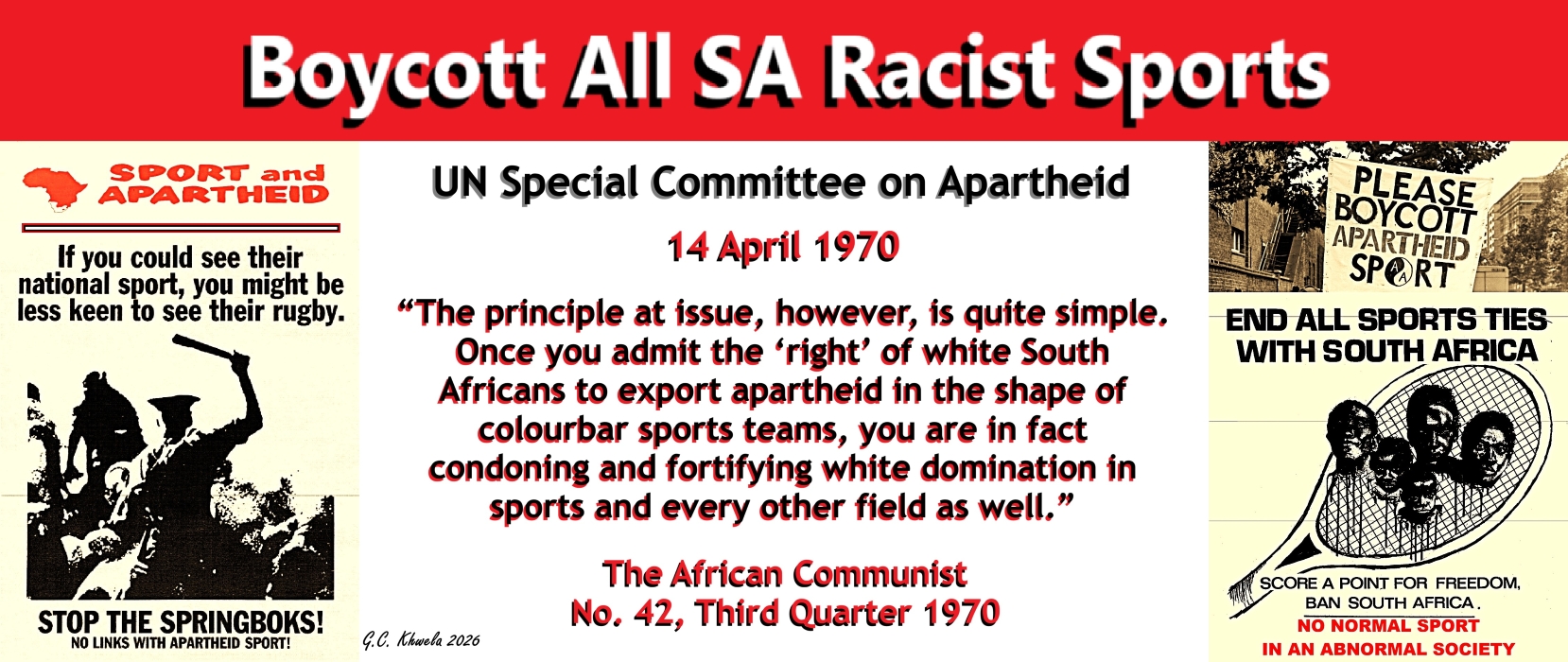
On 14 April 1970, the United Nations Special Committee on Apartheid urged a boycott of all South African racist sporting organisations and supported the African bloc’s proposal to exclude the country from both the Munich Olympics and the Olympic Movement itself. Subsequently, on 15 May 1970, the International Olympic Committee (IOC) extended the ban, which resulted in apartheid South Africa’s exclusion from the 1972 Olympic Games in Munich, Germany.
1970 became a particularly bad year for the South African racists in their efforts to continue imposing their unrepresentative all-white teams upon the playing fields of international sport. They were ousted from the Davis Cup Tennis tournament and were ultimately expelled by the International Olympic Committee. The bitterest blow was mass pressure in Britain, and from the African, Asian and Caribbean Commonwealth members, which forced the last-minute cancellation of their cricket tour of England.
In each case these decisions were forced upon reluctant sports administrators in the West after prolonged campaigns by the “non-European” and socialist countries, by democratic and working-class movements in Western Europe and in North America, as well as by the national liberation movements and Black sportspersons of South Africa itself.
The most tortuous and complicated arguments were advanced by those who wanted, for whatever reason, to preserve the claims of the white minority to be the sole representatives of South Africa in sport. It was argued that the Whites’ addiction to apartheid would not be diminished, but perhaps stiffened, if their teams were kept out, which was a dubious and irrelevant proposition.
“The principle at issue, however, is quite simple”, argued the SA Communist Party. “Once you admit the ‘right’ of white South Africans to export apartheid in the shape of colourbar sports teams, you are in fact condoning and fortifying white domination in sports and every other field as well. No amount of wriggling by the South African sports and other authorities and their foreign sympathisers can conceal or evade this blunt reality. Nor can their grudging and phoney ‘concessions’ alter the basic principle.”
Having refused for many years to consider issuing visas for non-white sportsmen, as in the cases of Basil D’Oliviera and the American tennis champion Arthur Ashe, the apartheid regime ultimately agreed that they were to kindly permit the New Zealand Rugby Union to include a few Maoris in their team. The “D’Oliveira Affair” was a very interesting case to consider with regards to apartheid South Africa’s political interference and racism in sports.
Basil D’Oliveira (1931–2011) was a South African-born cricketer of “Cape Coloured” (mixed-race) heritage who, due to apartheid restrictions, moved to England to play top-class cricket. After establishing himself as a star player for England, his potential inclusion in the England team scheduled to tour South Africa in 1968–69 – and his subsequent exclusion by SA Prime Minister John Vorster – triggered the “D’Oliveira Affair”, which became a massive controversy that led to South Africa’s sporting isolation.
However, regarding the “All Blacks”, as the New Zealand team is called, was earmarked to be playing the “All Whites” Springboks. Not a single African, Coloured or Indian player could by any remote stretch of the imagination be considered to join any team they were intending to meet. By agreeing to meet them on such terms they were allowing the claim of the white fifteen to represent “South Africa”, which was a gross insult to millions of South Africans who could not take part, and for that matter to the people of New Zealand who properly considered that merit, not skin-colour, was the criterion for selection in the national team.
Similarly, the promise to consider non-whites for the Olympic team was an empty one. No doubt, despite the abject lack of facilities for non-white sport, not a few non-members of the master race could qualify for a national team, if it were fairly chosen. But since the choosing was to be done by the whites, and since no open racial trials were possible in South Africa, it could not be fairly chosen.
“Keep politics out of sport” was one of the favourite slogans of those who wanted to keep the white South Africans in world sport. But apartheid politics which governed every facet of South African life, and which had absolutely nothing in common with sportsmanship or fairplay, were as inseparable from athletics and games as they were from every other aspect of life in our unhappy country. Indeed, the pretence that this was purely an issue for sportsmen and sports administrators and had nothing to do with “politics” was rapidly being swept away in the high winds of healthy controversy in the campaign to boycott the South African “All-Whites”.
In this respect the victorious campaign to stop the cricket tour of Britain was highly instructive. It had rapidly boiled up into a major political issue on the eve of the crucial general election that was under way in Britain at the time when such Notes were being written. Great credit was due to the “Stop the Tour” Committee, which united the forces of the Anti-Apartheid Movement and other British friends of South African freedom, whose imaginative and militant campaigning did so much to provide means of effective protest for those who felt outraged and ashamed of the invitation to the white cricketers.
Tribute was also paid to the African, Caribbean and Asian Commonwealth countries whose decisions to boycott the Edinburgh Games if the tour went on were an important factor in bringing home to Britain the strength and depth of their feelings against apartheid.
But it was going to be a great mistake to believe that such pressures alone would have brought the British Government to act as it did and virtually order the diehards of the Cricket Council to cancel their invitation. This was what they and apartheid Prime Minister BJ Vorster combined in calling “yielding to blackmail” – as if to yield to mass pressure, legally and democratically exercised for a progressive purpose can possibly be called “blackmail”. Of course, Vorster regarded any demands by non-whites and their friends as “blackmail”. He had his own ideas as to how such demands were supposed to be answered, as demonstrated at Sharpeville and numerous similar occasions.
The plain fact however was that the tour could not and would not have been called off were it not that the campaign against it enjoyed the overwhelming support of the great majority of progressive and democratic people in Britain: The Labour and trade union movement, the Liberal and Church leaders, practically the entire student movement.
The Cricket Council itself – before their final surrender, and while still doggedly persisting in their intention, despite everything, to go on with the tour – conceded the moral and political bankruptcy of their case by promising that “this would be the last” invitation to an all-white South African side. This damaging admission brought about their defeat. For if such tours were wrong in principle in the future, they were wrong at that moment: their undertaking irresistibly recalled the drunkard who promised that “this will be the last” spree.
The Cricket Council became the target of the healthy anti-racialist and democratic forces in Britain and in a sense not undeservedly so, for it was long had been a stronghold of those – like the old aristocrats of the IOC (International Olympic Committee) – who were living in or dreamt nostalgically of a return to a world where sport, like all other leisure pursuits were the virtual monopoly of the “Western” nations, and among them, for that matter, of the gentry and men of means.
But it was superficial merely to consider such a clash as one of the sports administrators vs. the Rest. Behind the apparently purposeless obduracy of the cricket chiefs were aligned immensely influential and powerful forces in British public life. They were neither foolish nor purposeless. Their determination to maintain and strengthen every possible link with the racist Republic of South Africa was based on naked greed and self-interest. Whatever the cost in human lives and suffering, they were out to continue and increase their vast profits from their Southern African investments – that is to maintain their partnership with Vorster and his Nazi thugs in the merciless exploitation of African labour and natural resources.
The political instrument of the then formidable “South Africa lobby” in Britain, was the Conservative Party. … Well over half the total amount of recorded political donations (to the Conservative Party and its associates) were made by companies with South African subsidiaries. What had all this to do with cricket tour? A great deal. For the men who dominated cricket and other sports – like their counter-parts in other imperialist countries – were overwhelmingly linked with Conservative political and monopoly capitalist interests.
Thus, the profound conflict which developed in Britain over the projected cricket tour helped to expose for millions of sports fans the hidden realities. It was not just a difference of opinion about sport: it was an aspect of the class struggle. On the one hand stood the millionaire imperialist interests which wanted to maintain apartheid in South Africa and favour racialism in Britain as well. On the other side the great majority of the people who were against fascism and its South African variety, who felt solidarity with its victims. The right-wing leaders of the Labour Party were pulled step by step in the wake of the tide of public indignation awakened by the “Stop the 70 Tour” campaign, until at last they were impelled to tell the indignant Cricket Council to call the whole thing off.
Thus, as it raged throughout the world, whether in the field of sport or any other sphere, the campaign to isolate the detestable apartheid regime proved to be more than a gesture with the fighting people of our country in their war of liberation. It was that of course, and the oppressed masses of South Africa deeply appreciated it as such. But it was also a catalytic issue which united the best forces of the working people and progressive forces; exposed the true faces and motives of the friends of white supremacy; and advanced the fight against imperialism to a higher level.
Sources:
Wikipedia.
South African History Online (SAHO).
Editorial Notes, “S.A. Racialism and World Sport”, The African Communist, No. 42, Third Quarter 1970.
Castro Khwela
Good day fellow Compatriots!
Discover more from CASTRO KHWELA
Subscribe to get the latest posts sent to your email.